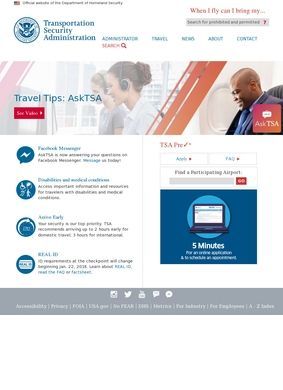
TSA.gov is the official federal site for airport and travel security in the United States, run by the US Transportation Security Administration. For a traveler, it works as the authoritative reference desk on what can pass through a checkpoint, how to speed up screening, and what the rules genuinely are before a trip begins. The material is organized into a handful of large areas, and the depth inside each one is considerable.
The travel section and the rules at the checkpoint
The Travel area is the part most fliers will ever touch. It gathers the Security Screening basics, the Liquids, Aerosols and Gels rule, guidance on Identification and REAL ID, explainer pages on Emerging Technology and Digital Identity, and specific pages on Claims and Travel Redress for when something goes wrong.
There is also plain guidance on Transporting Firearms and Ammunition, a subject where getting it wrong carries real legal penalties. A clear answer from the US Transportation Security Administration on that subject counts for more than an average travel tip, since a mistake here can mean an arrest rather than a delay.
The What Can I Bring? tool and the packing question
The centerpiece for everyday travelers is the live What Can I Bring? tool, a searchable lookup that answers the single most common pre-flight question: is this allowed? Type an item in and the site tells you whether it flies in carry-on, in checked baggage, or in neither. It settles the arguments over snow globes, pocket knives, and oversized toiletries, the sort I have watched stall an entire security line, with an answer that is official and final.
Paired with the Liquids, Aerosols and Gels page, the tool covers most of what trips people up at the belt.
REAL ID, identification, and travel redress
The Identification and REAL ID pages grow more important every year as the enforcement standard reshapes which documents get accepted at the checkpoint. The site spells out the acceptable forms of identification and what happens to a traveler who turns up without one.
Travel Redress is the route for people who are repeatedly flagged or misidentified, a quiet but genuinely important service for anyone snagged by a name match they cannot shake. These are pages a person hopes never to need, and is relieved to find written plainly when the moment comes.
PreCheck, TSA Cares, and passenger data
TSA PreCheck gets its own sprawling section, which makes sense given how many travelers now move through those lanes. The pages cover Enrollment Locations, renewal, the required documents, and how to use a Known Traveler Number, backed by a KTN Lookup Tool for anyone who has mislaid theirs. Past the basics there is PreCheck for Families, a list of Participating Airlines, Touchless ID, Fee Rebates, and even a checkpoint schedule. The coverage is thorough enough that almost any question a member might have is answered somewhere on the US Transportation Security Administration site.
TSA Cares is the section that quietly does the most good. It provides screening support and advance guidance for travelers with disabilities and medical conditions, and reaches further to cover religion, Tribal and Indigenous travelers, military members, children, seniors, and civil rights concerns. Flying is harder for a good many of these groups. A clearly labeled place to learn what to expect and how to arrange help is one of the more humane things the US Transportation Security Administration puts online.
There is also a Passenger Volumes dataset covering recent years, a small gift for anyone trying to gauge how busy an airport day is likely to be, or to pick a quieter hour of the week to fly.
For industry, the media room, and the agency behind it
Well past the traveler-facing pages sits a deep For Industry section aimed at airlines, airports, and cargo operators. It runs to Aviation and Cargo Programs, a Crewmember Access Point, Security Fees, Baggage Screening, General Aviation, and the Screening Partnership Program, alongside surface transportation material like TWIC, the HAZMAT Endorsement, and a Cybersecurity Toolkit. An Innovation strand takes in Counter-Unmanned Aircraft Systems and an Innovation Task Force, and a dedicated Industry Portal serves partners directly. Little of this concerns a holidaymaker, though it shows how far the US Transportation Security Administration reaches beyond the airport concourse.
The Media room and About section round the site out. Press Releases, Testimony, Statements, Factsheets, and Multi-Language Press Releases sit next to lighter material like the Canine Calendar and a run of videos, while the About pages set out the mission, the timeline and history, leadership and organization, employee stories, and jobs at the US Transportation Security Administration itself. A working A-Z Index and a site search hold the whole sprawling thing together, which they have to, because there is a great deal here.
As a resource, TSA.gov is comprehensive almost to a fault. The tools that matter to an ordinary traveler, the What Can I Bring? lookup, the PreCheck pages, and TSA Cares, are strong and specific, and the answers carry an authority no third-party travel blog can match. The flip side is the scale of it: a casual flier hunting one rule can wander into a maze of industry programs and policy pages, and a site this size does not always reflect a rule change on every page at the same moment.
Using the search box cuts through most of that clutter, and the US Transportation Security Administration site remains the first place to check and usually the last word on a rule. A quick yes-or-no question can still take longer to answer than it should, buried among pages built for airlines and cargo operators rather than a holidaymaker packing a bag.