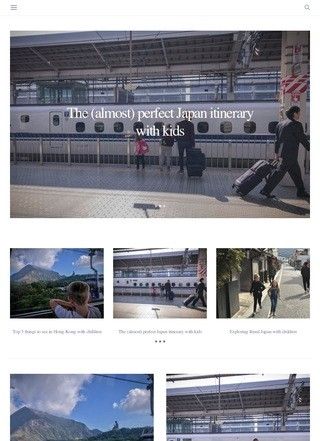
Packing a carry-on for a four-year-old is its own small panic: too much and you are dragging dead weight through three airports, too little and you are buying overpriced snacks at a gate in Tokyo while a tired child melts down beside you. This is the exact corner of family travel that Little Travelling Bug keeps returning to. Written by Nicole, the blog reads like notes from a parent who has done the long-haul flights and worked out which problems are worth solving in advance.
It puts the practical stuff front and centre: what goes in the hand luggage, how to keep a kid occupied for twelve hours, how not to lose one in a crowd. That is a different editorial priority from the postcard photography that fills a lot of travel writing, and it is a more useful one for most of the people likely to be reading.
Destination guides for families
The destination guides are the spine of Little Travelling Bug. There is coverage of Hong Kong and Japan, the kind of dense, child-unfriendly-on-paper cities that parents often write off, plus the Camargue in southern France, which is a more unusual pick and a good sign that Nicole is writing from real trips rather than chasing whatever cities rank well in search. What gives these entries their value is the lens: they are not general sightseeing roundups with a paragraph about kids bolted on at the end.
They start from the assumption that you are arriving with children of different ages and work outward from that to what is doable, what will bore a seven-year-old within twenty minutes, and where the practical friction lies. A parent who has read one of those guides will arrive with a clearer plan than one who had not.
Packing and safety advice
Alongside the place-by-place writing, Little Travelling Bug runs a steady line of how-to posts that apply regardless of destination. Packing comes up often, and not in a vague way: there is specific guidance on family hand luggage and on children's packing lists, the latter being one of those tasks every parent rediscovers from scratch on each trip. Safety gets real attention too, with pieces on keeping track of children in busy places and avoiding the kind of separation that turns a holiday into a nightmare for an hour. That emphasis is telling, because the unglamorous, slightly anxious side of travelling with small people is exactly what most lifestyle blogs skip over in favour of prettier subjects. Little Travelling Bug does not skip it.
Age-specific activity recommendations
The activity writing in Little Travelling Bug is pitched by age, which is the right call. A toddler and a ten-year-old want completely different things from the same city, and a single "things to do with kids" list serves neither of them well. There is also coverage of family-friendly events, including festival reviews, which points to content that follows the family's own outings through the year and not assembled in one sitting from desk research. That gives the writing a lived-in quality that is hard to engineer and easy to notice when it is missing. Posts that come from actual experience read differently from ones built on secondary sources, and the Little Travelling Bug entries on specific destinations generally read like the former.
Why travel matters for children
Running underneath all of this is a thread about why family travel is worth the hassle in the first place. Nicole writes about the developmental side of taking children abroad, the argument that exposure to other places and ways of living does something useful for a child beyond the trip itself. It would be easy for this to tip into preachiness, and a reader's tolerance for the philosophical framing will vary, but it is kept in proportion. It also explains the editorial choices across Little Travelling Bug: this is someone who believes travelling with kids is worth doing well, and that belief gives the site a point of view and avoids being a flat list of recommendations.
The format is a self-hosted blog on its own domain, English-language throughout, presenting as a personal and independent publication. That independence cuts both ways. There is no chain or tourism board steering the recommendations, so the opinions feel like Nicole's own. On the other side, the coverage is one person's experience, which means it is necessarily patchy. You will find depth on the handful of places she has visited and silence on everywhere else. That is the honest shape of nearly every blog of this kind, and Little Travelling Bug is no different.
Check the contact information
The area where the site gives least is on the basics of who is behind it and how to reach them. There is no phone number and no contact route surfaced in the main navigation, so a reader who wanted to ask a follow-up question or pitch a collaboration would come away with very little. For a purely personal travel diary that nobody is being asked to pay for, this matters less than it would for a business, and plenty of hobby bloggers stay deliberately low-profile. Still, a short about-and-contact page would do a lot to anchor the trust that the writing itself works to build. Its absence is the clearest thing holding Little Travelling Bug back from feeling fully established as a resource rather than a private diary that happens to be public.
On wider reputation, a search did not turn up notable third-party reviews or write-ups of Little Travelling Bug, which is unremarkable for an independent family blog but does mean a reader is taking the content on its own merits, with no outside endorsement to lean on. That is not a strike against the quality of the posts. The credibility here rests on whether the advice reads as genuine and grounded, and across most of what Little Travelling Bug publishes, it does.
Taken together, Little Travelling Bug is a useful, sincere resource for a specific situation: a parent planning a trip to one of the places it covers, or one looking for grounded, age-aware advice on packing and keeping children safe on the move. The writing earns trust through specific detail and a clear point of view, and the willingness to deal with the dull and worrying parts of family travel is where it is strongest. The limits are equally clear. The coverage is narrow by nature, there is no outside validation to lean on, and the missing contact details leave the operation feeling somewhat anonymous. Bookmark it when the destination overlaps; otherwise there may not be much there yet.