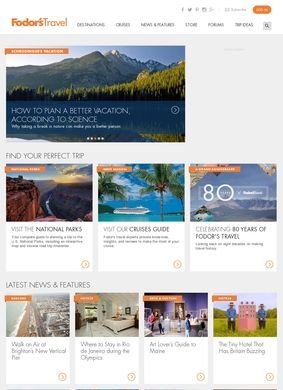
Where does a traveler turn when they want a guidebook tested by decades of editions instead of a listicle written last week? Fodor's is one answer, and the site makes its case quickly: more than 300 guidebook titles spanning over 8,000 destinations, sold as print books from $13.99 and as digital editions. The brand has been putting out travel guides since 1936, which puts Fodor's among the oldest and most widely distributed English-language guidebook series anywhere. That lineage is the real draw, and the website is built to feed people into both the books and a steady stream of free online reading.
Free content beyond the guidebook catalog
The free side is broad. Beyond the guide catalog, Fodor's runs travel news, feature articles, trip itineraries, road trip routes, and a steady stream of National Park content. Hotel and cruise coverage sits alongside the destination material, so someone planning a Mediterranean sailing or comparing resorts has somewhere to start without buying anything. The mix leans toward readers who plan ahead and read around a trip, and Fodor's clearly knows that audience well: leisure travelers, families, adventure types, cruise passengers, and people mapping out a long drive all get content aimed at them, at any budget.
AI Assistant for travel planning
One newer addition is an AI Assistant chatbot built for travel planning questions. Skepticism is warranted for these bolted-on helpers, since many simply rephrase whatever is already on the page, but on a site with this much editorial depth behind it there is at least a real corpus for the tool to draw from. Whether it pulls genuinely useful answers or simply points back to existing articles is something a reader will judge in a few queries. It is there, it is free to try, and it does not get in the way of the rest of the site.
Community forum with person-to-person advice
The community forum is worth singling out. Registered users can post questions and trade trip experiences, and a forum like this only has value if real people show up and answer each other. For a brand this established, that participation is a plausible bet, and it gives Fodor's a layer the books alone cannot offer: current, person-to-person advice that ages faster than a printed guide ever could. It also sits a little against the grain of how most travel sites now operate, leaning on social feeds rather than a true discussion board.
Books, digital editions, newsletters
On the publishing side, the practical details are clear. Books start cheap, digital editions exist for people who would rather not carry paper, and there are newsletter subscriptions for anyone who wants the articles pushed to them. A press room handles media inquiries, and the social presence covers Facebook, X/Twitter, Pinterest, and Instagram, so Fodor's is reachable through the channels most readers already use. None of that is unusual for a publisher of this size, but it is all present and accounted for.
What do customer reviews actually show?
Reputation is where the picture gets more textured, and it splits in a way worth understanding before drawing a verdict based on any single number. On the consumer-review aggregators, the sample is tiny: Sitejabber shows three stars from only three reviews, and Trustpilot lists Fodor's with a single review and no aggregate score visible. Three reviews tell you almost nothing, and reading either figure as a real verdict on a brand this large would be a mistake. Those platforms simply are not where Fodor's customers land.
Amazon ratings reveal content quality
Amazon is where the meaningful signal lives, because that is where the actual product gets bought and rated. Across multiple guidebook titles and several editions, verified purchasers tend to land in the four-to-five-star range, with the praise centered on content quality. For a guidebook publisher, that is a more useful picture than anything a handful of scattered site reviews could show, and it is consistent across more than one book, which makes it harder to dismiss. The one recurring gripe is worth flagging honestly: some buyers report missing pages in the ebook versions. For a digital edition you are paying for, that is a fair complaint, and anyone buying the e-version rather than print should check reviews on the specific title first.
Contacting support through web forms
Getting in touch takes a small amount of navigation. A link is reachable through the About Us page, but no phone number sits on the homepage and the route is form-based. For a media and publishing brand that is normal; most readers come for the content, not to phone an editor, and a contact form covers the people who do need to get in touch. Still, someone expecting a prominent support number will not find one here.
Behind the Fodor's brand name
It helps to know who actually owns the operation. Fodor's runs under MH Sub I, LLC doing business as Internet Brands, which means the editorial name carries a long history while the infrastructure behind it belongs to a large parent company. That arrangement is common for legacy media brands and is not a knock on its own. It does mean the warmth of a small independent outfit is not really what is on offer; Fodor's is a professionally run content machine attached to a respected name, and it behaves like one.
The catalog depth, the free articles, the itineraries, and the forum together make Fodor's a solid first stop for the reader who values an editorial, curated voice and wants a structured guide to a destination they are planning to visit properly. The weak spots are minor: the ebook page-count complaints, and contact details that take a click or two to surface.
Comparing Fodor's to Lonely Planet
The natural comparison is Lonely Planet, which competes on almost identical ground: a deep guidebook backlist, free online destination content, and a strong brand built over decades. Lonely Planet tends to skew toward independent and backpacker travel, with a slightly more adventurous editorial flavor, while Fodor's reads as more measured and practical, comfortable with families, cruises, and road trips across every budget. A traveler chasing off-the-beaten-path itineraries might prefer Lonely Planet's tone, but for reliable, well-organized planning of a mainstream destination, Fodor's holds its own and the price of entry is genuinely modest. Either is a reasonable choice; the decision comes down to which editorial voice matches the trip you are taking.