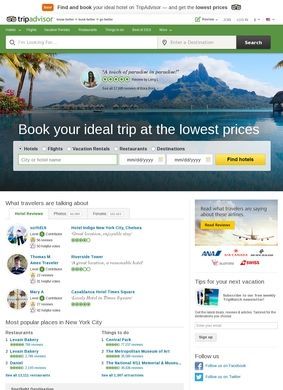
A personalized vacation quiz is a small thing that tells you a lot about where TripAdvisor has put its energy lately. Answer a handful of questions about the kind of trip you want, the pace, the company, the budget, and it pushes back a set of recommendations. Those sit alongside an AI-assisted trip planner that tries to assemble an itinerary from the same pool of places. Both features are the newest layer on top of something much older and much larger: a review archive that has passed a billion contributions covering hotels, restaurants, attractions, and the loose category of experiences that now stretches from a cooking class to a day boat to a guided museum walk.
Hotel price comparison tools
That volume is the whole point and also the central tension. Reviews are the gravity that holds the rest in orbit, and the rest is considerable. Hotel search runs as a price-comparison engine, pulling rates from a stack of booking partners so the listing for a single property shows several prices side by side and lets a traveler pick where to actually pay. The comparison is genuine rather than a bare affiliate link, and it tends to surface real differences between channels for the same room on the same night. That alone is a reason a lot of people open TripAdvisor even when they have no intention of reading a single review, treating it purely as a rate checker before booking elsewhere.
Booking dinners and tours in-house
The dining side comes through TheFork, which TripAdvisor owns, so booking a table is handled in-house even when it does not carry the same name on screen. Much of what looks like a sprawling third-party ecosystem is in fact TripAdvisor talking to its own subsidiaries. Restaurant discovery feeds into actual reservations, which is a cleaner loop than sending you off to call a venue yourself. The tours and activities arm is enormous, with more than 400,000 bookable experiences running through Viator, another subsidiary, and it covers the kind of small-operator excursions that used to be impossible to find before arriving somewhere. Cruise research sits in its own corner through Cruise Critic, a community with its own forums and comparison tools built for a kind of travel that does not map neatly onto hotels or restaurants.
Stacked up that way, the platform reads less like a single website and more like a holding company with a search box on the front. Someone planning a week somewhere can, in theory, read reviews, compare hotel prices, book a tour, reserve dinner, and research a cruise without leaving. Whether anyone actually moves through it that smoothly is a separate matter, but the pieces are present and they connect to real inventory instead of just pointing outward to other sites. Most travel sites do one of these jobs well; TripAdvisor attempts all of them under a single account.
From ratings to travel awards
Scale is the feature TripAdvisor sells hardest and the one that cuts both ways. A popular hotel in a major city might carry thousands of reviews, which sounds reassuring until you try to pull a clear picture out of them. The ratings aggregate into a star score and a ranking within a destination, and that ranking is what most people lean on, since almost nobody reads past the first screen of results. The Travelers' Choice Awards formalize this every year, handing recognition to top-rated properties and destinations and converting the aggregate score into a badge that hotels and restaurants then display on their own doors and websites. For many smaller venues, a strong TripAdvisor ranking is the closest thing they have to a marketing budget.
The destination guides and editorially produced articles are the counterweight to all that crowd-sourced noise. Instead of asking a visitor to wade through opinions, they offer a curated take on a city or a region, written by editors rather than voted up by the crowd. They are a quieter part of the offering and easy to miss next to the booking machinery, but they are where TripAdvisor behaves like a guide instead of a database. How well they hold up against the depth of a dedicated travel publication is an open question; on a platform this size, editorial tends to live in the shadow of the algorithmic ranking, and the ranking is what the homepage pushes first.
Business tools for property owners
There is a clear two-sided structure underneath the consumer view, and it is worth naming because it shapes what a reader sees. Property owners and tourism operators get business-facing tools to manage their listings and respond to reviews, which means the same review a traveler reads has a counterparty who can reply and who has a direct stake in the score. A membership and rewards program adds discounts on activities for travelers who opt in, which quietly nudges bookings back toward Viator and the in-house channels. None of this is hidden, exactly, but it is the kind of arrangement that a casual user rarely registers while looking at a four-star average.
What TripAdvisor puts in front of a traveler, then, is reach that is genuinely hard to match: global coverage, real bookable inventory across several travel types, and a recommendation layer trying to make sense of all of it at once. The AI planner and the vacation quiz are bets that the next phase of the site is less about searching the archive and more about being handed an answer pulled from it. That is the move every large platform is making right now, and TripAdvisor has more raw material to feed it than almost any competitor in the travel space.
How reliable is the ranking?
The unresolved part is what that material is worth once it has been ground down to a single recommendation. A billion contributions of wildly uneven quality, ranked partly by properties that also pay to advertise and that can answer their own critics in the same thread, can point a person somewhere genuinely good or merely somewhere popular, and the distance between those two has never fully closed here.
The newer the tool, the further it abstracts a reader from the raw reviews where they could have judged that for themselves, and it is not obvious whether handing TripAdvisor more trust to summarize is a step toward better trips or just a faster route to the same crowded places everyone else is already booking. TripAdvisor has the scale to answer that question better than almost anyone, and so far it has chosen to answer it commercially.