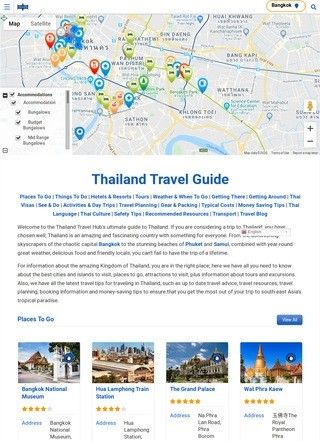
Thailand Travel Guide picks one country and stays there. No sidebar drift into Vietnam or Bali, no soft expansion toward "Southeast Asia" as a catch-all. The whole site is organised around the places a visitor would realistically search: Bangkok, Chiang Mai, Chiang Rai, Kanchanaburi, Hua Hin, Phuket, Koh Samui. Staying inside those borders is a decision, and it shapes whether the resource is actually useful.
Regions split into sights and activities
Within each region the material splits into what to see and what to do. The places-to-visit side covers temples, museums, beaches, markets, and historical landmarks; the things-to-do column picks up restaurants, nightlife, shopping, sports, and wellness. That split mirrors how most people actually plan a trip, pinning the sights first and filling the days around them. Someone splitting a week between a city and an island would find the relevant pieces sitting roughly where they expect. Thailand Travel Guide keeps that pattern consistent from region to region, so a visitor who learns the layout in Bangkok can apply the same logic to Phuket or Koh Samui without relearning the menu. That kind of repetition is dull to build and easy to skip, and the site did not skip it.
Visa currency and travel insurance
Thailand Travel Guide also carries guidance on visas, currency, and travel insurance, the unglamorous questions that decide whether a trip starts without drama. First-time visitors are clearly the intended audience, though the site also addresses backpackers, families, adventure seekers, and people after something more expensive. That is a wide net. A guide trying to speak to everyone can end up saying little to anyone, but the visa-and-currency material at least keeps Thailand Travel Guide grounded in concrete questions about paperwork and money, not mood photography. A first-time traveller worried about entry stamps and baht-to-dollar maths gets something practical to read, which is more than a lot of glossy destination sites bother to provide.
Affiliate links behind the recommendations
The commercial side is disclosed plainly, which is worth noting. Thailand Travel Guide runs on affiliate links: accommodation through Agoda and Booking.com, transport through 12Go Asia, tours and activities, flight comparison tools. A dedicated travel resources page names those affiliate relationships rather than hiding them in a footer, which is more transparency than a lot of similar sites manage. A reader should still treat every "book here" prompt as a link that earns the operator a commission, but putting the disclosure somewhere findable is the honest version of that arrangement.
Interactive features for visitors
There are a couple of interactive features beyond straight reading. Visitors can register an account, and businesses can submit their own listings, which points at an ambition to be something more like a platform. Whether those features see enough use to justify the infrastructure is impossible to judge from the outside. A Facebook page under the same name is kept reasonably active, so the operation is not entirely a static set of articles.
Searching for outside reviews
Searching for outside opinion on thailandtravelhub.com turns up almost nothing useful: the site's own pages, its Facebook presence, and reviews for unrelated Thailand tour operators like Evaneos, Intrepid, and Stubborn Mule. None of those speak to this site. No Trustpilot trail, no cluster of Google ratings, no independent voice confirming the quality of the recommendations. For a resource built around affiliate bookings, that gap has real weight. The whole proposition rests on whether the advice is sound, and right now no outside party says whether it is.
Contact options remain limited
Contact sits in a similar position. Thailand Travel Guide lists an email address and claims round-the-clock customer support, linking out to Facebook, Twitter, YouTube, and Pinterest. No phone number and no physical address appear in the material reviewed. A guide aimed at nervous first-timers, precisely the people most likely to need a real human when a booking goes wrong, leaves that human hard to locate. The promise of 24/7 support and a single email channel do not quite add up.
How much can readers trust it
As content, Thailand Travel Guide is a focused and reasonably well-organised effort. The regional breakdown is logical, the see-versus-do structure is genuinely helpful, and including visa, currency, and insurance pages shows someone thought past the scenic shots. The affiliate disclosure is a point in its favour. As a resource worth trusting with money, though, it is asking for confidence it has not yet built: the booking links are everywhere, verification is nowhere, and the support story is a claim rather than a structure. Readers can use Thailand Travel Guide to map an itinerary and get a sense of the geography. What remains open is what happens after the click-through, with no track record in public view and no obvious way to escalate if something goes wrong.