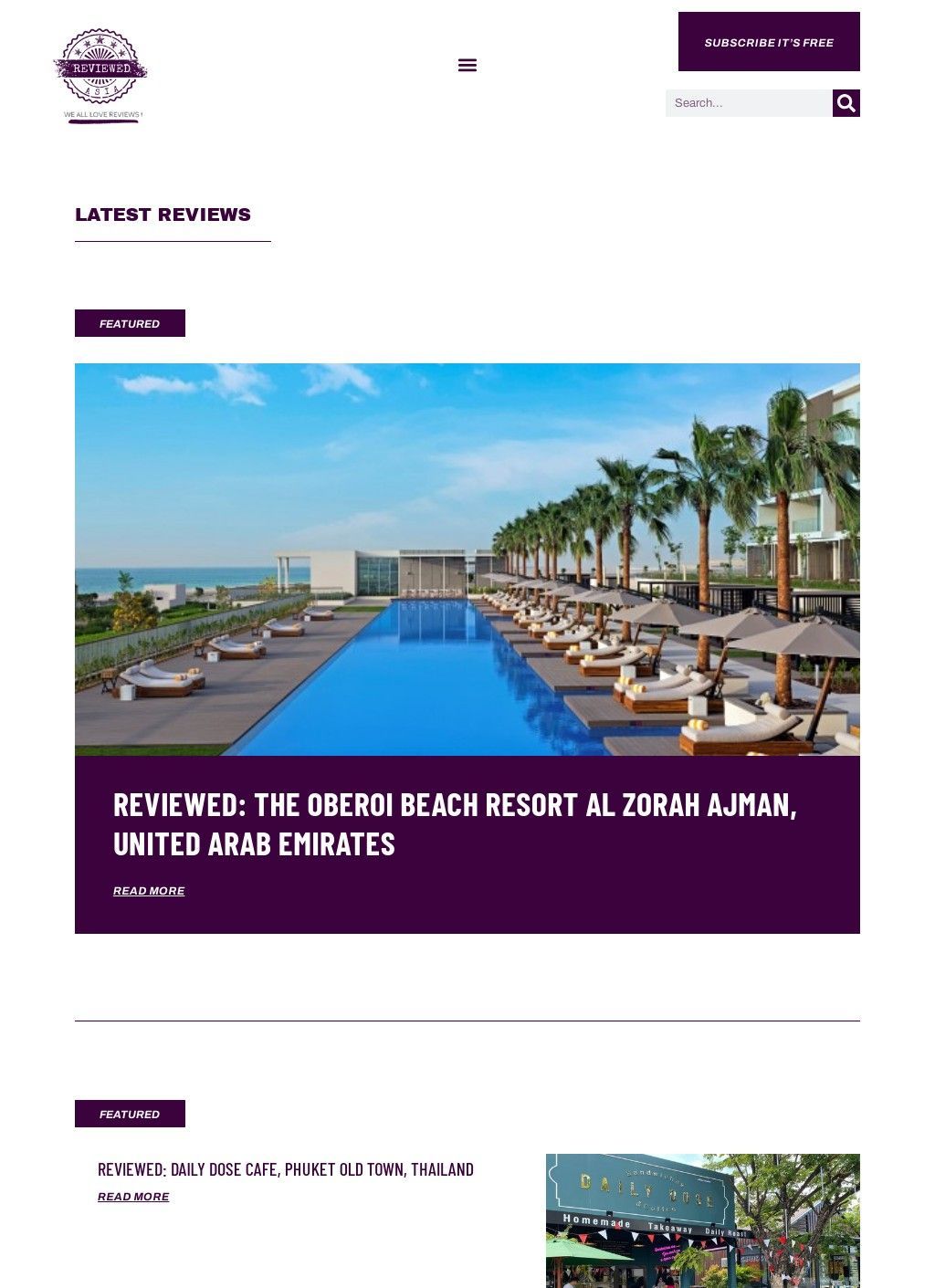
Planning two weeks across Thailand and its neighbors, most people hit the same wall fast: a hundred hotel listings that read identically and no honest sense of which restaurant, spa, or day trip is worth the detour. Reviewed: Asia positions itself as the filter for that exact problem, a review and travel-guide site publishing curated picks for Asian destinations instead of dumping every option into a search box and wishing you luck.
The coverage on Reviewed: Asia is sorted into a handful of plain categories. Accommodations holds the hotel reviews. Dining runs from restaurants to coffee shops and the brunch-and-breakfast circuit. Recreation is the more distinctive corner, putting golf courses, spa write-ups, and Muay Thai and martial arts side by side, a combination few travel guides even attempt. Activities gathers excursions and full itineraries for people who want a day mapped out, while a Resources section collects travel tips and practical guides for the logistics a trip actually throws at you.
The spread is broad enough that one visitor planning a single trip is unlikely to touch all of it, though each slice clearly has its intended reader.
How the recommendations get made
What holds the whole thing together is a contributor model, and it is worth understanding before trusting a single star rating. Readers are invited to write their own reviews, and the site builds its coverage out of that flow of contributions rather than relying on a small fixed editorial staff.
That structure is really the only way a site covering accommodations, dining, recreation, and full itineraries stays current across so many categories at once. A handful of staff writers could not keep pace with hotels, restaurants, spas, and Muay Thai gyms opening and closing across a region this size. A rotating pool of contributors can, at least in principle, and Reviewed: Asia leans on exactly that.
The VIP contributor path
Once a contributor reaches fifty reviews on Reviewed: Asia, they can qualify for VIP Contributor status. From there the site says these contributors work with partners on complimentary hotel stays, restaurant openings, launch events, and spa treatments to test firsthand.
That arrangement cuts both ways, and being clear-eyed about it matters. It is how Reviewed: Asia gets enough hands to cover a region this size, and it explains the steady flow of fresh write-ups across so many categories. It also means some of the warmest entries were produced by people receiving free rooms and treatments, which is exactly the context a reader weighing a real booking should keep in the back of their mind.
To the site's credit, it spells the model out on its About page instead of burying it, so anyone who reads that far knows how the coverage is funded. The catch is that an individual review rarely tells you whether it came from a paying guest or a comped VIP, and that missing label is where a careful reader has to supply their own skepticism.
Where the money comes from
Reviewed: Asia runs on affiliate partnerships, and it does not pretend otherwise. Booking.com and Rentalcars.com cover the hotel and car-hire side, GetYourGuide feeds the tours and excursions, and Holafly handles eSIM data for travelers who want to land in a new country already connected without swapping a physical SIM.
Click a recommendation on Reviewed: Asia, book through the link, and the site takes a commission. That is a standard way for a travel guide to fund itself, and being upfront about it beats pretending the reviews float free of any commercial interest. The partners themselves are established names, which lends the booking side more credibility than the reviews alone carry.
Coverage beyond the written page
The site is paired with a YouTube channel under the name Reviewed Asia, covering hotels, restaurants, excursions, and fitness across the same destinations. For a hotel room or a Muay Thai gym, video carries information that still photographs and tidy prose cannot, letting a viewer size up a room or the state of a facility with their own eyes. Running both formats gives Reviewed: Asia a second route to travelers who would sooner watch a walkthrough than read one.
How closely the channel keeps pace with the rest of Reviewed: Asia is harder to judge from the outside. The pairing is sensible all the same. A spa or a beachfront room is simply easier to trust on film than in a paragraph that might have been written for a free night's stay.
Whether it belongs in your planning
For a traveler who wants curation over a firehose of listings, Reviewed: Asia has a real use. The category spread is thoughtful, the booking links are convenient, and pairing written and video coverage fits the way people research a trip in practice.
The reservations are just as concrete. Reviews get shaped by comped stays, and there is no easy way to check the operation standing behind them.
What the site does not give you
Reviewed: Asia publishes no contact details on its pages. No phone number, no email, no postal address, and no contact page surfaced in the material reviewed. For a site steering readers toward paid bookings, the absence of any direct line is a genuine gap, since a recommendation that goes wrong or an affiliate link that misfires leaves no obvious way back to the people who pointed you there.
Outside reputation is just as sparse. A search for independent reviews of Reviewed: Asia turned up the site's own pages and its YouTube channel and little else genuinely about it: no Trustpilot profile, no Google or Facebook rating, no third party vouching for the picks. None of that proves the content is poor. It does mean a first-time visitor to Reviewed: Asia is being asked to take the site's own word for itself, with nothing from a stranger to back it up.
Set beside Tripadvisor, the trade-off comes into focus. Tripadvisor hands you thousands of unpaid opinions and a crowd rating you can pressure-test, at the cost of noise and sameness. Reviewed: Asia gives a tighter, more opinionated shortlist with a clear regional focus, but you are trusting a much smaller and far less transparent operation to have called it right. For sanity-checking a shortlist against a larger platform, it has value. As the sole source behind a payment, Reviewed: Asia asks for more trust than its transparency has so far earned.