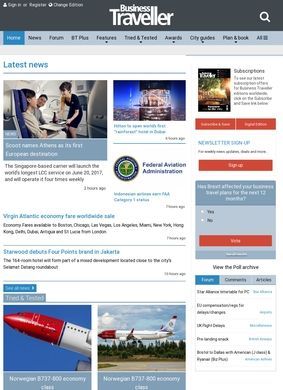
Business Traveler is a travel media brand, published as both a print and digital magazine and a companion website, aimed squarely at people who fly and check into hotels for work. The spine of the site is a review operation it calls "Tried and Tested," where the editorial staff work through airlines, hotels, airport lounges and restaurants and file a verdict on each. Filter menus let a reader narrow by category, so someone comparing business-class cabins is not wading through restaurant write-ups to reach them. That one structural decision tells you who the site is built for.
Inside the Tried and Tested reviews
The review section is the reason most people land on Business Traveler in the first place, and it is organised the way a frequent flyer thinks. Airlines and hotels form the two obvious pillars, with lounges and restaurants filling out the rest. The questions a work traveller asks tend to be narrow and repetitive: is the seat actually flat, is the lounge worth the walk to the far end of the terminal, is the hotel close enough to the meeting to skip a taxi.
A searchable, category-first layout answers those faster than a chronological blog roll ever could, and the filter menu is the part that keeps the whole thing usable once the archive grows large.
What gives the coverage weight is that it reads as first-hand assessment instead of reprinted press material. A "Tried and Tested" piece is framed as someone having flown the route or stayed the night, then reporting back. Whether every entry on Business Traveler lives up to that standard is impossible to confirm from the outside, but the format sets a useful bar, and it is the format that separates a review operation from a page of listings.
Airline and hotel coverage
Airlines and hotels make up the bulk of it here. Alongside the written pieces, Business Traveler produces airline video reviews, hosted on YouTube and embedded straight into the pages. That is a sensible call for anything as visual as a cabin walkthrough or a seat demonstration. Reading that a seat reclines fully is one thing. Watching someone lie flat in it, then twist to reach the tray and the power socket, tells you more in thirty seconds than a paragraph of adjectives.
Pairing text with video gives the airline coverage something firmer to stand on, and a flyer weighing two carriers on the same route comes away with concrete grounds to judge one against the other.
Hotel coverage runs on the same logic, if without the video. A business guest cares about a shorter list than a holidaymaker does: the desk, the wifi, the walk to the client's office, the breakfast that has to happen before an early meeting. Coverage built around that shorter list is more useful to the audience Business Traveler is chasing than a glossy spread about spa treatments would be.
The restaurant and lounge reviews slot in around the edges of the same trip, which is the point: a single site meant to answer every question a work journey throws up between the gate and the return flight.
How the reviews are sorted
Beyond the airline and hotel split, the sorting is the quietly practical part. A regional tag such as "Americas" lets a reader pull content tied to where they are flying, and the category menus keep the four review types cleanly separate. It is a functional system, not a flashy one, and for a reference tool that people dip into mid-trip from a phone at a gate, functional is exactly the right call.
The design on Business Traveler gets out of the way and lets the content do the work, which is more than plenty of glossier travel sites manage. Search and filter, then read. There is little friction between wanting an answer and finding one.
Issues, regional editions and reader engagement
Business Traveler still runs on the rhythm of a published issue. Each one carries cover features, including business profiles and the occasional celebrity, alongside the steady drip of travel-industry news that fills the site between issues. That mix, longer magazine features on one side and quick news on the other, is standard for the trade press, and it gives the site two speeds: something to read on a long flight and something to check before boarding.
Business Traveler runs in more than one regional edition. Signals in the site's own plumbing point to localized versions serving the United States and other markets, which fits a publication that has to cover different airlines, airports and hotel chains depending on where its readers sit. A traveller booking out of Chicago and one booking out of Singapore want different reviews, and the separate editions are how Business Traveler handles that split without watering down either one.
There is also a reader survey with prize incentives, run under the Business Traveler name, which is a straightforward way to pull feedback and demographic detail out of an audience that publishers and advertisers watch closely.
Embedded CNBC video segments turn up on the pages too, extending the news coverage with broadcast material, and the presence of Stripe on the site points to paid subscriptions or digital access sitting behind some of the content. None of that is unusual for a title of this kind, and together it suggests a business model that reaches past banner ads into subscriptions and reader data.
Where the credibility sits
Here the picture around Business Traveler thins out. A search for outside reviews of the brand itself turned up very little of use. Results were crowded with unrelated firms carrying similar names, corporate travel agencies and travel-management companies among them, and with the site's own "Tried and Tested" write-ups, which are reviews it publishes, not reviews of it.
So there is no third-party star rating or aggregate review count to point a newcomer toward. For an established media brand that is less damning than it would be for a shop or a contractor, since a magazine's standing tends to live in its readership and its place in the trade instead of in a Trustpilot score. Still, it leaves an outsider with little independent signal to weigh, and that is worth being honest about.
Contact transparency is the other soft spot, and an honest one to flag. What could be captured of the site did not surface a phone number, a postal address or a plain contact route, so a reader wanting to reach the publisher directly may have to hunt for it. For a title people come to read, the gap weighs less than it would for a service business, and a magazine is under no obligation to make its newsroom easy to cold-call. Even so, a visible contact page would have counted in its favour, and its absence deserves naming.
So the verdict on Business Traveler lands in the middle, and honestly so. As a working reference for airline, hotel and lounge reviews, it is credible and reasonably deep, and the embedded video plus the regional editions give it more substance than a bare aggregator of travel news. The reservations still stand, all the same: no independent reputation signal surfaced, and what could be seen of the contact details was sparse.
For the job it is built to do, lining up flights and hotels before a work trip and telling you which lounge is worth the detour, Business Traveler holds up well.
As a name you could vouch for on outside evidence alone, it asks you to take the brand largely on trust.