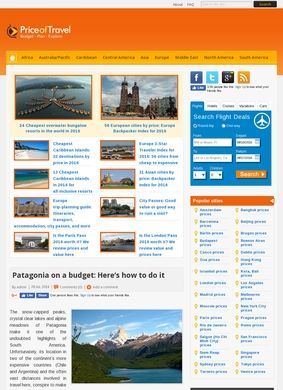
Figuring out what a day of travel will actually cost in a city you have never visited is harder than it looks. Price of Travel is built around that problem. The site collects daily budgets for accommodation, food, and local transport across more than 200 destinations and lets you compare cities side by side. If you are trying to decide whether a week in Lisbon will hurt less than a week in Prague, Price of Travel is constructed for exactly that decision.
Comparing cities by daily travel costs
The headline feature is the Backpacker Index, a global ranking of cities by what it costs to travel through them on a tight budget. It is a sensible organizing idea, because it turns a sprawling mass of destination data into a single sortable list. Around that index sit the regional cost guides, grouped by Africa, Asia, Europe, the Americas, and the Caribbean, so a reader can drill from a broad question about where in the world is affordable down to one specific city and its expected daily spend. Having it structured this way means Price of Travel functions more like a research tool than a business directory of travel vendors.
The Backpacker Index and regional guides
Beyond the raw budget figures, Price of Travel runs longer editorial pieces that read like they were written by someone who has done the trips. There are articles on the cheapest Caribbean islands, affordable European destinations, overwater bungalows, and regional rankings that pull the cheapest options to the top. The first-person voice running through these pieces points to a single-author operation, and that shows in the tone: opinionated, specific, willing to say one place is a better deal than another instead of hedging everything into uselessness.
Editorial pieces on affordable destinations
The practical sections fill in the gaps around a trip. Accommodation coverage spans hotels and hostels, transport pieces get into trains and cruises, and there is a steady stream of material on sightseeing passes and attractions, including Go City bundles and Eurail passes. Best-time-to-visit guides round it out, since shoulder-season pricing can swing a destination from expensive to reachable for a budget traveler. None of this is transactional. Price of Travel does not sell trips; it tells you what things should cost and points you toward booking elsewhere, which is a cleaner position than a site dressed up as advice but built to push one vendor.
Practical trip planning resources
That advisory stance comes with the usual caveat: the site carries advertiser and affiliate relationships, and there is an "advertise" link in plain view. Affiliate income is standard for travel publishing and not a mark against it, but a careful reader should keep in mind that pass and booking recommendations may sit downstream of those deals. The cost data itself reads as independent, and the editorial judgments feel earned rather than sponsored.
Advertiser relationships and affiliate income
On credibility, the picture is mixed. A contact page exists, and Price of Travel links out to YouTube, Facebook, and Twitter at @PriceOfTravel, so there is a real person behind it who can be reached and questioned about the figures. A search for outside reviews turns up very little. The results that surface mostly belong to unrelated companies with similar names, a Mexican booking agency and another discount-travel brand, none of which reflect on the site under review here. There is no Trustpilot, Google, Yelp, or BBB presence to lean on, which leaves the social accounts and the contact form as the only direct channels back to the publisher.
Limited third-party verification available
That absence is worth weighing honestly. For a publisher whose entire value rests on the accuracy of its numbers, no third-party track record means a visitor is trusting the author's word and methodology without external corroboration. The Backpacker Index is a recognizable name in budget-travel circles, which counts for something, but recognition is not the same as a wall of verified reader feedback. The work has to stand on its own merits.
And mostly it does. The depth of destination coverage runs deep, the cost-comparison angle is genuinely useful for trip planning, and the editorial pieces add context that a bare price table cannot. Price of Travel is best treated as a starting reference for budgeting a trip, a place to get a defensible ballpark figure, not a final authority. The daily numbers are worth cross-checking against current local prices, since costs drift and a single author cannot refresh 200-plus destinations constantly. Used that way, Price of Travel reads as a well-organized resource for budget travel research, with the honest caveat that its reliability rests on one publisher's diligence and not much outside verification. A traveler who treats the figures as a planning baseline rather than a guarantee gets the most out of it.