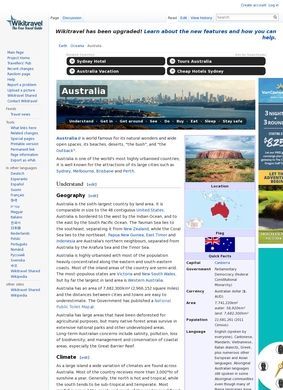
What does a first-time visitor to Australia need to sort out before booking the flights, and can a single free page hold all of it? The Australia entry on Wikitravel makes a decent run at yes. It gathers the whole shape of a trip into one collaboratively written guide: how to get in, how to move around a country the size of a continent, what to see once the plane lands, and how to steer clear of the things that bite.
Wikitravel is free, and anyone can edit it. Both of those facts cut in more than one direction.
How the Australia guide is laid out
The page follows the familiar wiki-travel skeleton, and for a country this large that structure does a great deal of the work. An Understand section opens with the groundwork: geography, climate, history, culture, public holidays, and the time zones that trip up anyone trying to schedule a call home. That climate note matters in a country where the seasons run opposite to the northern half of the world and a beach day at Christmas is normal, the sort of context a traveler needs before packing a single bag.
From there Wikitravel splits the practical journey into stages, each under its own heading, so a reader can jump straight to the part they need instead of scrolling through a wall of prose.
That modular layout is the quiet strength of the Wikitravel page. Australia is no one-week destination, and the guide treats it as the sprawling logistical puzzle it plainly is, organized more like a business directory a traveler dips into for one answer at a time than a magazine feature meant to be read start to finish.
The audience runs from the first-timer who has barely left their own hemisphere to the return visitor plotting a specific route or a single activity, and the same page serves both because the sections stack from broad orientation down to fine detail. A newcomer can read top to bottom. Someone who already knows they want to dive the reef skips straight to the part that helps and ignores the rest.
Getting in and getting around
The Get in section covers visas and the ways to arrive, by plane, by boat, or overland, the last one relevant mainly to travelers routing through Asia or the Pacific by sea. Get around is where the scale of the place shows itself: car, plane, train, bus, boat and bicycle each get their say, because crossing Australia is a genuine decision with real cost and time trade-offs behind it.
Wikitravel is honest about the distances in a way a glossy operator site rarely bothers to be, and that candour is the thing a traveler remembers when a fourteen-hour drive turns out to be exactly fourteen hours.
Putting all six modes on one screen also lets a reader weigh them against each other, which is where the real planning happens: a train that saves a flight, a bus that costs a day, a rented car that opens up everything in between.
What to see and do
See and Do is the section a holidaymaker came for, and it is the part I would read first. Wildlife viewing, landmarks, sports, diving on the reef, bushwalking through the interior: the range maps onto the actual reasons people fly halfway around the world for this country. Wikitravel keeps the entries practical over lyrical, pointing at where to go and how to reach it, which suits a planning session better than a daydream. Practical information sits close by, covering currency, costs, dining, accommodation and shopping, so budgeting and sightseeing stay in one reference instead of scattered across a dozen tabs.
That pairing is more useful than it first appears: a landmark is easy to fall in love with until the accommodation nearby prices the trip out, and having both figures in the same guide keeps expectations honest early.
Staying safe and staying connected
Australia carries a reputation for things that can hurt you, and the Stay safe and Stay healthy sections on Wikitravel meet it head on: dangerous wildlife, natural disasters, medical care and vaccinations are all covered, which is the responsible move for a destination where the local fauna is a running joke with a serious edge. The safety coverage is also the part most likely to reassure a nervous parent or a solo traveler, since knowing which animals and which weather to respect turns a vague dread into a short checklist.
Connect rounds it off with the mundane but necessary, internet, telephone and postal services. None of this is thrilling reading. That is the point. It is the reference a traveler is glad exists at 2 a.m. when a plan has just fallen apart.
Two things temper the enthusiasm. Because Wikitravel is open for anyone to edit, the quality of any given line rides on whoever last touched it. A well-tended section reads like advice from a friend who just got back; a neglected one can carry a price or a visa rule that quietly went stale a while ago, with nothing on the page to flag which is which. The open model that makes the guide broad and free is the same model that makes any single line worth a second check.
Wikitravel does the sensible thing and links out to the authoritative sources: the official Australia tourism site, government pages for customs and immigration, and the individual operators who run the transport and the tours. That is the right architecture for a volunteer guide. It knows the limit of its own authority on a visa rule or an entry requirement and sends the reader onward to the office that actually sets it, keeping the overview and the binding detail in their proper places.
So the honest read is a useful map, not a final word. Wikitravel hands a traveler a fast, free, well-organised overview of Australia and a set of doors to walk through for the specifics, which is a real service for anyone at the stage of turning a daydream into a plan. Treat the time-sensitive facts, the visa terms, the costs, the safety warnings, as starting points to confirm against the official links it points you toward, because on a community page nobody guarantees the sentence in front of you was checked recently.