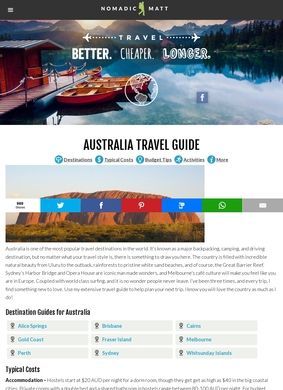
Budget planning for Australia on Nomadic Matt starts with a cost breakdown that splits daily spending into three tiers: backpacker level built around hostels, camping, and self-catering; a midrange option; and an upscale choice for people who want their own room and the occasional decent restaurant. That structure tells you most of what the site is about. Matt Kepnes built Nomadic Matt as a cost-focused travel reference, and the numbers attached to Sydney, Melbourne, Perth, Cairns, and Brisbane are the spine of the Australia page rather than decoration.
Budget tiers for Australia travel
The entry reads like a chapter in a much larger book. Alongside the budget math there are short city overviews, itinerary suggestions, climate and safety notes, and practical transport and accommodation advice. The hostel and camping coverage is the part that helps a first-time visitor figure out how to cross a very large and expensive country without going broke. Specificity is where Nomadic Matt earns trust on pages like this: naming price brackets and tying them to real cities is more useful than vague encouragement to "see Australia on a shoestring."
Hostel and camping guidance
The page also makes its money in plain sight. Booking links route through Skyscanner, Booking.com, Hostelworld, GetYourGuide, and Rome2Rio, which are standard affiliate partners across travel publishing. None of that is hidden, and the recommendations are mainstream enough that there is no obvious steering toward odd choices. The information is accurate enough to use; read it knowing the incentive is there.
Affiliate links and monetization
Beyond the Australia page, Nomadic Matt covers destinations worldwide with the same cost-analysis angle, plus content aimed at solo female travelers and families. A newsletter pushes ongoing tips by email, which fits how the operation runs: free guides up front, a relationship built over time. The itinerary suggestions give a starting frame, the safety and weather notes head off obvious mistakes, and the whole thing is written for someone who has not been before and wants a plan, not inspiration. Nomadic Matt has been at this long enough that the Australia guide reflects a destination the author has clearly spent time researching rather than summarizing from secondary sources.
Travel books and Superstar Blogging course
The commercial side goes past affiliate links. Kepnes sells travel books, including "How to Travel the World on $50 a Day," and runs a paid course called Superstar Blogging for people who want to turn travel writing into income. That course is a separate product from the destination guides, and it is worth keeping the two apart when judging the site. The Australia page costs nothing to read; the course is a paid bet on Kepnes as a teacher.
Mixed reviews across platforms
On reputation, the picture is mixed but mostly favorable. A Knoji aggregator listing puts Nomadic Matt at 3.9 out of 5 across 18 reviews, which is decent without being glowing. A Trustpilot profile exists, though the visible signal there includes at least one unhappy customer and no clear overall figure that could be confirmed. Third-party blog reviews of the Superstar Blogging course skew positive, and discussion on the r/travel subreddit about Nomadic Matt group tours runs mixed but largely positive in the anecdotes people share. Taken together, that is the profile of a long-established brand with real fans and the occasional detractor, about what you would expect from anything this widely read.
Reaching the operation goes through a contact form, and there is an active social presence across Facebook, Instagram, Threads, and TikTok. For a publishing brand that handles most inquiries online, that arrangement is normal. A form covers most of what a reader would need to ask, and the social accounts provide a separate channel for people who prefer it.
For the free guides, Nomadic Matt is a reasonable first stop for an Australia trip, with the affiliate angle noted and accepted. The site has a clear identity: Nomadic Matt is a budget-first resource, and that consistency makes it easier to calibrate how much weight to give any single recommendation. The harder thing to settle is the paid layer: the books and especially the Superstar Blogging course ask readers to trust the same author whose name carries a 3.9 average and at least one visible complaint, and the reviews of that course come mostly from other bloggers in the same ecosystem.
Whether that endorsement is independent enough to act on is not something the page itself resolves, and the outside review record numbers in the dozens, not the hundreds, and that volume leaves real uncertainty. The free content is solid; the paid products require more independent research before spending a cent.