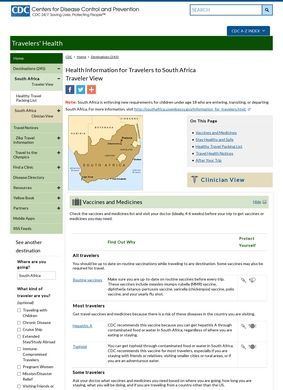
What does a traveler to Cape Town or the Kruger bush actually have to arrange before boarding the flight? Health Information for Travelers to South Africa answers that in a plain, fixed order, and it starts weeks before departure with the vaccines and prescriptions a clinician needs to sign off on. This is a destination page from the CDC's Travelers' Health program, built around a single country and laid out so a reader can go top to bottom and come away with a working checklist instead of a vague sense of things to look into someday.
The framing matters. A person planning a first trip to South Africa is usually juggling flights, lodging, and a safari booking, and health preparation slides to the bottom of the pile until it is nearly too late. Putting a single, ordered page in front of that person, one that moves from the most urgent items to the least, is a practical answer to a very common habit of procrastination.
Before the flight leaves
The most time-sensitive material sits near the top. Health Information for Travelers to South Africa opens with current Travel Health Notices, the alerts that shift from season to season, then moves into the Vaccines and Medicines section, which is where a first-time trip planner will spend the most time. Putting those two first is a deliberate choice, because several of the steps only work if a person starts them early.
Timing is the quiet thread running through the whole thing. A vaccine given the day before a flight does little good, a malaria prophylaxis has to be started on a schedule, and the layout of Health Information for Travelers to South Africa keeps nudging a reader toward the calendar and away from the suitcase. That is the single most useful thing a page like this can do.
Shots, pills, and the malaria question
The vaccine list runs through the immunizations a doctor commonly weighs for the region: hepatitis A and B, typhoid, and rabies for certain travelers, set alongside the malaria prophylaxis decision, which depends on exactly where in the country a person is headed. A beach city and a low-lying game reserve are different propositions, and the page treats them that way instead of issuing one blanket instruction.
Health Information for Travelers to South Africa does not pretend to stand in for a clinic visit. It links out to a tool for finding a clinic or vaccine provider, which is the practical bridge between reading a web page and getting a prescription actually written. What I appreciate is the restraint: the page hands over the considerations, names the specific diseases, points the reader at a professional, and stops there, without tipping into do-it-yourself medicine. That is the correct posture for guidance a nurse or physician is meant to build on.
The link to a clinic and vaccine-provider finder is easy to skip past and genuinely handy. Knowing that a shot is recommended does a traveler no good if they cannot find somewhere to get it, and pointing straight to a provider closes the distance between reading the advice and acting on it. That small feature is where a reference page turns into something a person can actually use.
The illnesses no vaccine covers
A separate section deals with the threats a shot cannot touch. Leptospirosis, schistosomiasis, tick-borne illnesses, and tuberculosis each get their own mention, worth flagging since a traveler who has had every recommended vaccine can still walk away believing they are fully protected. They are not, and Health Information for Travelers to South Africa is blunt about the gap.
These read as behavior problems as much as medical ones. Stay out of fresh water where schistosomiasis is a risk. Check for ticks after a day in the bush. Take the tuberculosis and leptospirosis notes seriously instead of skimming past them. It is the part of Health Information for Travelers to South Africa that a hiker or a game-reserve visitor should read twice, since avoiding these illnesses comes down mostly to what a person chooses to do once they are on the ground.
Staying well on the ground
Once a traveler has landed, the guide shifts from prevention to daily habit. The Stay Healthy and Safe section covers food and water safety, bug-bite prevention, germ reduction, outdoor safety, and the animal encounters that come with a country people fly in to see for its wildlife. Health Information for Travelers to South Africa runs wider here than a reader might expect, moving past strictly medical advice into the ordinary business of not getting hurt.
That breadth is the quiet strength of the page. It treats a trip as one continuous event, from the pharmacy counter at home to the drive out of the airport to the walk back to a lodge after dark. Few travel resources bother to connect those dots.
Food and water safety draws more attention than a first-time traveler might guess, and rightly so, since an upset stomach from the wrong tap water or a badly handled meal is the most common thing that quietly derails a trip. The bug-bite guidance loops back to the malaria and tick warnings from earlier in Health Information for Travelers to South Africa, so the sections reinforce one another instead of standing in isolation. A reader who works through the page in order finds the same themes coming around again, which is a fair way to make advice stick.
Roads, seals, and personal safety
Two sections stand a little apart from the disease material. Transportation Safety talks through driving conditions, vehicle selection, and road hazards, which is fair, because a car accident is a far likelier way for a visitor to be injured than any exotic infection. Personal Security handles pre-departure and in-country precautions for staying out of trouble. Health Information for Travelers to South Africa also closes the loop with an After Your Trip section on medical follow-up for anyone who comes home unwell, plus a Packing List of health items to carry along.
That packing checklist is a small thing that pays off in a country where a rural pharmacy may not stock what a traveler assumes it will. And the real value of Health Information for Travelers to South Africa lies in that completeness: every stage of a trip has its own heading, so nothing important is left to memory or to a frantic search at the departure gate.
One of the current notices is oddly specific, and it is a fair illustration of how the page behaves. There is a rabies outbreak among Cape fur seals along the South African and Namibian coast, carrying a flat instruction not to approach or touch the seals on the beach. Health Information for Travelers to South Africa sets that beside a measles awareness note, which is the whole point of a live destination page: the warnings get rewritten for whatever happens to be circulating the week a person plans to travel.