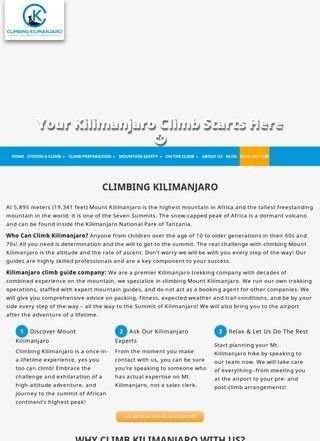
A 98.8 percent summit success rate is the number Climbing Kilimanjaro puts front and centre, and whatever you make of self-reported figures, it sets the tone for an operator that wants to be judged on whether people actually reach the top. The company runs guided treks up Mount Kilimanjaro on all seven of the established routes, which is more than many Tanzania-based outfits bother to support: Machame, Lemosho, Northern Circuit, Marangu, Rongai, Umbwe, and Shira are all on the books, with itineraries running anywhere from five to nine days depending on which line you take up the mountain. That spread matters because route choice is most of the decision a climber makes, and acclimatisation profiles differ sharply between, say, the longer Northern Circuit and the shorter Marangu.
Running treks without booking agents
One detail worth pausing on is the claim that every trek is run directly, not handed off to a booking agent or a local subcontractor. Plenty of names you see online are resellers who pass your money down a chain, and the price and the standards drift at each handoff. If Climbing Kilimanjaro is genuinely operating its own guides and porters, that is the difference between a brand and an actual on-the-ground company, and a prospective climber can test it by asking pointed questions before a deposit goes anywhere.
Guiding across all ages
The experience pitch leans on longevity: sixteen-plus years of guiding, and a willingness to take a wide span of people up the mountain. Climbing Kilimanjaro says it has worked with climbers from age ten through people in their sixties and seventies, which reads less like a boast and more like a statement that the guiding is paced and supported rather than aimed only at hardened trekkers. Kilimanjaro is a walk-up peak, no ropes or technical climbing, so age matters far less than acclimatisation discipline, and an operator that openly takes children and older climbers is implicitly saying it builds in the slow days that get people to the crater rim.
Meru climbs and safari add-ons
The offering does not stop at the summit. Climbing Kilimanjaro also arranges Mount Meru climbs, which is a sensible acclimatisation warm-up that experienced trekkers often pair with Kilimanjaro, plus safari packages covering the Ngorongoro Crater and the wildebeest migration. There are Zanzibar beach extensions too, for the fairly common pattern of climbers who want to collapse on a coast after a week at altitude. Pre- and post-climb accommodation in Arusha is handled as part of the arrangement, which removes one of the more annoying logistical gaps for someone flying into Kilimanjaro International with a duffel bag and no plan for the first night.
Bundling the climbing package
Taken together, Climbing Kilimanjaro is a full-trip vendor, not a single-product seller, and the bundling is logical instead of scattershot. Meru feeds the main climb, the crater and migration safaris fill the days a tour group has spare, and Zanzibar is the reward at the end. The route-specific planning guides on the site reinforce that Climbing Kilimanjaro expects people to do serious homework, which is the right expectation to set for a trip that is physically demanding and not cheap.
Checking outside reviews and ratings
On the question of whether other people rate the experience, the outside picture is reassuring and reasonably deep. Trustpilot carries somewhere around 155 to 157 reviews depending on which regional subdomain you land on, and the sentiment sits close to five stars. A Trustindex aggregate pulls together 657 customer ratings averaging five stars, and there is a TripAdvisor listing with reviews present, though the precise count was not something I could pin down from what surfaced. Numbers like these are not a guarantee, since any operator can have a bad week on the mountain, but several hundred independent ratings, consistently positive, take far more effort to fake than a handful of glowing quotes pasted onto a testimonials tab. Climbing Kilimanjaro keeps its own reviews page, and the existence of the external trail behind it gives that page some credibility.
Contact channels and missing phone
Reaching the company is where I would temper the enthusiasm slightly. There is an email address listed, info at the company domain, and links out to Facebook, Instagram, YouTube, and Twitter, so Climbing Kilimanjaro is reachable and visibly active on social channels. What the homepage does not show is a phone number or a physical street address. For a Tanzania-based operator that is not unusual, and a serious climber is going to end up in a long email or WhatsApp exchange anyway before any money changes hands. Still, for a trip of this size and cost, some people will want a voice on the other end of a line before they wire a deposit, and the absence of a posted phone number is a fair thing to weigh.
Questioning the summit success rate
If there is a caution to register, it is the same one that applies to any operator quoting a near-perfect success rate: the figure is theirs, measured their way, and the honest move is to ask how they define a successful summit and what happens when a climber has to turn back early. The answer to that question, more than the headline percentage, tells you how Climbing Kilimanjaro handles the days that go wrong. Seven documented routes, coherent supporting trips, and several hundred outside ratings give a buyer plenty to verify before paying.
Route guides versus resellers
The route guides and seven-route coverage on the Climbing Kilimanjaro site make it straightforward to start mapping a trip before a single email is sent, and the operational questions left to ask are concrete rather than foundational. That puts it in a different category from the resellers who post a price and little else and still crowd the same search results.