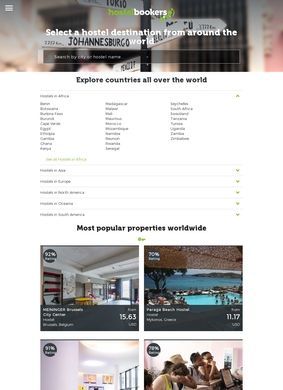
Type hostelbookers.com into a browser and you never actually land there. The address answers with a 301 redirect and hands you straight to HostelWorld.com, the parent platform that absorbed the brand. So a review of Hostel bookers is really a review of what that redirect delivers: a large budget-accommodation engine covering roughly 14,848 hostels spread across 3,152 cities, with hotels and B&Bs folded in alongside.
That number does most of the talking. Backpackers, students, and anyone chasing a cheap bed will find genuine breadth through Hostel bookers, from Barcelona and Lisbon to Hanoi and Bangkok, with property coverage stretching across Europe, Asia, Africa, both Americas, and Oceania.
What the redirect gives you
Once you arrive at the parent site, the machinery is clearly built for one job: matching a traveler to a dorm bed or a private room somewhere on the map. Destination guides anchor the experience. Pick a city (London, Amsterdam, Paris, Berlin among the featured ones) and you get curated hostel listings with ratings, pricing, photos, and guest reviews attached, which is the level of detail a first-time backpacker needs before committing a deposit.
Beyond the core booking flow there is more than I expected. A blog carries practical travel content: solo travel guides, notes on student discounts, the sort of writing aimed squarely at people planning a long trip on little money.
Tours, experiences, and the awards angle
The platform reaches past beds. A "Tours and Experiences" section lets travelers book activities alongside accommodation, which makes sense for the audience, since a backpacker booking a week in Bangkok often wants the day trips sorted in the same place. There is also a "Hostel Awards" program that recognizes standout properties, giving owners something to compete for and giving travelers a shortcut to the better-regarded options. A mobile app rounds it out for people booking on the move, and it carries the same catalog that Hostel bookers points you toward on the desktop site.
For hostel owners rather than guests, affiliate and partnership tools exist to list a property and pull in bookings, and a careers page sits over on people.hostelworld.com. None of this is hidden, though it clearly serves the parent brand more than the Hostel bookers name that used to front it.
The reputation is where it gets uncomfortable
Here the picture turns. A traveler doing homework on Hostel bookers runs into a wall of grievance. On Trustpilot, the hostelbookers.com listing sits on a TrustScore built from 8,977 reviews, and the recurring theme in what surfaces is disputes over cancellation policy: charges that did not match what customers thought they had agreed to. A separate, smaller Trustpilot entry for a near-identical domain shows just 18 reviews, the kind of fragmentation that muddies the trail.
SmartCustomer is blunter, scoring Hostel bookers at 2.9 stars off 9 reviews and summarizing the mood as generally dissatisfied. On Trustmeter, a UK-domain listing carries at least one one-star complaint centered on refunds. A hostel-management forum thread piles on, arguing over how HostelBookers and HostelWorld handle review policies.
The sample sizes vary wildly and the raw star average is not spelled out everywhere, so treat the exact figures with care. But the direction is consistent. The complaints cluster tightly around money: refunds, cancellations, charges that felt like moving targets. When negative feedback scatters across unrelated topics it can be noise; when it concentrates this hard on one process, it reads as a real weak point in how bookings and their reversals are handled.
Finding a human to talk to
Contact is the other soft spot, and it compounds the refund worry. The landing page shows no phone number, no email, no postal address. What you get instead is a "Help/Support" link pointing to a separate help subdomain and a "Talk to Us" support form, plus the full set of social channels: Facebook, Twitter, Instagram, YouTube, Pinterest, and TikTok. A missing public email is fair enough, since a form covers that and spam is real. The absence of any phone line is harder to shrug off for a platform that so plainly generates billing disputes.
When the main friction is money coming back to you, a support form is a thin lifeline. A traveler weighing Hostel bookers against a rival should factor that in.
Who the brand really is now
It is worth being clear-eyed about what Hostel bookers is at this point. The independent site is gone, rolled into a bigger competitor, and the name mostly survives as a redirect and a set of legacy review pages. Anyone typing the old address expecting the original service will find themselves on HostelWorld with a different logo at the top.
That is not automatically bad, since the underlying inventory is enormous and the guides are useful, but a booker should know they are transacting with the parent, under the parent's cancellation terms, not with the standalone brand the reviews were originally written about.
Whether it deserves a booking
The inventory behind Hostel bookers runs to tens of thousands of properties, and the trip-planning tools around it beat a bare search box. For a budget traveler who wants selection and is comfortable reading the fine print, Hostel bookers, by way of its parent, can find a bed in the city they want without much trouble. The catch is not the beds. It is what happens if plans change.
My honest steer: this suits the flexible backpacker who books cheap, rarely cancels, and treats a dorm reservation as low-stakes. If that is you, go through the redirect and use the destination guides and Hostel bookers listings to compare properties. If your plans are shaky or the trip is expensive, do one thing before you pay: open the "Talk to Us" form and ask the exact refund and cancellation terms in writing, then screenshot the answer. Given where the complaints land, that small step is the difference between a smooth trip and a fight over your money.