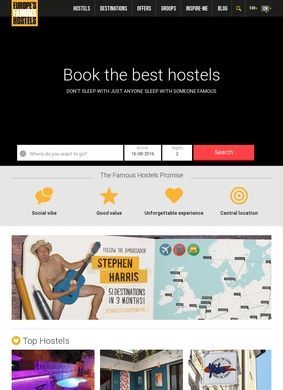
One Famous hostels property per city is the rule that shapes the entire network: a single hand-picked independent hostel in each location, never two competing for the same map pin. That constraint tells you most of what Famous hostels is doing and why. The model spans 22 countries, and every property inside it is independently owned, so the listings read less like a chain and more like a club that vets its members. Anyone who has booked a bed in an unfamiliar city and ended up somewhere grim will understand why a curated shortlist has appeal.
Direct booking and pricing structure
Reservations run directly through Famous hostels with no intermediary booking fee tacked on, so the price a traveler sees is closer to what the hostel actually charges. That adds up when you are stacking a week of nights and every few euros counts. Each property on Famous hostels has its own page carrying specific booking and contact details, which keeps practical information tied to the place it belongs to rather than forcing everything through one central desk. It is a straightforward setup, and it generally works.
Experiences and group services
Famous hostels stretches beyond beds into the things people actually do once they have dropped their bags. An Experiences section covers local tours and activities, with the usual hostel staples like pub crawls and walking tours sitting next to less expected options such as scuba diving. A group bookings service handles parties of more than six, which is the awkward size that standard online forms tend to choke on. A Travel Tips area collects destination guides, the kind of thing a first-time visitor reads on the train in or a seasoned traveler skims to find the one local tip they would not have thought to look for.
Eurail and Flixbus partnerships
Famous hostels leans into partnerships more aggressively than comparable networks. Eurail and Flixbus ticket holders get discounts of up to 20 percent, which is a sensible pairing because the people riding cross-border trains and long-distance buses are exactly the budget travelers a hostel network wants to catch. The two offers feel less like marketing decoration and more like a real attempt to sit inside the trip a backpacker is already planning.
EcoWanderer sustainability discounts
Then there is the EcoWanderer program, which hands discounts to travelers who make sustainable choices on the road. Sustainability tie-ins can be hollow, but pinning a concrete price break to the idea gives it some weight, and it fits the independent-hostel crowd that tends to care about that sort of thing anyway. Whether the discounts add up to serious money depends on how a given traveler stacks them, and Famous hostels does not pretend otherwise.
Community features and operational history
A member community called Talk! runs alongside a members login portal, so Famous hostels is trying to build something stickier than a one-off reservation. Famous hostels also posts job listings and student internship opportunities, which is a telling detail: a platform recruiting in the open is one that expects to be around for a while. The awards page marks roughly 30 years of operation, and three decades in the budget travel trade is not nothing.
Geographic reach across Europe
That longevity is the strongest card Famous hostels holds. A network does not survive that long in a market where hostels open and close constantly, and the one-per-city discipline has clearly held together long enough to span a continent. The reach across 22 countries reinforces the point. If a traveler is plotting a multi-city route through Europe, the geographic spread alone makes Famous hostels worth checking before defaulting to the big aggregator sites, where the sheer volume of options makes curation impossible.
Limited third-party review visibility
Reputation is where things get complicated. The Famous hostels network-level site carries a Trustpilot profile with nine customer reviews, and that is a limited pool for an operation claiming this much history and geographic spread. No score surfaced clearly, and no other third-party platform turned up review counts for the central brand. Some of that is structural: bookings and feedback scatter across individual hostel pages and the city-level properties, so the parent name collects fewer reviews than any single busy hostel might. A would-be guest looking for reassurance at the network level will not find a deep well of independent voices to draw on.
Central contact information gaps
Contact transparency has a similar wrinkle. There is no general phone number, no central email, and no headquarters address on the Famous hostels homepage. Inquiries route through individual hostel pages and a system embedded in the booking flow, and a contact page is not given a prominent spot in the main navigation. For the property-level booking this works fine, because the place you are actually staying is the place you would want to reach. For anyone with a question about the network itself, a group booking spanning several cities, or a problem that does not belong to one hostel, the path is less clear than it should be. That is a fair caveat against an otherwise functional operation, not a dealbreaker.
Put the pieces together and Famous hostels reads as a serious, long-running curation effort with a clear philosophy and some genuinely useful traveler perks bolted on. The direct-booking, no-fee structure quietly saves money over a long trip. The Experiences and group services round Famous hostels into something more than a list of beds. The light third-party review trail and the buried central contact route are the two things holding the verdict back from unqualified, and both trace to the same cause: the value lives in the individual hostels more than the parent brand page.
The practical question is whether the one-per-city promise delivers a better stay than the alternatives. The structure is designed to guarantee it, and 30 years of survival in a fragile market is real evidence that it has worked for a lot of people. For a traveler weighing where to sleep across a string of European cities, the discounts, the curation, and the no-fee booking are genuine advantages. Famous hostels does not offer the sheer volume of the big aggregators, but that is partly the point. The shortlist is the product, and three decades on the road is a reasonable argument that the shortlist is good.