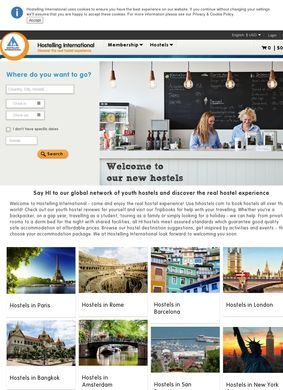
What does a 2,300-hostel network give a budget traveler that a single cheap guesthouse cannot? Hi hostels answers that with reach and a shared standard: one account that books across more than 2,300 affiliated properties in Brussels, Hamburg, London, Sydney and cities throughout Canada, all held together under the Hostelling International banner and its claimed 2.63 million members worldwide.
The proposition is plain enough. Budget accommodation with a community streak, aimed at backpackers, adventure seekers and anyone stretching a long trip across many borders. Whether Hi hostels belongs on a traveler's shortlist comes down to three things: how well the search and booking work, what the paid membership is actually worth, and what people say once they look past the front page.
How the booking network holds together
The engine of Hi hostels is a destination and hostel search that runs across the whole affiliated network. Type in a city and the site returns properties tied into the Hostelling International system, with a single login carrying a traveler from one country to the next.
The destinations pushed hardest up front lean toward the reliable magnets, Brussels, Hamburg, London and Sydney among them, with Canada flagged as well. Coverage at that scale is the genuine draw; very few budget-lodging brands can put one account in front of thousands of beds spread across several continents, and that breadth is the thing a lone guesthouse can never match.
Booking itself sits on the site rather than off in a dozen separate systems, a real convenience for a traveler stitching together a multi-country route where every extra login and every new payment page is a chance for something to go wrong.
Scale cuts both ways.
A web of 2,300-plus independently run hostels is only ever as consistent as its weakest link, and Hi hostels makes no claim that every affiliated property is cut from the same cloth. The brand sets a floor and supplies the booking channel. The room a traveler gets in London will not be the room they get in Sydney, and the price and upkeep move with it.
That is refreshingly honest, and it is also the crux of the problem, because the Hi hostels name over the door ends up telling a guest less than the individual property's own reviews do. The network is a promise of a baseline, not a guarantee of a specific bed.
What the paid membership buys
Membership is where Hi hostels tries to turn a booking tool into a reason to keep coming back. The paid program bundles discounts on stays with a run of travel perks, and it reaches outside its own walls for extra value: Bounce for luggage storage, Airalo for eSIM data abroad, and a travel insurance option offered through the site. For someone already hopping between HI properties for weeks at a time, the discount arithmetic can cover the fee comfortably. For a traveler booking one weekend, it is far less clear the membership ever pays for itself.
The perks suit a long-haul backpacker and mean little to a casual one, and Hi hostels does not really disguise that split. A person planning six weeks across Europe reads the Bounce and Airalo deals very differently from someone booking two nights in a city they will never revisit. The eSIM tie-in in particular is aimed squarely at the traveler crossing borders often enough to dread roaming charges, which is the exact person the paid tier is built to keep.
More than a bed for the night
Past search and membership, Hi hostels keeps a blog stacked with travel guides, destination write-ups and pieces on skiing, swimming, cycling and cultural outings. The content is there to pull in trip-planners, and it suits the audience the brand wants. The experience angle is the useful part: a backpacker deciding where to go next is exactly who reads a piece on cycling routes or a ski town before they ever open the booking form, and the blog meets them at that stage.
Alongside it, Hi hostels promotes sustainable, eco-conscious hostelling and runs community programs, including youth engagement through advisory panels, so the social mission reaches past a single footer line. That youth-panel piece is the kind of thing a purely commercial competitor would not bother with, and it fits a movement that has always framed itself as more than a room for hire.
A newsletter signup rounds the offering out. None of this is decorative; it points at a brand chasing trip-planning attention months before anyone books a bed.
What the reviews and the contact page tell you
Sizing up Hi hostels as a brand runs into one snag: nearly all the outside reviews attach to individual hostels, not to the network overall. HI New York City Hostel carries an 8.6 out of 10 on Booking.com across 16,196 reviews and a 4 out of 5 on Tripadvisor from 2,120 reviews. HI Chicago Hostel sits at 8.5 on Booking.com over 9,859 reviews. Hostelworld piles on tens of thousands more, upward of 75,798 across New York hostels alone, and yet those still track specific buildings, not Hi hostels as an operator.
That volume is substantial and mostly warm. But it is evidence about beds in named cities, not about the parent brand's own handling of a booking. Sixteen thousand people vouching for a hostel in Manhattan says a great deal about that hostel and almost nothing about a property with no reviews at all in some smaller town on the same network.
On Hi hostels itself the signal is smaller and more mixed. A Trustpilot page for the site gathers customer-service feedback that praises cleanliness and easy booking while grumbling about rising rates and promotion problems, and no aggregate star score surfaced to tie it together. That combination is worth sitting with: the good notes are about the physical stay, and the sour ones are about money and process, exactly the parts a central brand controls.
As an employer, Hostelling International pulls a 3.5 out of 5 for compensation and benefits on Glassdoor, which speaks to working there more than staying there. Netted out, the network's own standing reads decent but unsettled.
Contact is workable without being open-handed. Hi hostels keeps a contact page at its /contact/ address, and the familiar social channels are all in place: Facebook, Instagram, YouTube and TikTok. The landing page shows no phone number, no email and no street address, so reaching a person means clicking through to that contact page first. For a global operator this is mild friction, not a warning sign, though a guest with a booking gone wrong in a distant timezone might wish the path to a human were shorter.
The socials do double duty as a support channel the way they now do everywhere, which softens the point without fully answering it.
That leaves the doubt the front page cannot clear. The booking system works, the membership can pay off for the right kind of traveler, and the property ratings for flagships like HI New York and HI Chicago are genuinely strong. What Hi hostels never quite proves is whether the brand holds its standard once a traveler steps outside that handful of heavily reviewed hostels, and the Trustpilot complaints about rates and promotions hint that the answer shifts from property to property.
Booking on the strength of the name alone, in a city with no reviews to check, means trusting the network's floor to hold without knowing if it will. Whether it holds is the one thing thousands of glowing reviews for other cities will never confirm.