What does a night in one of these places actually come with? At Hosteling international, a standard bed booking includes free towels and sheets, WiFi, a shared guest kitchen, laundry, luggage storage, and staff on the desk around the clock. That is the pitch to backpackers and budget travelers: a cheap bed with the basics already sorted.
The model is community-oriented lodging aimed at budget-conscious travelers, backpackers, youth groups and international visitors. Shared kitchens and common spaces are the social engine of that idea, cheaper than a hotel and built so strangers end up cooking and talking in the same room. A newsletter signup and active social channels on Instagram, TikTok and YouTube round out how Hosteling international keeps in touch between trips.
A network stretched across two coasts
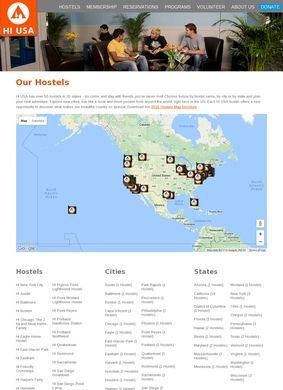
Hosteling international runs its properties in two regional blocks, and the split is geographic. The Eastern side lists hostels in Boston, Chicago, Hyannis, Martha's Vineyard, New Orleans, New York City, and Truro. The Western side lists Santa Monica, Pigeon Point, Point Montara, Sacramento, San Diego, and San Francisco.
Thirteen locations is a modest footprint for a country this size, and the choices tell you who Hosteling international is really for.
Eastern region beds
The Eastern list mixes two very different kinds of trip. Boston, Chicago, New Orleans and New York City are urban stays, the base you want when the plan is museums, music and public transit.
Hyannis, Truro and Martha's Vineyard sit out on Cape Cod and the islands, which is a summer-holiday crowd rather than a city one. One brand covering both means Hosteling international is selling to the gap-year traveler and the seasonal beach visitor at the same time.
Western region beds
Out west the pattern repeats. San Francisco, San Diego, Santa Monica and Sacramento are city and coastal-city stays. Pigeon Point and Point Montara are the outliers, small coastal spots down the California shore that are more about the setting than the nightlife. If you are stringing together a Highway 1 drive, those two are the reason to book with Hosteling international instead of a chain motel.
More than a place to sleep
The offering runs past nightly beds. Hosteling international handles group-travel accommodations, rents out event space, and runs programs that have little to do with a walk-in guest looking for a bunk.
That mix reflects its roots as a mission-driven organization, and it is where the value case gets more interesting than the nightly rate alone. The hostels fund the programs, and the programs give the beds a reason to exist beyond price.
Educational travel and scholarships
This is where the nonprofit side shows. Alongside the beds, Hosteling international runs educational travel programs and offers travel scholarships, the kind of thing a hotel chain would never bother with.
It is a genuine point of difference. A traveler comparing a bunk here against a private hostel down the street is also, quietly, backing a program that funds other people's trips. For a student traveler, that can turn a stopover into something closer to a program, with the lodging as one piece of it.
Groups and event space
Youth groups and organized parties are clearly a target. Hosteling international offers group-travel accommodations and lists volunteer opportunities for people who want to give time rather than just pass through.
For a school trip or a club on a budget, a single booking that houses a whole group under one roof is the practical draw. The event-space rentals point the same way, toward organizers who need a room as much as a row of beds.
How it books, and how it is judged
Booking with Hosteling international runs through the site, and reservations are the core action the hostels page pushes you toward. Contact is thinner. A contact page link is there, but the landing page itself carries no phone number, no email and no street address, unlike a typical business directory listing; you are sent to the contact page or to an individual hostel's own listing for anything specific. For a walk-up problem that extra hop is a mild annoyance, though each property having its own front desk and 24/7 staffing softens it.
The reputation is harder to pin down than the amenity list, partly because the biggest pile of reviews does not belong to the US arm at all. Trustpilot carries 1,138 reviews for hihostels.com, the global federation's booking site that Hosteling international is affiliated with, and the comments there run mixed: praise for clean rooms and easy booking, complaints about rates creeping up. A thousand-plus reviews is a real sample, but with the aggregate star score not surfaced, the headline is the volume, and the split between happy bookers and frustrated repeat guests is what you end up reading.
The US-specific footprint for Hosteling international is much smaller. SmartCustomer has a single review at 4.0 out of 5. WorthEPenny shows two reviews averaging 4.5 with everyone recommending. Yelp holds branch-level reviews, such as four for the Nantucket property with mixed notes on amenities and price. A Rick Steves forum thread has travelers speaking well of HI hostels against independent ones, though with no score attached. Taken together, the customer-facing scores are sparse and scattered, which makes it hard to lean on any single one.
One more layer is worth separating out, because it measures the workplace, not the guest experience. On Indeed, Hosteling international has 58 employee reviews. Glassdoor puts employee ratings at 3.9 out of 5 for work-life balance, 4.2 for culture and values, and 3.4 for career opportunities, with 84 percent saying they would recommend working there. Solid numbers, but they say nothing about your night in a bunk.
So the amenity promise is clear and the mission is real, yet the thing a budget traveler most wants to trust, the price, is exactly what draws the recurring complaint, and the strongest body of customer evidence sits under a global federation instead of under Hosteling international itself. Whether the cheap-bed pitch still holds at the counter, once those rising rates are added up, is the doubt no review count here quite settles.