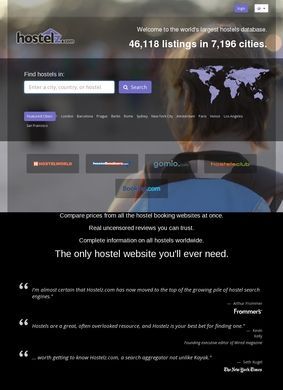
You have a week in three cities, a fixed budget of maybe ten dollars a night, and four browser tabs open across different booking sites trying to figure out where the cheapest decent bed actually is. That comparison is the exact job Hostelz sets out to do, and it is the reason a budget traveler ends up on the site in the first place. It pulls hostel listings from Hostelworld, Booking.com and other sources into one search, so the price for a given dorm in Boston or Austin shows up side by side instead of forcing you to check each platform on its own. The site does not take the booking itself. It compares, then hands you off to the partner where the bed is sold.
Behind the price comparison model
That handoff is worth understanding before you rely on it. Hostelz positions itself as the layer above the booking engines, not a replacement for them. The pitch is that it runs the most comprehensive hostel database going, indexing properties that slip past the individual platforms. So the final transaction, the cancellation terms, the customer service if something goes wrong, all of that happens on whichever site you clicked through to. What you get from Hostelz is the comparison and the discovery, which is genuinely the hard part when prices and availability shift between sources for the same room.
Scale of the hostel database
The breadth is the strongest selling point. The platform indexes a large catalogue of properties across thousands of cities and countries, and it claims to surface hostels that never made it onto one or another of the big booking sites. I cannot independently count the database, but the city-by-city browse structure backs up the scale: drill into a place and you get a list with starting prices, the sort of "Boston from $10, Austin from $9" framing that tells a budget traveler quickly whether a destination is even in range. For someone planning a multi-stop trip, that single view across sources saves real time, and it is the core reason Hostelz exists at all.
Social score for measuring atmosphere
Reviews and photos are aggregated from several sources, which gives a fuller picture than any one platform tends to show, though it also means the quality varies with wherever a given review came from. The more distinctive touch, and the one Hostelz seems proudest of, is the Social Score, a 0 to 100 rating that tries to quantify how social a hostel is, drawn from its amenities and traveler data. Whether a number can really capture the atmosphere of a common room is a fair thing to be skeptical about, but for a solo traveler who cares more about meeting people than about thread count, it is at least an honest attempt to measure what most booking filters ignore entirely.
Jobs, guides and travel articles
There is more here than search. Hostelz also runs a jobs and work-exchange section, listing hostel work and volunteering across North America and other regions, which speaks to a specific slice of the backpacker world that funds long trips by working the front desk for a few weeks. Destination guides and travel articles round it out, aimed squarely at solo and budget travelers, and the editorial side does not shy away from comparing rivals like Hostelworld directly. That willingness to write about competitors reads as more confident than most aggregators, which usually pretend the alternatives do not exist.
Reputation across blogs and forums
On reputation, the picture outside the site is modest. Trustpilot carries around ten reviews sitting at roughly four stars, so the direct user feedback is limited even if the tone is favorable. The more telling support comes from elsewhere: travel blogs such as hostelgeeks and jrpass have published positive write-ups praising the listing breadth and the price comparison, and threads on Reddit's travel community mention Hostelz approvingly as a multi-platform aggregator. Independent corroboration from people with no stake in the site counts for more than a polished homepage, and across blogs, forums and the handful of Trustpilot voices, the direction is consistent.
Contact page without phone support
Contact is the one place where expectations should be set carefully. There is a contact page and it works as a route in, but it is form-based: no phone number and no physical address turned up. For a platform that does not handle your booking or your money directly, that is a smaller concern than it would be for a hotel or a tour operator, since any payment dispute lands with the partner site anyway. Still, anyone who wants a human voice on the other end should know going in that the channel is written, not spoken.
A backpacker stitching together a long itinerary across many cities, who wants to compare budget beds without juggling tabs and does not mind being redirected to finish the booking, gets clear value from Hostelz. Someone after a single hotel in one city, or one who wants the whole transaction handled in one place with a phone line for support, is better served by the booking sites directly. Hostelz is honest about being a research and price-checking layer, and the published evidence backs that description up. How much that handoff model matters depends on how you like to book, and the site gives you enough information to make that call before you commit.