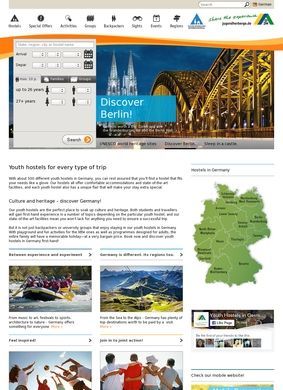
Roughly 400 hostels under one roof, with beds priced from about 18.50 to 30.30 euros a night, is the core of what the Germany youth hostel association puts in front of a visitor to its English-language site. That is a serious footprint, and it tells you straight away that this is the German arm of a much older movement: the original Deutsches Jugendherbergswerk, the body credited with inventing the hostel concept in the first place. The site connects into Hostelling International, a federation of some 4,000 hostels worldwide, so a card bought through the German side is recognised far beyond its borders.
Booking search across 400 German hostels
The booking search is really the heart of the site, and it works as such. Locations span the obvious big cities, Berlin, Hamburg, Cologne, Frankfurt, Dresden, Bremen, and a lot of smaller places besides, and the tool lets you check availability and rates before you decide. The price band quoted up front is refreshingly concrete. You are not left guessing whether a night costs 18 euros or 80; the range is stated, and it sits squarely in the budget category where most people expect a hostel to live.
Network scale for multi-city trips
Scale is the headline argument for the Germany youth hostel association, and it changes the planning calculus in a way that a single independent hostel simply cannot. Booking through a 400-property network with a shared standard means a school or a club can plan a multi-stop trip across the country, switching cities, without leaving the system. The Hostelling International link extends that logic across borders, so the same membership that gets you a bunk in Dresden is accepted at thousands of hostels elsewhere. For a movement that effectively started the whole idea, that reach feels earned.
Families, schools and educational groups
What separates the Germany youth hostel association from a plain backpacker bunkhouse is how deliberately it splits its offering by audience. Families get their own track, with children's playgrounds and programs aimed at parents travelling with young kids. School and educational groups are arguably the biggest constituency here: class trips and structured educational experiences are clearly a long-standing part of the operation, and the infrastructure reflects that.
Sports teams, conferences and rehearsal spaces
Then there are the corners you might not expect from the Germany youth hostel association. Sports teams can book training camps and team-building stays. Conference organisers are offered meeting rooms and packaged deals, which pushes the operation closer to budget event hosting than to simple overnight lodging. There is even a musical rehearsal program with dedicated practice spaces, which is the sort of niche provision that hints at decades of working out what visiting groups tend to ask for. That detail is more persuasive than any amount of general description, because nobody fits out rehearsal rooms on a whim.
Backpackers and student travellers are still squarely in the mix, so the breadth does not come at the cost of the original clientele. The Germany youth hostel association also sells membership in the DJH organisation itself, which is the traditional model: you join, you get access, and in most of the Hostelling International world that membership is what opens the network to you. A solo traveller passing through Germany and a teacher organising a class trip are using two very different parts of the same machine, and the site manages to address both without burying one under the other.
That said, breadth carries a risk the Germany youth hostel association cannot fully resolve from a website. When one organisation tries to serve toddlers, choirs, conference delegates and sports squads, the worry is always that everyone gets a competent middle and nobody gets a perfect fit. The audience-by-audience structure on the site is more careful than that worry implies, but a prospective visitor only learns the truth by booking and turning up.
Food sourcing and nature education
Food and sustainability get real attention rather than a passing mention. The Germany youth hostel association points to regionally sourced catering, weekly vegetarian menus, and healthy-eating certifications, which is a meaningful step for an operation feeding large groups of schoolchildren and teams day after day. Outdoor and nature education sits alongside this, including herbology courses and various open-air activities tied to locations outside the cities.
Regional catering for school groups
This is where the network reads less like a lodging provider and more like an educational institution that happens to own a lot of beds. The sustainability and nature programming lines up logically with the school-group focus and the rural hostels that would naturally host that kind of learning. Whether every one of the 400 sites delivers the same standard of catering and certification is the open question, and the site does not really answer it. A national headline about regional sourcing is one thing; what lands on the plate at a small hostel in a particular region is another, and a prospective group leader would want to confirm it property by property.
Language options for cross-border visitors
The trilingual presentation the Germany youth hostel association offers, English, German and French, is a quiet indicator of who travels here: a lot of the audience is school groups and visitors from neighbouring countries, and the French inclusion in particular makes sense given cross-border educational exchange. It is a practical choice, not a cosmetic one.
The substance is genuinely there, and the Germany youth hostel association is plainly more capable and more varied than the word "hostel" implies to most English speakers. Membership, the booking tool, the price clarity and the audience-specific tracks all point to an organisation that has thought hard about how people actually use it. Where it gets harder to judge is consistency. A network as large as the one the Germany youth hostel association runs, serving constituencies as different as toddlers, touring choirs, conference delegates and football squads, lives or dies on whether the individual hostel matches the national promise. A single search-and-book site can only take the planning so far before the real variable, the specific property, takes over.