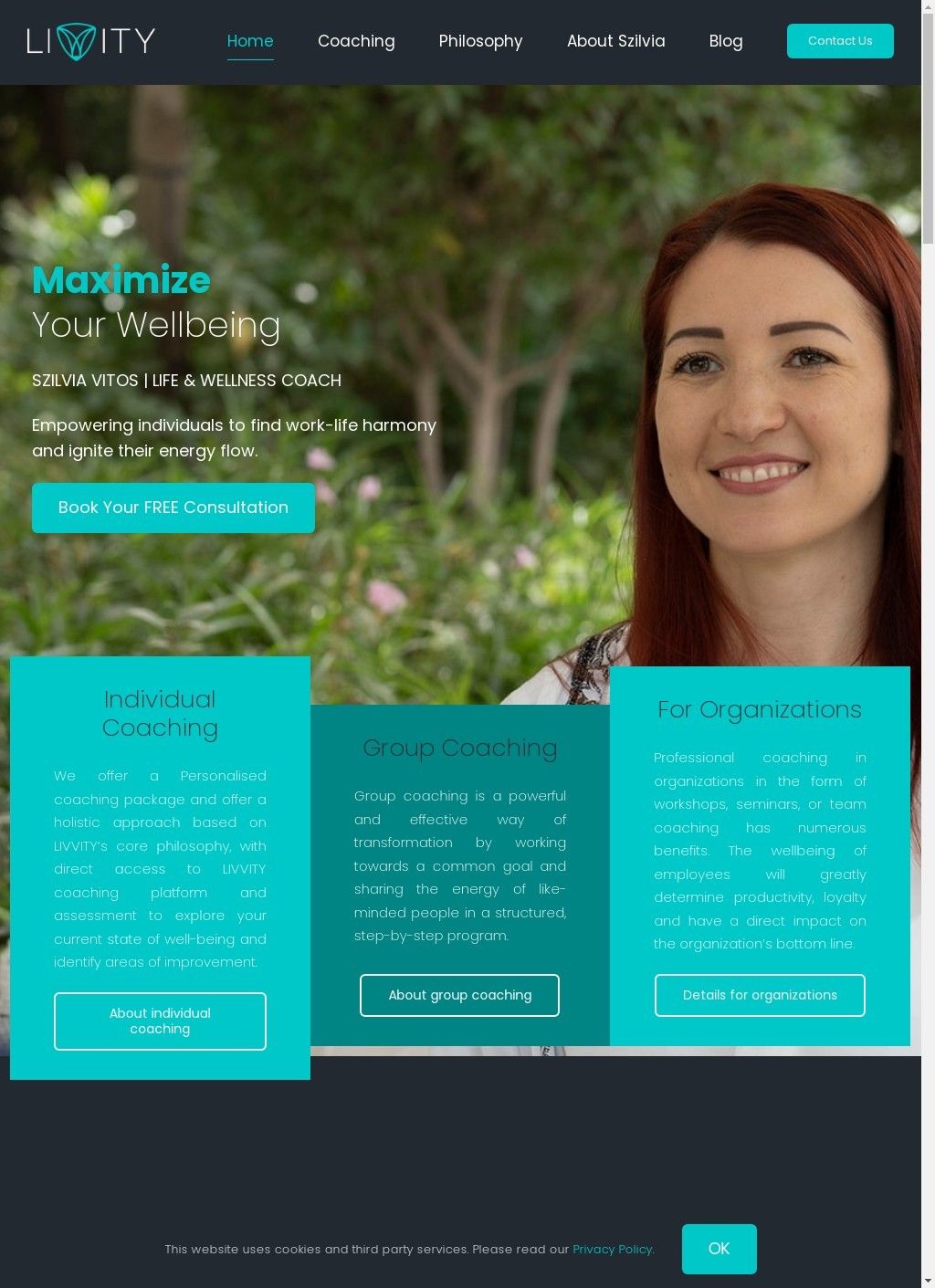
LIVVITY does something unusual for a solo coaching practice: it built its own psychometric intake before selling anything. Three tools sit at the front of the process, the LIVVITY Wellbeing Wheel, an Emotional Intelligence assessment, and MapsTell, a behavioural profile instrument. Most coaches at this scale ask discovery questions over a call and take informal notes. Starting with structured baseline data changes the dynamic; a coach and client both see a defined picture from the first session, and have a fixed starting point to revisit across subsequent work. That design choice shapes everything else about how LIVVITY operates.
Three assessment tools shape the intake process
LIVVITY is based in Dubai and led by Szilvia Vitos, a Certified Transformational Health Coach and Life Coach (CTNC). The declared focus is senior corporate leaders managing pressure between high performance at work and keeping the rest of their life functional. That framing is narrower and more specific than coaching websites in this category typically attempt, and LIVVITY holds it consistently through service descriptions and case framing, carried through into the headline copy. The four-pillar model, Mindset, Heartset, Healthset, and Soulset, maps broadly onto cognitive patterns, emotional capacity, physical health, and personal values. Each pillar can be addressed separately or treated as part of an interconnected whole, depending on what a client brings to the process.
Leadership focus and the four-pillar model
LIVVITY offers 1:1 coaching as the flagship product, group programs for professional cohorts, and corporate training packages positioned as a distinct track. The corporate work is framed as a separately designed product tailored to the commissioning organisation, rather than repackaged individual sessions sold in bulk. Companies buying coaching for leadership teams bring procurement questions, confidentiality requirements, and outcome metrics that solo clients do not carry, and LIVVITY's site reflects that difference in how each track is described. Whether the actual programme delivery lives up to that separation is harder to assess from the outside, but the structural distinction is clear in the positioning.
Individual coaching, group programs, corporate training
Below the paid tiers, LIVVITY runs workshops, live events, and a blog covering wellness and leadership topics. A free downloadable guide built around twenty practical strategies for energy flow rounds out the lower end of the content offering. Someone who is not yet ready to commit financially can take the guide away and form a view on whether the approach fits their situation. A free discovery consultation is also bookable through the site. The overall architecture is deliberate: free content and blog at the base, then a discovery call, then group, individual, or corporate engagement depending on what depth and context a prospective client is looking for.
Free resources and discovery calls
Practices that lead with high-ticket offers alone suit people who have already decided on a provider and are choosing between options. LIVVITY's free guide and open discovery call suit people who are interested but not yet persuaded, a wider and earlier slice of the eventual client pool. Among coaching and wellbeing services in a business directory, that entry point design is genuinely less common at this scale. It also shifts the evaluative burden: a prospective client can get a real sense of the approach before committing to a paid session, which is a meaningful advantage when the coaching model is as credential-specific and assessment-heavy as LIVVITY's.
Entry point design for uncertain prospects
LIVVITY maintains active LinkedIn and Instagram accounts under the livvitywellbeing handle, and a contact page is accessible through the site. No phone number and no street address appear on public-facing pages; location is stated simply as Dubai. The setup assumes a prospective client will book the free discovery call as the first point of real contact. For a practice built around scheduled one-to-one sessions, a calendar booking link is a sensible front door. Anyone who prefers a direct conversation before making any scheduling commitment will find the current setup limited on that point, since there is no phone line or email address immediately visible outside the booking flow.
Contact methods and booking approach
Testimonials on the coaching and workshop pages describe specific outcomes and professional situations, framing results in context rather than generic praise, which makes them more useful as reference points. They live entirely on LIVVITY's own site. A search of the practice did not surface ratings or reviews on any external platform. For a small Dubai-based solo coaching practice, this is not unusual, and the number does not need to be padded: the external review record is simply zero, which is worth knowing going in.
Testimonials without external verification
The CTNC credential is specific and verifiable through the certifying body. The three named assessment instruments and the deliberate split between individual and corporate tracks give LIVVITY more structural clarity than is common at this size of practice. Where the picture stays incomplete is on outcomes: the testimonials describe the coaching experience positively but do not report measurable before-and-after data, and without any external platform footprint the self-reported claims have nothing to push back against them.
Framework clarity versus measured outcomes
The four-pillar model and the intake tools are well-designed and clearly described. How they translate to sustained results for any given client is a question the listing cannot resolve, and neither can the testimonials alone. What LIVVITY offers is a coherent framework backed by a named credential and a sensibly structured entry process; what the practice has not yet built is an independent record of outcomes at scale.
Business address
LIVVITY
Dubai,
UAE
United Arab Emirates
Contact details
Phone: +971 55 123 3223