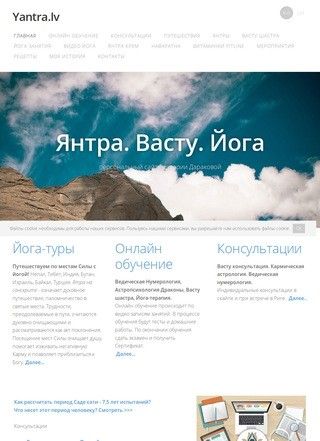
Yantra.lv is a Russian-language spirituality and wellness platform run out of Riga, Latvia, built around Vedic and astrological teaching for a Russian-speaking audience. The core of the site is paid online education: structured courses in astro-psychology, Vedic numerology, Vastu Shastra, and yoga therapy. These are not loose video collections. Each course runs through pre-recorded lessons paired with tests, homework, and a certification exam at the end, which puts Yantra.lv closer to a graded program than to the usual stack of watch-and-forget clips. It is a format that takes more effort to maintain than most comparable schools bother with.
Structured courses in Vedic studies
Alongside the courses sit one-on-one consultations, and this is where the site shows its specific point of view. The astrology work is karmic, organized around the lunar nodes (the so-called Dragons), so a session reads someone's chart through that particular lens instead of a generic horoscope. Vastu consultations deal with harmonizing a home, and there is Vedic numerology on offer too. Yantra.lv runs sessions over Skype or in person in Riga, a sensible setup for a teacher whose students are scattered across Russian-speaking countries but who also keeps a local practice.
Karmic astrology and lunar node readings
The travel side gives Yantra.lv its most distinctive texture that a purely digital school would not have. It arranges group retreats to Nepal, Tibet, India, Bhutan, Sri Lanka, Bali, Egypt, and Turkey, presented as trips to places treated as spiritual power sites. That is a long and ambitious list of destinations, and it tells you the operation is meant to extend past a webcam and into shared physical journeys. Whether those trips run on a fixed calendar or assemble when enough people sign up is not something the landing page settles, so a prospective traveler would need to ask before counting on any particular date.
Spiritual retreats across multiple continents
Then there is the retail layer. The site sells a Yantra.lv-branded cream and carries the Fitline range of vitamins and supplements. Bundling physical products with spiritual teaching is a common move in this corner of the wellness market, and it is worth flagging plainly: Fitline is a multi-level marketing line, so anyone buying into that part is stepping into a different commercial model than a single course purchase. The teaching, the consulting, and the product sales are three separate businesses sharing one roof, and a visitor should read each on its own terms.
Branded products and supplement sales
This is the honest sticking point. Yantra.lv hosts its own testimonials section, with customer accounts of the courses and consultations. Internal testimonials are fine as a starting point, but they are curated by the site itself, so they cannot do the job that independent reviews would. A search for outside feedback tied specifically to Yantra.lv turns up nothing usable. The reviews that surface on major rating platforms all belong to unrelated companies that happen to share the Yantra name, including a software firm and an IT staffing outfit, so they say nothing about this practice in Riga.
Where can you find independent verification?
That absence is not proof of anything bad. A niche, Russian-language spiritual school operating largely through closed course groups and word of mouth would naturally leave a light footprint on Trustpilot or Google. Still, it changes how a careful person should approach the paid offerings. Listed in any business directory, Yantra.lv would show up with almost no independent trail, which means the trust you extend rests on the teacher's own materials, the depth of the free-facing content, and any direct conversation you can have before handing over money.
Limited phone and address information
Contact is the other place where Yantra.lv asks for a leap. The landing page shows no phone number and no street address, and the route in runs through social channels (Facebook, Instagram, YouTube) plus Skype for booking sessions. The social accounts are active, which is reassuring in the sense that someone is clearly present and posting. For a service involving paid courses, personal consultations, and international travel, the lack of a visible phone line or a posted Riga address is a real gap. Booking a retreat to Bhutan through Instagram messages is workable, yet most people would want a firmer point of contact before wiring funds for a trip abroad.
Free video content from the teacher
The Facebook, Instagram, and YouTube presence does more than open a contact channel. A YouTube channel in particular lets a curious visitor watch the teacher explain ideas in their own words, for free, before deciding whether the paid astro-psychology or numerology track is worth it. For an offering built almost entirely on trust in one person's expertise, that window is more useful than any testimonial block could be.
Coherent Vedic framework with serious structure
What Yantra.lv does well is coherence. The astrology, the Vastu, the numerology, the yoga therapy, and the retreats all sit inside one consistent Vedic framework, taught by what reads as a single practitioner with a defined method. That focus is a genuine strength next to the scattered, everything-for-everyone spiritual sites that are easy to find online. The course structure, with its tests and certification, reflects more seriousness than the format usually carries.
Sparse public record and MLM connections
The weaknesses are the mirror image: no external reviews to check, opaque contact details, and a product arm that pulls the brand toward MLM territory. None of these sinks the offering outright. A Russian-speaking reader already drawn to Vedic astrology, Vastu, or numerology, and comfortable judging a teacher through their videos and social posts, will find Yantra.lv substantive and unusually structured. Someone who needs independent reviews and a published phone number before paying will find the public record too sparse to act on. The published evidence, taken honestly, supports cautious interest rather than quick commitment.