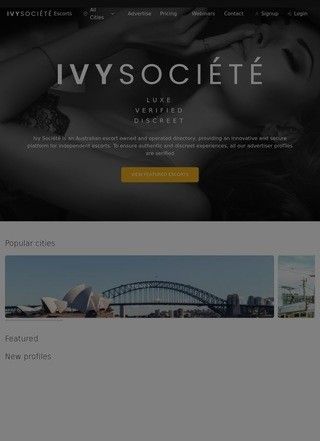
Someone in Brisbane trying to book an independent escort tends to hit the same wall: dozens of scattered ads, no clear sense of who is a genuine person, who set the price, or whether the photos belong to the person who actually answers the phone. Ivy Societe is built to clear that wall. It is an Australian-owned and operated platform that gathers independent adult service providers into city-sorted profiles, so the search starts with a list you can scan instead of a forum thread or a classifieds dump. The premise is simple, and Ivy Societe executes it, at least structurally, with more care than the category usually manages.
City and suburb browsing structure
The geographic spread is the first thing that reads as serious. Profiles are grouped by Sydney, Melbourne, Brisbane, Perth, Adelaide, the Gold Coast, Newcastle, Canberra, the Sunshine Coast, and Darwin, and within a city you can narrow down further by suburb. For a country where a half-hour difference in location decides whether a booking is convenient or pointless, suburb-level browsing is the practical detail that separates a usable site from a vanity page.
Sorting in smaller markets
A client in the outer suburbs of Melbourne is not forced to wade through every CBD listing to find someone nearby, and that single filter does a lot of quiet work. The smaller markets like Darwin and Canberra have naturally fewer listings than Sydney or Melbourne, but the structure holds regardless. When a pool is limited, good sorting does more work than raw volume, and Ivy Societe gets that right.
Profile fields and pricing tiers
Each profile on Ivy Societe carries a consistent set of fields: the provider's name, age, city, a short tagline they have written themselves, an availability marker, and an advertised hourly rate in Australian dollars. The "available now" flag turns out to matter, because timing is half the frustration in this category. Someone deciding on the night wants to know who can actually see them, not who advertised once last month. Rates on the visible listings run from roughly A$250 up to about A$1,000, and profiles are split into a standard tier and an "Elite" tier. The people advertising set their own rates and inclusions, which the platform is upfront about. Ivy Societe is not pricing the service or taking a cut of the negotiation; it is hosting the listing and letting the provider define the terms.
That self-described "escort-owned and operated" framing shapes how the whole thing presents itself. Ivy Societe leans on verification and safety as its central pitch, positioning itself as a vetting layer between a client and a provider instead of an anonymous board where anyone posts anything they like. Whether the verification runs as deep as the wording implies is something a client can only judge once they start contacting profiles, but the intent is stated plainly and the two-tier structure at least points to some internal sorting going on. There is also a reviews section, hosted on the site itself, where clients can leave written feedback on individual providers.
Reviews hosted on the site
In a corner of the internet where trust is the scarcest currency, a built-in review channel is a sensible design choice, and it keeps that feedback attached to the listings instead of scattered across third-party forums. Its real value depends on whether those reviews stay honest and unfiltered over time, and whether Ivy Societe moderates them with a light enough hand to keep them believable.
Global reach beyond Australia
The scale of the operation is worth flagging. Ivy Societe is not Australia-only. The same platform runs listings for the United States, Canada, New Zealand, Singapore, Hong Kong, and the United Kingdom, with the /au path serving as the Australian slice of a larger whole. That breadth cuts both ways. It points to a real business with infrastructure behind it, not a weekend project that vanishes in a month, but it also means the Australian section is one storefront among several. A wide footprint is not the same as deep local coverage, and a prospective user should check that listings in their own city are populated and current before treating the platform as a primary source.
On reaching the company itself, the picture is sparse. There is no phone number and no physical address anywhere on the front of the site, and the operators give themselves no obvious central point of contact. The design deliberately routes you toward individual provider profiles, where the actual booking conversation happens, rather than offering a single business contact page.
Limited paths to support
For a platform of this kind that is a defensible structure, since the transactions are between client and provider, not client and Ivy Societe. Even so, a visitor who wants to ask the operators a direct question, report a problem with a listing, or query how verification works has very little obvious path to do so. That is a fair mark against it. Ivy Societe does maintain a presence on X and Instagram, which gives some public-facing channel, but a social handle is not the same as accountable customer support.
How reliable is outside feedback?
The outside reputation is where caution is warranted. On Trustpilot the platform has a single review and no aggregate rating that turns up in search. Searchfrog, an Australian listing aggregator, carries a short description of the business but attaches no rating and no review count. There are no Google, Yelp, or BBB entries to be found at all. For a platform spanning seven countries, that is a remarkably quiet external footprint. It does not prove anything is wrong.
Plenty of legitimate operations in sensitive categories keep a low public profile and steer clear of mainstream review sites for obvious privacy reasons, and clients in this space are rarely keen to leave a named trail. The practical effect is still the same: a new user cannot lean on a body of independent feedback to confirm whether the verification and safety claims are accurate.
So the verdict lands in the middle. As a tool, Ivy Societe is well constructed for what it sets out to do. The city-and-suburb structure, the standardized profile fields, the transparent provider-set pricing, the availability flags, and the on-site reviews together make for a cleaner, safer-feeling way to search than what this category usually offers. The candour about advertisers setting their own rates and inclusions counts in its favour, and the multi-country operation points away from a fly-by-night setup.
Set against that are two real gaps: the near-absent third-party reputation and the lack of any clear route to the people running Ivy Societe. Anyone using Ivy Societe should treat the verification and safety promises as claims to test in practice rather than facts already settled. The published record is good enough to justify a closer look; it is not yet deep enough to justify much more than that.