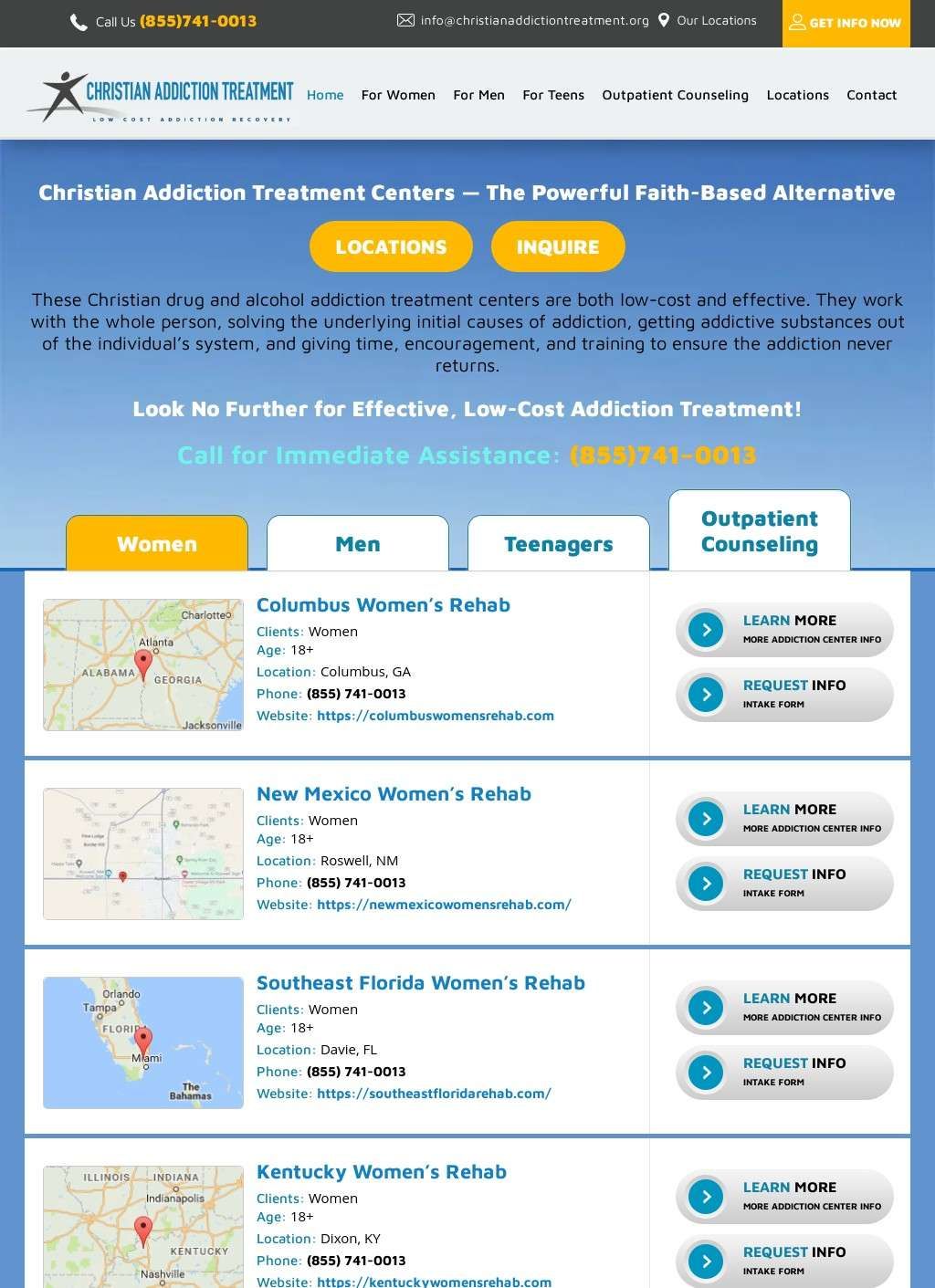
Christian Addiction Treatment Centers is a faith-based residential and outpatient addiction program running across Florida, Georgia, Kentucky, New Mexico, and South Carolina. It operates under the Adult and Teen Challenge umbrella, a non-profit that has been at this for more than sixty years, and it takes both the treatment model and the pricing philosophy from that parent network.
Program structure and duration
The residential program runs roughly a year. In a field where four-week stays get marketed as full recovery, a twelve-month commitment sits at the far, serious end of the spectrum, and Christian Addiction Treatment Centers states it plainly instead of hiding it behind an intake call. Adults eighteen and older enter gender-specific facilities. The outpatient track, Christian counseling, opens to anyone fifteen and up. Two paths, two sets of intake criteria, described separately, so nobody has to guess which one applies to a fifteen-year-old versus a thirty-year-old. Competing listings tend to leave that lower age floor off entirely.
Residential track for adults eighteen and older
The approach is openly Bible-centered: healing framed as the body and spirit treated through Christ, aimed at root causes instead of symptoms. There is no hedging in the language. Someone who wants a secular program will know it within the first paragraph. Someone hunting specifically for a Christian model will not have to dig for it. In a category where the spiritual framing often hides in the fine print and only emerges once you are on the phone, putting it on the surface is the honest move.
Faith-centered healing through Christ
Structured community living and peer mentorship are the daily mechanics. People further along in recovery live alongside and mentor those earlier in it, a model carried straight over from Adult and Teen Challenge. The non-profit structure has a blunt consequence for the bill: Christian Addiction Treatment Centers positions itself well below conventional residential rehab pricing. Over a year-long stay, that spread is the sort of number a family already shopping private treatment will notice immediately, and the site leads with it rather than parking it in an FAQ.
Community living with peer mentorship
Five states, named towns, street addresses. Florida runs Jacksonville, Pensacola, and Fort Myers. Georgia covers Columbus and Dublin. Kentucky operates two facilities out of Dixon. New Mexico serves Roswell and Tijeras. South Carolina lists Columbia. Each entry carries an address, so geography is answerable without dialing anyone, which is not the norm here.
Locations across five states
The site is laid out the way someone actually researches this decision under pressure. There are separate pages for women's and men's programs, for outpatient, and a why-Christian-rehab explainer written for a visitor arriving cold. That explainer is the smart inclusion: the first thing a frightened newcomer wants to know is exactly what it answers, and it sits in the navigation instead of being buried three clicks deep in the About copy. A testimonials section fills out the rest, pulled from patient accounts on the program's own pages. The whole structure reads like the people behind it understand their visitors are usually in an acute, narrow decision window, not browsing for fun.
Inside the website navigation
A phone number sits on every page. An email address is published. A "Get Info Now" prompt trails the visitor throughout. When the gap between deciding to ask for help and actually following through can slam shut in an afternoon, keeping the contact path in peripheral vision is a functional decision, not decoration. The street addresses live in the locations directory too, so an in-person walk-in to a specific facility is possible without dialing a central line ahead of time.
Contact options on every page
For verdict purposes, most of what a family needs from Christian Addiction Treatment Centers is already on the page and does not require a call to assess: a year-long duration, gender-specific structure, the fifteen-and-up outpatient floor, five states and named cities, a clearly below-market price position, and an unmistakable faith framework. Those facts can be weighed as they stand. The faith-centered model is either a fit or a deal-breaker, and the site makes that determination easy in the first paragraph. What no listing can settle for you is whether a year inside a Christ-centered residential community is the right shape of help for a particular person; that is a judgment, not a missing data point.
From independent reviews to direct facility questions
On outside reputation, a standalone search turns up no independent rating count for Christian Addiction Treatment Centers under its own name across the usual review platforms. The on-site testimonials are the program's own. The Adult and Teen Challenge parent does carry third-party reviews, and those sometimes attach themselves to the Christian Addiction Treatment Centers name in search results, but they belong to the network, not to any one facility here. The sensible reading is to take the parent's record as context for the model and not as a score for Jacksonville or Roswell specifically, and to put pointed questions about intake, current bed availability, and the exact mechanics behind the below-market pricing to whichever facility a family is actually considering. The location pages hand over a direct number for precisely that conversation.