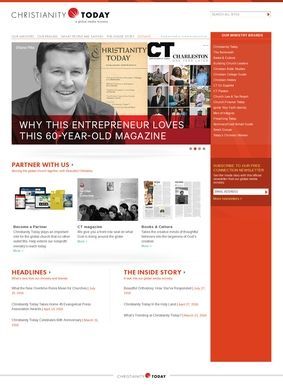
ChristianityToday.com carries a print pedigree that runs back seven decades, which makes it older than several of the movements now argued over in its own pages. By the organization's own count it reaches around 40 million people a year, 38 percent of them outside the United States, with roughly 1.5 million reading in a language other than English. Those are the numbers of a global newsroom, which is a strange thing for a mid-century evangelical magazine to have become.
The reach also skews young. The organization reports that about 40 percent of its audience falls between 18 and 34, a detail that cuts against the assumption that a legacy religious title mostly serves the people who subscribed decades ago.
What sits behind ChristianityToday.com is a media and publishing house, not a single website. It reports and comments on faith, culture, and theology, and it does so across print issues, the site itself, podcasts, books, and a mobile app. The through-line is a stated aim to give a biblical reading of the news and the culture, aimed at two audiences at once: clergy running congregations and individual believers trying to think through current events.
What lands on the page
The site reads like a broadsheet with a theology desk bolted on. Its main sections run across News, Ideas, Theology, Church Life, Culture, and History, and the split tells a reader what kind of publication this is: part journalism, part argument, part record-keeping. A visitor arriving for a report on a denominational split and one arriving for a long essay on doctrine are both accommodated without either feeling like an afterthought.
Audio has grown into a channel of its own. ChristianityToday.com reports around 6.5 million podcast listens a year, which puts its shows on the same footing as its written work instead of treating them as a promotional sideline. A reader who commutes gets the same reporting without needing a screen.
Print has not been left behind in the move online. ChristianityToday.com still runs print and online publications side by side, and the printed magazine remains a reference point that anchors the brand for longtime subscribers even as the digital sections carry the daily traffic. The mobile app ties the pieces together, letting each reader assemble a personalized feed from sections that would otherwise sit in separate corners of the site, so a busy pastor and a curious student can pull two very different versions of the same publication onto their phones.
News, Ideas, and the Theology desk
The News section is where the organization behaves most like a wire service with a specific beat. It covers the events that move through churches and religious institutions, from leadership scandals to legal fights to global mission work, and it reports them at length instead of the quick-hit style of a social feed. Ideas is the commentary wing, the place for argued opinion pieces on where faith meets politics, ethics, and culture.
Theology is the deepest water, closer to a seminary common room than a news page, and Church Life turns the focus toward the practical business of running and belonging to a congregation.
Culture covers books, film, and music through a religious lens, and History gives the whole thing a long memory, tracing how the church arrived at its present arguments. Read together, these sections explain why ChristianityToday.com can hold both a breaking-news reader and a graduate student. The first thing I look for on a site that mixes reporting with opinion is whether the two are kept visibly apart, and here the section labels do that work honestly, so a reader knows when they are getting facts and when they are getting a case.
What CT Pastors offers clergy
A large slice of ChristianityToday.com is built for people with a pulpit. CT Pastors gathers field guides and preaching tools aimed squarely at clergy: material for building a sermon, running a staff, and handling the recurring problems of church leadership. The Leadership Journal sits in the same territory, a resource for the working minister rather than the person in the pew.
This is the part of the operation an ordinary reader might never notice, and it is arguably where ChristianityToday.com does its most specific work. General religion coverage is available in many places. Practical, tested guidance for the person actually preparing next Sunday's sermon is a narrower and more useful thing, and pitching part of the site directly at that reader gives the whole publication a professional spine that a purely consumer title would lack.
Who it serves and how it holds together
The two audiences pull the publication in slightly different directions, and ChristianityToday.com manages the tension by keeping distinct doors into the same building. A pastor comes in through CT Pastors and the Leadership Journal. A layperson comes in through News and Culture. The mobile app narrows the gap further by letting each reader curate a personalized stream, so the seminary-level theology and the film reviews do not have to compete for the same front page.
The scale of the audience, with its 38 percent outside the United States and more than a million non-English readers, means the coverage cannot assume an American frame of reference and get away with it. That international spread is one of the clearest things separating ChristianityToday.com from a domestic church newsletter, and it shapes what the News desk chooses to follow. A story about persecution in one country or a theological dispute in another lands hard with a readership that large and that scattered, and the History section gives those stories a longer frame than a daily feed usually allows.
The operation supports itself the way a lot of mission-driven media now does, on more than one leg. There is a store at store.christianitytoday.com selling books and commentaries, and a giving page where readers can donate to fund the journalism directly. Books and printed commentaries extend the brand past the daily article and into the reference shelf, which is a sensible move for a publisher whose readers are inclined to study rather than skim.
The commerce and the donations together suggest a subscription-and-support model doing the work that advertising alone no longer can, and it lets ChristianityToday.com keep reporting that a purely ad-funded site would struggle to sustain.
Whether all of this holds up depends on where a reader stands. An evangelical looking for coverage that shares their starting assumptions will find ChristianityToday.com congenial; a reader outside that tradition should treat it as an informed partisan on the questions where faith and politics overlap, which the Ideas section makes little effort to hide.
The reporting in News is the part that travels furthest beyond the core audience, since a well-sourced account of a church split or a court ruling is useful regardless of the reader's own beliefs. That is the section that has done the most to give the publication a reputation past its own pews.
Against a named alternative the shape of ChristianityToday.com comes into focus. A reader weighing it against The Gospel Coalition, another well-known evangelical presence online, is really choosing between two different instincts: The Gospel Coalition leans toward a network of devotional and theological essays written from a tighter doctrinal position, while ChristianityToday.com puts a working newsroom at the center and lets original reporting carry the load that the alternative hands to reflection.
Someone who wants daily coverage of what is happening across the global church, with the sermon tools and the long theological pieces available on the same site, has the stronger case for starting here; someone after a more uniform doctrinal voice may prefer the alternative. Both are serious. They simply answer different questions.