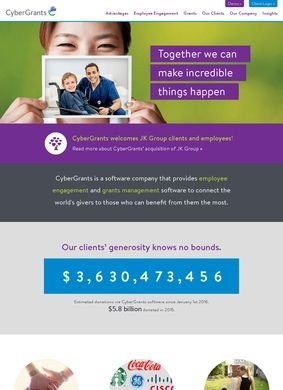
CyberGrants is a grants-management software product, now folded into the Bonterra Tech portfolio and reached through that company's Corporate Social Responsibility pages. The original CyberGrants web address no longer opens a site of its own. It redirects, by way of an impact subdomain, to Bonterra's CSR product page, where the tool is listed as CyberGrants: Grants Management.
Anyone typing the old address expecting the independent company will land somewhere quite different. The redirect itself is worth a pause: a brand that people bookmarked and typed for years now hands them quietly to another company's marketing page, with no landing note to explain the change.
What they find is a product pitched at corporate giving teams. Bonterra markets its CSR software as enterprise-grade grantmaking paired with a modern employee-engagement experience, and CyberGrants is the grantmaking engine inside that bundle. A companion product called Deed handles the employee-impact and volunteering side with an AI-driven angle, so a large employer could pair CyberGrants with Deed and run both the money going out in grants and the staff activity behind it from a single vendor.
For a corporate social responsibility team juggling a grants budget, a matching-gifts programme, and thousands of employees logging volunteer hours, that consolidation is the pitch. Grants management, in practice, covers the whole cycle: taking in applications, routing them through review and approval, paying out awards, and producing the compliance reporting a public company expects at year end. CyberGrants is built to carry that load at volume.
The scale claims are large. The page says the platform is trusted by half of the Fortune 100 and reports platform-wide totals of twenty-eight billion dollars in giving, including roughly nine billion in grants, close to a billion in employee donations, and over sixteen million volunteer hours. CyberGrants specifically is credited with handling a quarter of all corporate giving that moves across the platform.
Those are numbers that only make sense at enterprise scale, and they set expectations a small nonprofit tool never would. They also frame who this is for: not a two-person foundation, but a company cutting hundreds or thousands of grants a year and needing to track every one through approval, payment, and reporting. Whether a buyer reads a quarter of all corporate giving as reassurance or as a warning that they will be a small account among giants depends on the size of their own programme.
CyberGrants does not stand alone in the catalogue. Bonterra's wider portfolio, laid out in the site navigation, runs across fundraising and engagement tools such as EveryAction, Network for Good, DonorDrive, Mobilize and GiveGab, a capacity-building product called Jumpstart, and case-management software under the Apricot name, including a version built for government. EveryAction and Network for Good sit on the nonprofit fundraising side, DonorDrive and GiveGab lean toward peer-to-peer and community giving, Mobilize organises volunteers, and the Apricot line handles case management for social-service agencies.
Seeing CyberGrants sit among all of that clarifies its place: one specialised piece of a broad social-good software company, aimed squarely at the corporate grantmaker while sister products chase nonprofits, fundraisers, and public agencies. A buyer should understand they are signing with a large platform vendor, with everything that implies about support, roadmap, and the pace of change once a smaller product gets absorbed into a bigger company's priorities.
For someone evaluating the tool, the supporting material is reasonable. The site carries a resources library with insights and learnings, a blog, events and webinars, case studies, and a training hub branded Bonterra Academy, plus a pricing section and separate login portals for each product, CyberGrants among them. A prospective buyer has documentation to read and a clear place for existing customers to sign in, and the case studies in particular give a corporate reader something concrete to measure their own programme against.
Bonterra Academy signals a vendor that expects customers to train staff on the system, which is a quiet admission that the tool takes some learning.
Getting a straight answer as a prospective buyer
The harder part is reaching a person before becoming a customer. Nothing in the reachable page content lists a phone number, an email address, or a physical office. The routes forward are a Request a Demo button and a Talk to an Expert prompt, both of which put a prospect into a sales pipeline, plus login and login-support links meant for people who already hold accounts on products like CyberGrants.
For a category this expensive and this consultative, that is normal, but it is worth naming plainly, because it shapes how a first-time evaluator meets the brand before a single feature has been shown.
That gatekeeping is consistent across the site. Case studies, webinars, and the resources library are all open to browse without logging in, so information is not the scarce resource, a live person is. A visitor can read for an afternoon and still not find a way to ask a specific question without first booking a demo.
The demo wall and login support
A curious buyer cannot simply pick up the phone or fire off an email to a published address. Everything funnels through a demo request, and the sales conversation is the front door.
For existing customers the login-support path covers account and access issues, so the gap hits prospects harder than clients, and it hits the merely-curious hardest of all. Someone who wants a quick, low-commitment answer about whether CyberGrants fits their programme has to agree to a sales touch to get it. Buyers used to trying software before they talk to anyone will feel that wall, and it sits awkwardly beside a Trustpilot reviewer's exact complaint that there was no one to reach.
What software reviewers report
Outside opinion on CyberGrants is scattered and mixed, and it needs sorting by type before it means anything. On the customer side, TrustRadius lists reviews of the tool as a grants-management solution, and G2, SoftwareAdvice, Financesonline and Shortlister all host user reviews as well. The sentiment on CyberGrants splits the way it often does with heavy enterprise software: praise for centralised tracking and general ease of use, set against complaints about a clunky interface and slow fund distribution.
That second gripe is not cosmetic: slow fund distribution means grantees waiting longer for money they have already been promised. For a compliance-driven buyer, the tracking praise is the headline feature working as intended, while the interface and payout gripes are the daily friction that only shows up after signing. None of those pages showed a clean aggregate star score in the results reviewed, so a reader gets impressions, not a single tidy number.
Then there is the noisier material a careful reader should keep separate. Trustpilot has drawn only four reviewers in total for CyberGrants, one of whom left a negative note complaining that there was no customer-support link or telephone contact, which echoes the reachability issue on the site itself. Sitejabber shows a single one-star review, but its text is an employment complaint about promotion practices, not a verdict on the software. Glassdoor, an employer-review site, reports that seventy-six percent of employees would recommend working there, with marks around four out of five for work-life balance, culture, and career opportunities.
Those Glassdoor and Sitejabber entries describe life as a worker, not the experience of buying or running CyberGrants, and folding them into a product judgement would mislead a reader into rating a workplace dispute as a software flaw. The safer habit is to read each platform for what it actually measures before trusting any score it carries.
Strip the employment chatter away and what remains for a prospective buyer of CyberGrants is a sparse, mixed customer record: a handful of software-review profiles with no headline score, a product generally called functional yet faulted for a dated interface and sluggish payouts. For a tool said to move a quarter of the corporate giving on a platform that counts half the Fortune 100 as clients, the Trustpilot tally for CyberGrants tells its own small story. Four people have bothered to weigh in, and one of them logged on mainly to say there was no one to call.