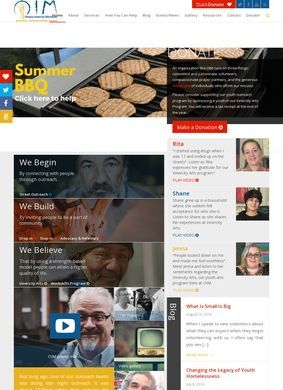
Ottawa Innercity Ministries is an interdenominational Christian charity in Ottawa, Ontario, that has worked with people affected by homelessness, poverty, and social injustice for more than 35 years. The site does not lead with mission statements. It leads with what the organization does on the street, and that is the right call, because the work is concrete and the numbers behind it are specific.
Street outreach and program breakdown
The headline figure is hard to ignore: in 2025 Ottawa Innercity Ministries logged 33,443 connections with street-involved individuals. That is the kind of count an organization keeps when it is measuring actual contact rather than projecting ambitions. Street Outreach is the core of it, with sandwich runs and supply distribution carried out where people are. Door Outreach extends the same idea indoors. Around those two anchors sit a set of programs that each address a different need, and none of it collapses into one vague pledge to help.
Programs for veterans
A few of these stand out for being unusually specific. Operation Road Home is a veterans-focused housing initiative, paired with a second stream, Innercity Veterans Outreach and Support, that keeps the veteran population in view as a group with its own circumstances. Pointing two separate programs at former service members tells you Ottawa Innercity Ministries noticed a pattern in who it was meeting and built a response around it.
From street relief to arts and language classes
Then there is Innercity Arts, a community arts program, which is a less obvious choice for a charity built on emergency basics. Running creative programming alongside sandwich runs suggests Ottawa Innercity Ministries treats the people it works with as more than a logistics problem to be solved with calories and blankets. The Winter Wear drives handle the seasonal reality of an Ottawa winter, and the ESL Classes for people who do not speak English point to a newcomer population that needs language access before almost anything else falls into place. None of these reads as filler. Each one maps to a real subgroup that Ottawa Innercity Ministries clearly keeps running into, and the variety is what makes the listing convincing instead of padded.
That range is the strongest argument for the place. A charity can do one thing repeatedly and do it well. Ottawa Innercity Ministries instead runs a spread of programs that fit together: immediate relief on the street, housing help for a specific cohort, language classes, seasonal clothing, and arts. The breadth could read as scattered, but the throughline is consistent, and the 35-plus years of operation behind Ottawa Innercity Ministries suggest something sustainable rather than improvised.
Ways to donate and connect
Donating is set up to be easy and to suit different habits. The site offers Interac, PayPal, and CanadaHelps, which covers the people who want a fast e-transfer and the ones who prefer a receipted donation through a recognized charity platform. There is a volunteer sign-up section for those who would rather give time, and a blog of community stories that does the quiet work of showing outcomes instead of only asking for money. Links out to Facebook, Instagram, LinkedIn, and YouTube round out the public footprint.
Checking credibility before you give
For anyone weighing whether a charity is legitimate, the registered Canadian charity number, 140888736RR0001, is the detail to check first. A registration number means the organization files with the Canada Revenue Agency and that a donor can verify its standing independently, which is the single best protection against giving to something that only looks like a charity. The presence of a CanadaHelps profile reinforces the same point. These are the credentials a careful giver should look for, and Ottawa Innercity Ministries puts them out in the open where they can be checked in a minute.
Reaching out by phone or in person
Contact information is fully visible and unambiguous. There is a street address at 391 Gladstone Ave., a phone number, and an email, all on the site. For a donor or a volunteer, a physical Ottawa location plus a direct line removes the friction that sometimes makes small charities feel unreachable. You can find them, call them, or walk in.
Outside opinion is limited, and it is worth being honest about that. Nicelocal shows a 4.9 rating, though the number of reviews behind it is not specified, so that figure is harder to lean on than a rating built on a deep pile of feedback. Indeed has a single five-star employer review. The Facebook page has drawn 3,056 likes and 74 check-ins, which speaks more to community presence and people physically showing up than to any formal score. There is no Trustpilot, Yelp, BBB, or aggregate Google rating to consult. For a local charity that does most of its work on the street, that is fairly normal; the people it serves are not the type to leave star ratings, and that gap should be read in context, not as a red flag.
What establishes credibility here is not crowd reviews anyway. It is the charity registration, the open contact details, the named programs, and a measured activity figure that Ottawa Innercity Ministries is willing to publish. Those four things, taken together, do more to build trust than a wall of anonymous stars would. Any listing in a business directory lives or dies by how much of this kind of verifiable information it surfaces, and this one surfaces quite a lot.
Comparing Ottawa Innercity Ministries to the Ottawa Mission
A giver in Ottawa deciding where a homelessness donation does the most good will often compare Ottawa Innercity Ministries to the Ottawa Mission, the larger and far better-known shelter downtown. The Ottawa Mission has scale, a long history, and the visibility that comes with both. Ottawa Innercity Ministries makes a different case. It is smaller, it goes to people on the street instead of waiting for them to arrive at a door, and it runs niche programs (veterans housing, arts, ESL) that a big shelter may not prioritize. The registration number means any of this can be checked before a dollar changes hands, which is a reasonable place to start.