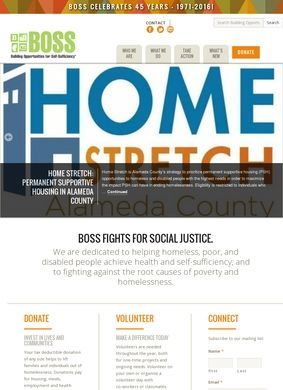
What really moves a person from a shelter cot to a lease they can hold onto? Building Opportunities for Self-Sufficiency (BOSS) answers that with a phrase it repeats across its site, "from survival to stability," and then backs it with four levers: housing, healing, career support, and community. Building Opportunities for Self-Sufficiency (BOSS) is a Bay Area nonprofit that goes after the root causes behind poverty, homelessness, incarceration, and violence, rather than treating any one of them in isolation.
The people it works with are individuals and families facing homelessness and systemic inequity across the East Bay, specifically Berkeley, Albany, Emeryville, and Oakland. That geography matters. These are expensive, unequal cities where a single missed rent check or a night in custody can start a slide that is hard to reverse, and the organisation positions its whole model around catching people before or during that slide. Naming those four East Bay cities specifically keeps its promises local and checkable instead of gesturing vaguely at the region.
Programs that move people from survival to stability
The program list runs broader than the housing label most people expect from an anti-homelessness group. Housing Security programs handle the assistance and stability support meant to keep a roof in place, and the second half of that pairing is the harder one, since keeping someone housed after a placement is where most interventions quietly fail. Alongside it, Wellness, Empowerment and Resiliency, known as WERC, runs community-based healing and support, and a Trauma Recovery Center provides specialised trauma-recovery services for people carrying the aftermath of violence or upheaval.
Building Opportunities for Self-Sufficiency (BOSS) treats the wound and the rent as parts of the same case, which is a specific philosophy about why people end up unhoused to begin with. It assumes that untreated trauma and instability feed each other, so putting a recovery center and a housing program under the same organisation is a deliberate design choice, not an accident of mission creep.
Haven for Black Healing, or HBH, is a distinct strand within Building Opportunities for Self-Sufficiency (BOSS): culturally aligned healing spaces for people affected by violence, incarceration, and displacement. Cultural specificity is the point of it. Generic services often miss the communities hit hardest by the criminal-legal system, and a program built explicitly for Black healing is a bet that who delivers care, and how it is framed, changes whether people walk through the door at all.
The organisation also runs social-justice initiatives, so the work reaches past direct service into advocacy on the conditions that produce the crises in the first place.
Two of the four levers, career support and community, get less concrete billing than the housing and healing programs. The site names them in its mission line, and the WERC hub and the social-justice work plainly carry the community piece, but a reader looking for a standalone jobs or workforce program will find the career-support strand described more as a value than as a named service. It is worth flagging for anyone drawn in by that particular phrase.
The pre-trial program inside the courts
The Pre-Trial Expansion Program is the piece that shows how far Building Opportunities for Self-Sufficiency (BOSS) is willing to reach. It places case managers directly inside the courts, in partnership with the Alameda County Probation Department, to connect people awaiting trial with housing, health, employment, and recovery resources. That is an unusual spot for a nonprofit to plant itself.
Meeting someone at the pre-trial moment, before a conviction hardens into a record and a lost apartment, is where an intervention can change a whole trajectory. Someone connected to housing and treatment while their case is still open is in a very different position than someone who cycles through jail and comes out with nothing. Building Opportunities for Self-Sufficiency (BOSS) has built a standing program around exactly that window, and the probation-department partnership gives it a foothold most community groups never get.
Free legal help at WERC
Once a month, on the second Thursday, Bay Area Legal Aid sets up at WERC to give free legal help through its partnership with Building Opportunities for Self-Sufficiency (BOSS). The clinic covers housing rights, public benefits, family matters, reentry support, and record-clearing, which reads like a checklist of the exact legal knots that keep people cycling back through homelessness.
Record-clearing in particular can be the line between a job offer and another rejection, and reentry support addresses the moment people are most likely to fall back. Putting a legal clinic in the same building where clients of Building Opportunities for Self-Sufficiency (BOSS) already come for healing and housing is a sensible piece of design, since the people who need a benefits appeal or an eviction defense are usually the same people already sitting in the WERC waiting room.
How solid is the record
Getting in touch is easy, which is no small thing for an organisation whose clients may be mid-crisis. Building Opportunities for Self-Sufficiency (BOSS) posts a Berkeley street address, a phone number, an email, and even a fax line, with a contact page collecting them in one place. For a walk-in population, a real address on University Avenue is worth more than any web form, and Building Opportunities for Self-Sufficiency (BOSS) does not make people hunt for it.
The outside record falls well short of the program list, and this is where a careful reader should slow down. Charity Navigator gives Building Opportunities for Self-Sufficiency (BOSS) a two-out-of-four-star rating on accountability and transparency. That is a middling mark, not a failing one, but not the score a donor hopes to see either, and it signals that the disclosure and governance side has room to tighten before the numbers inspire full confidence.
For a nonprofit asking the public to fund an interlocking set of programs, transparency is the currency that lets an outsider check the claims, and a two-star showing there is the one figure that should prompt a prospective donor to ask follow-up questions.
Beyond that, hard feedback is scarce. Glassdoor lists ten employee reviews and Indeed hosts an employee-reviews page, yet neither shows an aggregate figure, and both speak to what it is like to work at Building Opportunities for Self-Sufficiency (BOSS), not what it is like to be served by it. GreatNonprofits and GuideStar carry organisational profiles without a visible rating. A Network of Care service directory is blunt about it: there are no reviews for this agency yet. I went hunting for a single beneficiary voice, one client saying the housing or the healing held, and came up with nothing.
That absence is the doubt that will not resolve. Building Opportunities for Self-Sufficiency (BOSS) describes an ambitious, tightly connected model, pre-trial case management, trauma recovery, culturally specific healing, a monthly legal clinic, and housing underneath it all, and the coordination between those parts reads as genuinely thoughtful. But a two-star transparency rating and a complete absence of beneficiary reviews mean the outcomes are being taken largely on the organisation's own word. Whether Building Opportunities for Self-Sufficiency (BOSS) delivers on the ground for the families it names is not something the public record settles yet.