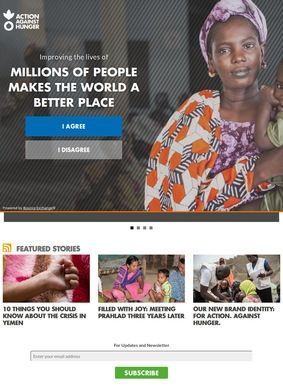
What does a listing under philanthropy owe a reader who is trying to decide where a donation will do real work? A clear account of what the organization does, where, and for whom. Action Against Hunger answers that quickly. It is an international humanitarian nonprofit, registered as a 501(c)(3), that has built its whole mission around one problem: hunger and the malnutrition that follows it. The site does not wander. Everything on it circles back to feeding people who are at risk of starving and to preventing that risk from recurring.
Program areas and how they connect
The work that Action Against Hunger does splits into a handful of program areas, and each one is concrete enough that you can picture the activity behind it. There is nutrition and health, which covers the direct treatment of malnourished children and the medical care that goes with it. There is food security and livelihoods, aimed less at the emergency meal and more at helping families grow, buy, or earn their own food over time. Water, sanitation and hygiene, which the organization abbreviates as WASH, sits alongside these because clean water and disease prevention are inseparable from keeping a child nourished. Then there is emergency response, the fast-moving arm that shows up when a crisis breaks. Rounding it out are research and innovation, and advocacy directed at policymakers.
Research and advocacy work
That last pair is worth dwelling on, because it tells you something about how the organization thinks. Plenty of groups treat hunger purely as a delivery problem: get the food to the people. Action Against Hunger clearly does that, but the organization also puts money and staff into studying what works and into pressing governments to change the policies that keep people hungry in the first place. Research and advocacy are the slow, unglamorous parts of this field. Their presence here points to an outfit trying to shrink the problem rather than just respond to it.
Food security paired with livelihoods
The pairing of food security with livelihoods deserves the same attention. Handing out food answers today's emergency, but a family that can farm or earn is a family that stops needing the handout. By putting those two ideas in the same program area, the site makes clear that the goal is exit from crisis, not permanent dependence on aid. The WASH work slots in beside it for a practical reason that anyone who has read about malnutrition will recognize: a child treated for hunger and then sent back to contaminated water is a child who gets sick again. Treating the water supply and the disease risk is part of treating the hunger, and the site frames it that way.
Scale of operations
The scale that Action Against Hunger claims on the site is large. It reports reaching 26.5 million people, with a workforce of more than 8,500 staff, across upward of 55 countries. The geographic spread runs through Africa, the Americas, Asia, Europe and the Middle East, so this is not a regionally focused charity that happens to have an international name. Numbers like that deserve a second look, and here the site backs the headline figure with named program areas and named crisis zones instead of leaving it as a bare statistic.
Active crisis zones
Those crisis zones are front and center. Action Against Hunger carries current response alerts for places where the need is most acute: Gaza, Somalia, Sudan, Ukraine. Listing active emergencies by name is a small thing, but it changes the character of the site. It reads as an organization telling you where its people are working right now, which is more useful to a prospective supporter than a static mission statement. The priority populations are stated plainly too, with children and women named as the groups the work is built around. In malnutrition terms that focus makes sense, since young children and mothers carry the heaviest consequences of a food crisis.
Donation mechanisms
For anyone who lands on the page ready to give, the practical machinery is there. Action Against Hunger provides donation mechanisms and a set of ways-to-give sections, so the site explains the cause and gives you a way to act on it in the same visit, rather than leaving you to hunt for a next step. The presence of that infrastructure matters for a group whose funding drives the fieldwork. The organization also maintains a spread of social channels, with a presence on Facebook, Twitter, YouTube, LinkedIn and Instagram, which is the expected footprint for a body operating at this size and useful if you want to follow the work between donations.
What the site reveals and what it cannot
It is worth being honest about what a site like this can and cannot tell you. The program descriptions and the reach figures come from Action Against Hunger itself, and an entry in a business directory is not the place to audit a charity's spending ratios or field outcomes. What the site does well is state its scope without inflating the language around it: six program areas named, the countries named, a reach figure attached to both. Anyone wanting financials or independent evaluations has to look past the marketing pages, but those pages do not overreach, and that restraint counts in their favor. A search for outside reviews of Action Against Hunger itself turns up little beyond charity-watchdog ratings, which is normal for a body that runs on grants and field programs instead of a storefront.
Coherence across multiple disciplines
The breadth is genuinely wide. A single organization running nutrition treatment, water and sanitation projects, livelihoods programs, emergency deployments, a research function and a policy operation is holding a lot of different disciplines under one roof, and Action Against Hunger runs all of it at once. Action Against Hunger has structured all of it around the same endpoint, which keeps the mission coherent even as the activities multiply. Hunger is the through-line, and every program area connects back to it. That coherence is easier to claim than to maintain across 55 countries, and the site at least presents it cleanly.
Evaluating a gift to this organization
If you are a donor weighing where to put money that is meant for humanitarian relief, particularly someone drawn to child and maternal nutrition or to emergency response in active conflict zones, Action Against Hunger belongs on your shortlist to examine closely. The organization does real work in real places, and the site gives you enough specifics to evaluate whether its priorities match yours. A sensible next step is to open the crisis-response section for a region you care about, read how Action Against Hunger describes its work there, and then look up its most recent financial filing.
Starting points for different donor types
For a lawyer, employer, or grantmaker considering a partnership, start instead with the research and advocacy pages, which show the side of Action Against Hunger that reaches beyond direct aid. Either way, the entry gives a firm starting point, and the organization behind it has the reach to make a gift count. The page states its programs, its scale, and its current crisis zones plainly enough that a donor can check them against a personal set of priorities before deciding, which is about as much as any single listing can be expected to do.