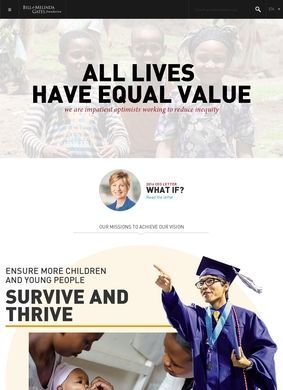
Someone working on a malaria vaccine rollout in rural Tanzania, or a researcher trying to understand why so many children still die before their fifth birthday in parts of South Asia, eventually runs into the same wall: who is funding the work, and what has actually moved. The Bill and Melinda Gates Foundation site is built to answer exactly that. It is the public face of one of the largest private philanthropic organizations on the planet, run out of Seattle, and the material here is aimed less at casual browsers than at the people who need to know where the money goes and what it has bought.
Mission and global health priorities
The mission statement is plain enough that it does not need decoding: the goal is that every person gets the chance to live a healthy, productive life. In practice that ambition narrows to specific places and specific problems. The work concentrates on low- and middle-income countries, with Sub-Saharan Africa and South Asia carrying most of the weight. Global health sits at the center, and the site does not abstract it into slogans. You see the named fights: vaccines and immunization campaigns, malaria, tuberculosis, HIV/AIDS, and the long grind of polio eradication. Anyone who follows public health will recognize how much of the modern playbook for these diseases traces back through grants the Bill and Melinda Gates Foundation has written over the years.
Maternal health and economic opportunity programs
Alongside the disease work, two other pillars hold the program together. Maternal and child health covers nutrition and reproductive health, the unglamorous areas where small interventions compound into large differences in survival. Economic opportunity is the third leg, and it is broader than the health portfolio: digital financial services, support for smallholder farmers, women's empowerment, and education. The spread is wide, but the Bill and Melinda Gates Foundation does not treat it as scattered. Each strand connects to the same underlying claim, that health and income rise together and that progress in one without the other tends to stall.
Grants database reveals funding figures
What gives the site its weight is the numbers it is willing to put on the table. The Bill and Melinda Gates Foundation is a grantmaking organization first, channeling money to partner groups instead of running most programs in-house, and the figures are stated openly, not hedged or buried. It reports 2,506 active grants across 1,472 grantee organizations, organized under 51 program strategies, with $8.5 billion in total charitable support deployed. A searchable grants database lets a visitor pull these apart and see which organizations received what. For anyone evaluating the foundation, or hoping to become a grantee, that database is the most useful thing on the site. It turns a vague sense of scale into something you can actually query.
Annual reports pair with storytelling platforms
The publishing side is more substantial than a typical organization's press page. The annual Goalkeepers Report is the headline product, tracking global progress against health and development targets and serving as a yearly scorecard that researchers, journalists, and other funders cite. The Partners of Human Potential storytelling platform sits at the opposite end of the register, trading statistics for individual stories, and The Optimist newsletter carries a regular update for people who want the foundation's reading of where things stand. I found the contrast between the hard grants database and the narrative material telling: the organization clearly knows that data alone does not move policy, and that stories alone do not survive scrutiny. The Bill and Melinda Gates Foundation is doing both at once, and keeping them clearly separated rather than blending them into something mushy.
Leadership profiles, media coverage, career openings
Beyond the funding and the publications, the site covers a media center, policy and advocacy resources, and leadership profiles. The co-chairs Bill Gates and Melinda French Gates are named and profiled, which is worth noting for an organization whose direction is so closely tied to the people steering it. A careers portal handles recruitment for a workforce of roughly 2,215 staff worldwide. None of this is decorative. Each section answers a question a specific kind of visitor arrives with, whether that is a reporter chasing a statement, a policymaker looking for the foundation's stance on an issue, or a job seeker checking what the place is hiring for.
Expect a learning curve for newcomers
If there is a fair caveat, it is that the breadth can be daunting on a first visit. The Bill and Melinda Gates Foundation works across so many strategies and regions that a newcomer may need several clicks to orient. The navigation rewards people who already know roughly what they are after. That is a reasonable trade for an institution of this size, and the grants database does a lot to compensate, but it means the site serves the informed visitor better than the curious one wandering in cold.
Checking public reviews for grantmakers
A search across Trustpilot, Google reviews, and similar platforms turns up no meaningful public rating for the Bill and Melinda Gates Foundation as an organization visitors review in the consumer sense. That is not unusual for a private foundation of this type. Coverage comes instead through journalism, academic citation, and policy circles, where the foundation is widely discussed and frequently critiqued on strategic grounds. The absence of a star rating does not leave the picture empty; the Goalkeepers Report citations and the grant data are the record people actually consult. A grant-seeker or researcher looking for evidence of how the Bill and Melinda Gates Foundation operates has concrete material here rather than branding alone.
Grants data over marketing claims
The strongest thing about the resource overall is that it does not hide behind abstraction. Figures like 51 program strategies and $8.5 billion deployed are tied to a queryable database, not feel-good language. An organization can talk about impact endlessly; the Bill and Melinda Gates Foundation instead lists the grants and lets you look. That posture separates a serious philanthropic operation from one that mostly markets itself, and it runs through the whole site. The grants database alone is reason enough to bookmark the page if you work anywhere near global health or development funding, and the Goalkeepers Report gives an annual anchor for understanding how the Bill and Melinda Gates Foundation reads its own progress against the problems it set out to solve.