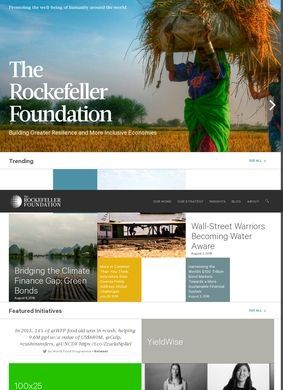
Electrify one billion people by 2030, with 300 million of them in Africa. That is the headline target on the Rockefeller Foundation site, and it is the first of three priorities the foundation now groups under the label "Big Bets." The framing tells you a lot about how the organization wants to be read. This is not a grants page with a mission statement bolted on top. It is a working agenda with deadlines attached, and most of the site is built to explain how the money and the research line up behind those deadlines.
Three Big Bets for global impact
The other two bets sit beside the energy one without much hierarchy. Good Food covers two threads: scaling Food is Medicine programs inside the United States, where diet is treated as part of clinical care, and getting nutritious school meals to 100 million children worldwide. American Jobs aims at 1.6 million jobs spread across 250 distressed U.S. communities. Stacked together, the three give a clear sense of where the Rockefeller Foundation is pointing attention and capital, and the site does the useful thing of keeping them concrete rather than letting them dissolve into general talk about progress.
Good Food and American Jobs programs
Underneath the three headline programs the work fans out into areas that have been part of the institution for a long time: health systems, innovative finance, the deployment of frontier technology, and community-driven development. These read as connective tissue. Innovative finance, for instance, is what lets the Rockefeller Foundation stretch a philanthropic balance sheet into infrastructure the size of national power grids, and the energy bet would be hollow without it. The site does not bury these supporting strands, which I found more revealing than the marquee numbers, because they show the mechanics rather than just the ambition.
Supporting infrastructure beneath headline programs
One figure does a fair amount of work across the pages: the Rockefeller Foundation reports reaching 731 million people across its target communities in 2025. It is the kind of aggregate that deserves a careful eye, since "reaching" can mean many things, but it gives a rough scale to the operation. A reader who wants to test that claim has somewhere to go, because the site carries the publications and reporting that sit behind the programs. The foundation has been at this since 1913, and the long horizon is visible in how the priorities are written: 2030 targets, not quarterly wins.
Measuring reach across target communities
What the site offers a visitor depends on why they arrived. Researchers and policy people get publications and news. Organizations looking for support get grant information, though, as with most large funders, the path from interest to actual funding is rarely a simple open door. Job seekers get career listings. The structure assumes you already know roughly which of those buckets you fall into, which is reasonable for an institution of this size but means casual browsers may find the front door more declarative than inviting.
Navigation by visitor type
The geographic spread is worth noting because it maps directly onto the programs. The Rockefeller Foundation's home base is New York City, with additional offices in Washington D.C., Nairobi, Bangkok, and Bogota. That footprint is not decorative. An Africa energy target needs a presence in Nairobi; food and jobs work in the Americas explains Washington and Bogota; Bangkok anchors the Asian end of the school-meals push. The offices read as working instruments, not letterhead, and the Rockefeller Foundation is plainly describing a network that follows its stated priorities instead of one organized around administrative convenience.
Global offices aligned with priorities
The Bellagio Center in Italy sits a little apart from the rest. It functions as a convening and residency venue, the place where the Rockefeller Foundation gathers people to think and write, and it has a history that predates the current strategy. Its inclusion on the site is a reminder that this is an institution with a culture of bringing scholars and practitioners together, not solely a check-writing operation. For anyone studying how large philanthropy actually operates, that mix of field offices and a dedicated retreat is itself informative.
The Bellagio Center as convening space
As a source, the Rockefeller Foundation site is most valuable when you treat it as a primary document about its own intentions and a clearinghouse for the research it funds. The publications and news sections are where the substance lives. The Big Bets framing is the foundation's self-presentation, and it is honest enough to be verified: a target of 100 million children fed or 1.6 million jobs created is a number someone can return to and measure. That willingness to be pinned down is more useful than vaguer language would be.
Using the site as primary source material
Where expectations need tempering is around the gap between ambition and confirmed outcome. The Rockefeller Foundation presents goals through 2030 and a headline reach figure for 2025, but a visitor evaluating impact has to do their own work separating aspiration from delivered result. The foundation gives the inputs and the framing generously; the independent verdict on whether the bets pay off is not something its own site can settle, and it would be a mistake to read the targets as accomplishments.
Distinguishing goals from confirmed outcomes
On outside reputation, a search for the Rockefeller Foundation across major review platforms returns no meaningful user-submitted ratings, which is expected for a century-old philanthropy of this kind. Its standing comes from institutional track record and published output, not aggregated star counts. The published record is extensive and goes back far enough to judge, which is a reasonable substitute.
Institutional reputation built on track record
For researchers, policy people, grant seekers, or anyone wanting a window into how a century-old funder sets its agenda, the Rockefeller Foundation has put together a substantial and well-organized resource. It rewards visitors who arrive with a specific question and know which section answers it. Treat the 2030 numbers as a scorecard still being filled out, consult the publications for harder evidence, and the site delivers a credible account of what one of the larger players in global philanthropy is trying to do and why it believes these particular bets are the right ones to make.