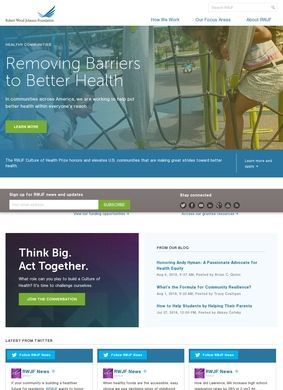
A community organizer in a struggling neighborhood needs money to run a maternal health program, a researcher wants funding to study how housing affects health outcomes, a small nonprofit is looking for an established partner to back its work on food access. All three end up at the same address. The Robert Wood Johnson Foundation, based in Princeton, New Jersey, is one of the largest health-focused philanthropies in the country, and its site is built around getting that kind of visitor from the front door to an actual application. The Robert Wood Johnson Foundation has been at this since 1972, long enough that the site reflects a clear idea of who is meant to show up.
Health equity as organizing principle
The framing the foundation puts at the center of everything is health equity, with a stated position that health should be a right and not a privilege. That is the lens through which the grant areas are organized. Maternal and birth justice sits alongside disability rights, community power and grassroots advocacy, economic inclusion, food systems, and the physical and built environment people live in. The Robert Wood Johnson Foundation pays particular attention to communities affected by structural racism and to populations that tend to get left out of national health conversations. Working through the focus areas, you get a clear sense of an organization that has decided where it stands and funds accordingly.
Grant opportunities and award database
The practical core of the site is the funding machinery. Active grant opportunities are posted with their own pages, and there is a searchable database of grants already awarded, which is useful for anyone trying to figure out whether their work fits the pattern of what The Robert Wood Johnson Foundation has historically backed. Browsing past awards tells you more than any mission statement about where the money goes.
Grantee portal and leadership development
For organizations already in the system, a MyRWJF portal handles the account side, and a set of grantee resources supports the work after the check clears. Prospective applicants get the public-facing opportunity listings; existing grantees get the tools and reporting infrastructure behind a login. I found the split sensible, because it keeps the open pages focused on people who are still deciding whether to apply rather than burying them in administrative detail they do not need yet. The foundation also runs leadership development programs, which extends its reach past grant checks into building people who go on to do health work elsewhere. It is a different kind of investment than a one-time grant, and the site treats it as its own track.
Financial transparency and sector evaluation
On outside reputation, a search across major review platforms turns up no public ratings or user reviews for The Robert Wood Johnson Foundation, which is typical for large institutional philanthropies. Organizations in this space tend to be evaluated through charity watchdogs and sector publications rather than consumer review sites, and The Robert Wood Johnson Foundation publishes its financials in a way that supports that kind of scrutiny.
Research publications and policy advocacy
Beyond funding, The Robert Wood Johnson Foundation publishes a substantial body of work in its Insights section. This is where the research publications, policy advocacy materials, and blogs live, alongside a tool called RWJF Answers that points people toward specific information. For a foundation this size, the publishing arm is part of the influence, shaping how health policy gets discussed alongside the grant writing.
Insights archive by focus area
The Insights archive is worth visiting even if you never plan to apply for a dime. A policy staffer, a journalist, or a graduate student can pull useful material out of it, and The Robert Wood Johnson Foundation keeps everything organized by the same focus areas that drive the grants. The advocacy materials make the foundation's positions explicit, so there is no mystery about what it is pushing for on maternal health, disability, or economic inclusion.
National scope with New Jersey roots
New Jersey gets singled out throughout the site as the home state of The Robert Wood Johnson Foundation, with work and emphasis directed there specifically. National scope, local roots, and the site does not pretend otherwise. That dual identity comes through in how programs are described, some aimed at the whole country and some at the place the foundation has lived since 1972.
From endowment to annual disclosure
On the question of money and accountability, the About section carries annual reports and financial disclosures, which is the kind of transparency you would expect from an institution sitting on an endowment of roughly fourteen billion dollars. The Robert Wood Johnson Foundation does not hide the scale of what it manages, and publishing the financials lets anyone trace how a foundation of this size operates year to year.
What you take away from the site depends on why you came. A grantseeker gets a real intake path with current opportunities and a history of past awards to study. A researcher gets a deep library and a position laid out in plain terms, since The Robert Wood Johnson Foundation states its priorities without hedging. The work is organized around health as a national project with a New Jersey center of gravity, and the funding, the research, and the leadership programs all run off the same equity premise.
The Robert Wood Johnson Foundation has built the site so that a first-time visitor and a long-term grantee end up in different rooms of the same house, each with the tools that fit where they are. Founded in 1972 and still pointed at the same broad goal, the published evidence, the grant database, the financials, the advocacy positions, all of it is laid out in enough detail to make a genuine assessment without waiting for a conversation that may never happen.