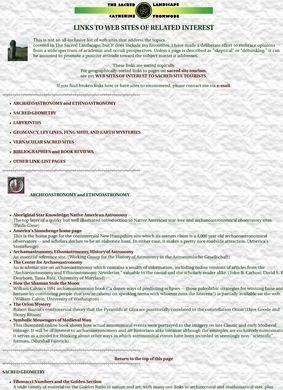
What does a page called Sacred Sites actually hand a visitor? A sorted set of outbound links, nothing more mysterious than that. Published as the Sacred Landscape section of the much larger Lucky Mojo site, the Sacred Sites collection gathers external reading on archaeoastronomy and ethnoastronomy, sacred geometry, labyrinths and spirals, geomancy, ley lines, feng shui, and the loose grouping the curator files under Earth mysteries.
It is a directory of pointers, then, not a shelf of original essays. That single distinction shapes who should bother with it and who will leave disappointed.
Inside the Sacred Landscape links
Breadth is the organising idea. Beyond the astronomy and geometry headings, the subject range that Sacred Sites gathers reaches vernacular sacred places, bibliographies, and book reviews, and it branches further into additional link-list sub-pages for readers who want to keep digging past the first screen. Someone chasing down, say, stone circles could move from a curated reading list to a book review to an external site without ever leaving the trail the page has laid out, which is the practical value of a hand-built index over a raw search that buries good sources under merchandise and ads.
The curation carries a declared point of view. The compiler describes a deliberate effort to embrace opinions from a wide spectrum of academic and occult perspectives, and that is a useful, honest flag: this is not a peer-reviewed reading list, and it never pretends to be one. A reader is told upfront that careful scholarship and frank esoterica share the same shelf here, which is more candour than link collections in this subject usually offer.
Three sorts of visitor are served at once. The academic researcher gets a starting map for a literature search. The casual enthusiast gets a browsable afternoon among labyrinths and standing stones. The traveller plotting a route around ancient monuments gets a themed shortlist to work from before ever leaving home. None of them gets a finished answer from Sacred Sites, and the page is careful not to pretend otherwise, which is a rarer kind of honesty than the subject usually attracts.
Archaeoastronomy to ley lines
The span of subjects is the real draw. A single Sacred Sites page carries a reader from the hard-edged study of how ancient cultures tracked the sky, through sacred geometry and the winding internal logic of labyrinths, out to the far more contested ground of ley lines and geomancy. Placing mainstream archaeoastronomy next to Earth-mysteries material is a deliberate choice, one some researchers will read as muddled and others will find refreshingly unfenced.
Either way the grouping is explicit, so nobody is misled about what sits where or how seriously the wider academy takes it.
A wide spectrum of academic and occult perspectives
That mixture is the entire proposition of Sacred Sites, and whether it works depends heavily on who is reading. An academic after vetted sources only will still have to separate wheat from chaff on their own.
A curious generalist, or a traveller mapping a trip around ancient monuments, gets a much faster start than a cold search engine offers, because a human being has already sorted the material by theme and cleared away the obvious noise. The value here is the sorting, not any single link inside it.
The shop behind the links
Sacred Sites does not float free of a business. It is one room in the house that Lucky Mojo Curio Co. built, an operation far better known for selling hoodoo and rootwork supplies: oils, candles, incense, mojo bags, herbs, and soaps, alongside correspondence courses and workshops in conjure. The link directory reads as a scholarly companion piece to that commercial catalogue, and knowing the parent trades in occult goods explains why the perspectives on offer lean the way they do. That is context a first-time visitor deserves before deciding how much weight to give the recommendations.
Searched by its own name, Sacred Sites draws no reviews to speak of: queries surface a tarot deck, a television show, and unrelated tour listings, purely because the phrase itself is so common. The parent shop is the better name to check. Yelp carries 59 reviews for the Lucky Mojo Curio Company storefront, though no star average showed in the snippet, and discussion threads on Quora and Reddit weigh in with anecdotal, generally trusting opinions rather than tidy scores.
The company also hosts its own testimonial pages and a long-running customer forum, both worth reading with the usual caution owed to self-published praise.
How to reach Lucky Mojo
Contact is easy, and that counts in the site's favour. A clearly linked contact page carries a phone line, a Forestville, California mailing address, and an ordering email, plus a separate email set aside specifically for reporting broken links on this page. Profiles on YouTube, Facebook, and Instagram are linked as well, and a customer forum sits within reach for anyone who wants to compare notes. For a page that lives or dies by whether its outbound links still resolve, keeping a channel dedicated to dead-link reports is a genuine sign the pages get tended instead of quietly abandoned.
Sacred Sites fits a comparative-religion class, an introductory-archaeology unit, or a trip planned around old holy places better than idle browsing. Its bibliographies and book reviews are the place to build a shortlist, and the broken-link email is worth keeping handy for the moment a pointer goes stale.