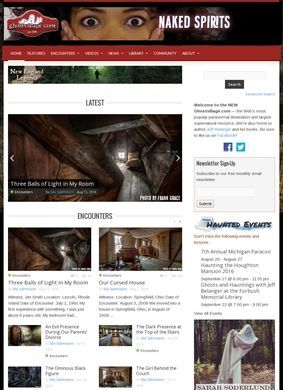
You hear a floorboard creak in an old New England farmhouse, you snap a photo of a grey shape by the barn, and the next morning you want somewhere to figure out whether anyone else has seen the same thing. That is the itch Ghostvillage.com was built to scratch, and it has been scratching it since writer Jeff Belanger launched the site in 1999. The place gathers ghost stories, haunted-location lore, and supernatural folklore into one long-running archive, with a clear tilt toward New England and its back roads.
Reader submissions drive the archive
What holds the whole thing together is the reader material rather than editorial pieces handed down from above. The "Encounters" section runs on first-hand accounts that visitors send in, complete with photos and video where people have them. Someone who witnessed something odd can fill out the "Report Your Encounter" form and add their own story to the pile, which keeps the site fed with the raw, unpolished material that makes this kind of subject worth reading. That feedback loop, ordinary people describing strange nights and other ordinary people reading them, has kept Ghostvillage.com going long after sites built on a single spooky theme fizzle out.
Layered on top of the submissions is a steady stream of features, news articles, interviews, and a research library that archives older material. The audience is fairly plain to read off the content: paranormal enthusiasts, folklore researchers, and the sort of listener who queues up a podcast about a haunted mill for the drive home. Ghostvillage.com does not pretend to be a scientific journal, and it lets the stories speak for themselves instead of dressing them up as proven fact. A visitor gets the sense the material has been collected by someone who genuinely cares about the folklore, not scraped together to sell ad space.
New England Legends Podcast
It does, and it is probably the strongest single reason to bookmark the place. The affiliated New England Legends Podcast has cleared 400-plus episodes, a number that tells you more about the operation than any tagline could. Episode 452, for instance, walks through regional haunted locations, and the sheer episode count means someone new can drop in and still have years of back catalogue to work through. A show that survives past four hundred installments is being made by people who finish what they start, and in a corner of the internet full of abandoned blogs, that kind of longevity counts for a lot.
The podcast also gives the written archive a reason to keep growing. Stories that surface on the show can feed the site, and locations covered on air often have a matching entry or article to read afterward. For anyone planning a weekend of driving to supposedly haunted spots around Massachusetts, Connecticut, or Rhode Island, that pairing of listen-then-read is genuinely useful, and it is one of the clearest signs that Ghostvillage.com is more than a story dump: the audio and the text point back at each other.
Print magazine and field guide
There is a print and merchandise side too. Ghostvillage.com sells and promotes Shadow Zine, a magazine whose eleventh issue takes on time travel, and points readers toward the book Wicked Strange: Your Guide to Ghosts, Monsters, Oddities, and Urban Legends from New England. Neither feels bolted on. A site rooted in regional legend collecting is exactly where you would expect a zine and a field guide to live. Both extend that interest into formats you can hold in your hands.
Directory and newsletter options
Beyond the stories and the audio, Ghostvillage.com keeps a paranormal directory of related businesses, handy if a reader wants to find an investigation group or a themed tour instead of only reading about hauntings. A newsletter sign-up rounds out the ways to stay in the loop, so a casual visitor can turn into a regular without having to remember to check back. These are small features, but they show a site thinking about how someone actually uses it over time.
Put the pieces side by side and the range is wide but coherent: submitted encounters, editorial features, interviews, an archive, a directory, a long podcast, a magazine, and a book, all tied to the same New England supernatural theme. Nothing here reads as filler bought to pad a page. Each part reinforces the others, which is the mark of a site someone has tended for two decades, in a genre where enthusiasm usually burns out after a year or two.
Trust and outside verification
On the question of trust, the honest position is mixed but not troubling. Ghostvillage.com maintains a Facebook page with 2,243 likes, where it describes itself as the web's most popular paranormal destination according to Google and Amazon. That is the site's own framing, a claim to weigh rather than an audited fact. Looking for outside verdicts turned up nothing: no Trustpilot score, no Google reviews block, no BBB or Yelp presence surfaced. That is unsurprising for a hobbyist community site, since people who read ghost stories rarely leave a one-to-five rating the way they would for a plumber, but it means the reputation rests mostly on its own history and social following, not on tallied third-party scores.
Contact through submission forms
Reaching the people behind it is straightforward enough. There is a contact page under the About section, alongside the About page itself and the separate Report Your Encounter and newsletter functions. A direct phone number, email, or mailing address was not sitting on the pages that were checked, so contact runs through the site's form instead of a number you can dial. That is a reasonable setup for a submissions-driven project, though a visitor who wants a quick phone call should know the form is the main door in. Ghostvillage.com clearly expects most contact to arrive as a story, not a call.
Community accounts, not laboratory evidence
A fair caution: this is community-sourced material about an inherently unprovable subject. The encounters are personal accounts, not evidence, and the site does not claim otherwise. Anyone expecting laboratory certainty will leave disappointed. Read on its own terms, as a curated collection of regional legend, Ghostvillage.com comes across well, and its twenty-plus years give it a depth newer paranormal blogs have not had time to build.
The design leans practical over slick, which suits the content. You come for the stories and the audio, and both are easy to reach. The directory and archive reward a visitor who likes to dig their way from one haunted location to the next, and the newsletter and podcast subscriptions mean the material follows you instead of making you chase it. Ghostvillage.com is not trying to dazzle on arrival; it is trying to give you somewhere to keep coming back.
A New England folklore buff or a paranormal researcher who wants a large, still-active well of first-hand accounts and long-form audio will find plenty to work with here, and Ghostvillage.com can hold a spot in a regular rotation. Start with a recent New England Legends Podcast episode to gauge the tone, browse a few submitted encounters near where you live, and if a story of your own has been rattling around, use the Report Your Encounter form to add it. Someone planning a tour, or a skeptic looking for certified proof, can borrow the location leads but should bring their own judgement.