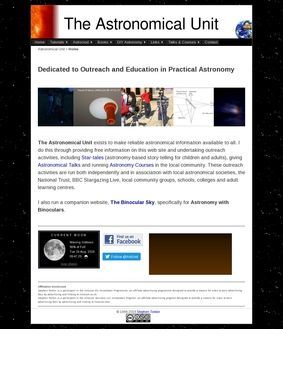
Where does a beginner go to learn how to pick a first telescope without getting upsold into the wrong gear? Astrocrud, the website Stephen Tonkin runs under the banner of The Astronomical Unit, answers that question with a stack of plain tutorials: how to choose a scope, how to set up eyepieces, how to get a polar alignment right. None of it sits behind a paywall, and that single fact shapes how the whole site reads. It is built to teach, not to sell.
Topics from optics to debunking
The instructional material is the backbone here. Beyond the starter guides, the site moves into optics, cosmology, and mathematical astronomy, so it serves the curious reader who wants the why as well as the how. There is a section on natural phenomena, and one I found more interesting than expected: a pseudoastronomy area that takes apart common misconceptions. That last part tells you something about the operator's priorities. Plenty of hobby sites stay safely vague; this one is willing to say when a popular belief is wrong and explain the reasoning. For a listing filed under paranormal phenomena, that skeptical streak is worth flagging, because Astrocrud is on the debunking side of that line, not the credulous one.
Book recommendations and DIY projects
The content widens out past reading. Tonkin lists book recommendations sorted across several astronomy categories, which is the kind of curation that saves a newcomer hours of guesswork at a bookshop. There are DIY project resources too, for people who would rather build or tinker than just read. The mix suggests someone who has taught this subject for a while and knows where learners get stuck.
In-person events and target audience
Then there is the in-person side. Astrocrud points to "Star-tales," astronomy-based storytelling aimed at both children and adults, along with astronomical talks pitched at different audiences and community courses and workshops. These are real services attached to a real person, which lends the educational claims more weight than an anonymous content farm would carry. A companion site dedicated to binocular astronomy is linked as well, a sensible nod to the fact that not everyone starts with a telescope and that binoculars are often the smarter first buy.
Who is this for? Amateur astronomers looking to sharpen their setup, educators hunting for material they can use, students, and general readers who just want a clear explanation. The breadth is wide, but it does not feel padded, because each strand connects back to teaching the night sky in practical terms.
Identifying the person behind Astrocrud
On the question of who is behind it, the answer is unusually clear for a personal site. Tonkin is identifiable through affiliate disclosures and through social accounts on Facebook and on Twitter, now X, under the handle AstUnit. Affiliate disclosures, in particular, are a small mark of honesty: the operator is telling you upfront where book links might earn a commission, which is more transparency than many free resources bother with.
Contact page location
Contact is routed through a separate page rather than posted on the homepage, so reaching Tonkin means an extra click. A visitor will not find a phone number or postal address on the landing page, which is exactly what you would expect from a solo operator running a free resource. The route exists and is findable.
Free model without reviews
Outside validation is sparse in a different way: a search turned up no notable third-party reviews of Astrocrud, and nothing on the usual rating platforms pointed back to this specific site. That is not a black mark so much as a quiet one. Niche educational sites run by individuals often live below the radar of review aggregators, and the value of the material does not depend on a star count. A reader who leans on outside opinion before trusting a source will have little to go on here beyond the work itself. Fortunately, the work is easy to inspect, since all of it is open and free to read.
What holds the whole thing together is the absence of a sales motive. There is no premium tier, no gated course, no constant push toward a checkout. The free model means the incentive points toward being useful and accurate, and the debunking section reinforces that the aim is getting the astronomy right. For a subject where bad information spreads fast, that posture matters.
How does this site compare?
How does it stack up against the obvious alternative? Someone weighing where to learn the basics might reach for Sky and Telescope's website, which carries more polish, a larger staff, and a steady stream of news and gear reviews. That resource wins on production and currency. Astrocrud wins on a different axis: it is a single experienced teacher's library, free of charge, with a clear voice and a willingness to correct popular errors that a commercial outlet might soft-pedal. For a beginner who wants patient explanation over a glossy feed, and who values knowing exactly whose judgement they are reading, Tonkin's site is worth the visit. It will not dazzle anyone, but it teaches, and for this corner of the hobby that is the point.