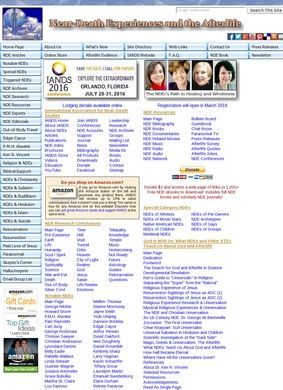
Someone comes back from a cardiac arrest certain they watched the room from above, and what they want next is not comfort. They want to know if anyone else has described this, and whether anyone serious has bothered to write it down. Near Death, published at near-death.com, exists to answer exactly that question. It has spent years collecting firsthand accounts and setting them next to the science, the psychology, and the religious tradition that each try, in their own way, to make sense of what happened.
It reads as a reference first and an argument second, and the way the material is organized shows that bias toward sorting things out over selling one answer.
Eight doors into one question
The material splits into eight sections, and that split is the whole design of the place. Experiences holds the personal accounts. Then come Science, Psychology, Parapsychology, Philosophy, Paranormal, Reincarnation, and Religion, each circling the same event from its own angle. Someone arriving skeptical can start in Science and never touch a personal story. Someone grieving can start in Religion or Experiences and skip the lab data entirely. Near Death leaves that choice to whoever shows up.
That structure is the strongest thing on the site. Most pages that touch this subject pick a side early and stay there. Near Death keeps the skeptical material and the devotional material under one roof without pretending the two agree, and it does not flatten one into the other just to make the site easier to summarize. A visitor can move between sections at will, and nothing in the layout nudges them toward the answer the site would prefer they land on.
From the experiencers themselves
The Experiences section runs on stories submitted by the people who lived them, told in their own words. That is the appeal and the catch in the same file. The collection is large and genuinely varied because nobody has sanded the accounts down to fit a pattern. It is also self-reported and uncorroborated by design, and Near Death does not dress that up as anything else. Above the raw accounts sits a highlighted chapter, "The Search for God and Afterlife in the Age of Science," which functions as close to a thesis statement as the site allows itself.
Read a dozen accounts back to back and the repetitions start to surface on their own, which is presumably the point of pooling that many in one place instead of reading a single story by itself.
Recent writing and a reading list
Newer articles show the scope keeps moving instead of sitting frozen in place. Pieces on the Gospel of Mary Magdalene and on Emanuel Swedenborg pull the subject toward religious history and eighteenth-century mysticism, well past the hospital-room story most visitors expect when they land on the site. A curated set of book recommendations rounds this out, and the Amazon links attached to them carry affiliate tags, so Near Death takes a small commission on anything bought through them.
That is an ordinary arrangement, and the site does not hide it; the titles still read as chosen on their own merits. An FAQ, a bibliography built for people doing actual NDE research, and a page of afterlife jokes and quotes fill in the remaining corners of the site. The jokes do real work too, breaking up reading that would otherwise stay heavy from start to finish.
How far to trust it
Credibility on ground like this comes down to who stands behind the page and what they are willing to claim. Near Death states an association with IANDS, the International Association for Near-Death Studies, the established body in this particular field. If that tie holds, it places Near Death closer to the research community than to the fringe, and it changes how the rest of the material should be read.
IANDS is not a household name, but among people who actually study the subject it is the reference point, so a stated link to it means more than any amount of confident prose on the page ever could.
Near Death frames the association as an association, not as a badge or an endorsement, and that restraint counts in its favor.
Outside verdicts are harder to come by, and there is no point pretending otherwise. A search for reviews of Near Death mostly turns up other things wearing the same title: a 2003 horror film, a 1989 documentary, a video game, each carrying its own scores on the usual sites, none of them this website. No substantial independent review of near-death.com itself turned up anywhere in that search. The case for the archive rests on what it actually contains and on the IANDS connection, not on a wall of star ratings borrowed from somewhere else.
Getting a message through
Reaching whoever runs the site is straightforward enough. A contact page exists, and Near Death keeps active links to Facebook, Twitter, YouTube, Pinterest, Reddit, and LinkedIn, so a story or a question has more than one route in. There is no phone number and no postal address, which fits a single-subject reference site that lives entirely online. Anyone trying to pin down exactly who runs it is working from a contact form and the IANDS mention, not a letterhead, and that is simply the shape of a project built this way.
It asks for a certain amount of trust up front, and it earns most of that trust from the material itself rather than from any credential printed on the page.
Who it is built for
This is not a five-minute stop for a casual browser looking for something to skim. Near Death rewards a particular kind of reader: someone trying to make sense of their own strange night, a relative sitting with a fresh grief, a parapsychology or religious-studies researcher who needs primary accounts and a bibliography gathered in one place. For that reader the archive runs deep and stays organized in a way that holds up over repeat visits, section by section, instead of dumping everything into one long scroll.
Its honest limits are the self-reported stories and the absence of outside reviews, and Near Death does not hide either one. Set against eight organized sections, articles that keep arriving instead of stopping, a research bibliography, and a stated IANDS connection, the balance still tips toward the useful side. None of that turns the site into a clinical source, and it was never trying to be one.
A researcher or a seeker after primary material, more than a tidy verdict, will get real use out of a long visit here. Start with the Experiences section, read a dozen accounts in a row, then follow the highlighted chapter on God and the afterlife into the Science and Religion pages and let them make their case against each other. That is where Near Death does its best work.