Archaeogeodesy, a Key to Prehistory is a multi-part scholarly article by James Q. Jacobs, posted on his personal site at jqjacobs.net, that proposes a single field of inquiry: the study of how prehistoric and ancient peoples determined place, positioned points, navigated, observed the sky, and measured and represented the Earth. Jacobs first wrote the text in 1992 and put it online in 1998, and the page reads like the founding statement of a discipline he is trying to define, not a casual blog post. The opening section of Archaeogeodesy, a Key to Prehistory does the unglamorous work most enthusiast sites skip: it sets out what archaeogeodesy is, why it might count as a distinct subject, and how one would go about studying it in practice.
Historical survey of geodetic knowledge
From there Part One moves through a historical survey of geodetic knowledge, touching on Egyptian, Greek, Arabic, Chinese, and Indian contributions to measuring the Earth and locating points on it. This is the kind of comparative groundwork that separates a serious attempt from a list of mysterious-monument photos. The later claims about prehistoric alignments only hold up if the reader trusts that ancient cultures had the means to measure at all, and Jacobs builds that case deliberately before pressing forward. Archaeogeodesy, a Key to Prehistory then narrows to the Irish passage tombs, with Newgrange, Knowth, and Dowth treated at some length, examining how those structures align with astronomical events.
Egyptian, Greek, Arabic, Chinese, Indian contributions
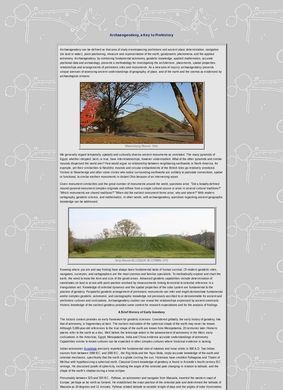
The most distinctive part of Archaeogeodesy, a Key to Prehistory is its argument about spatial relationships between monuments that sit far apart from one another. Instead of reading each site in isolation, the article examines distances and bearings linking distant prehistoric structures, the implication being that their placement encodes deliberate measurement across long baselines. That is a strong claim, and it is the sort of thing that has burned plenty of fringe writers who saw patterns in noise. What raises the credibility of this particular treatment is the documentation: the site includes photographs of mounds in North America and Ireland recorded with GPS, so the coordinates underlying the spatial reasoning are stated and verifiable rather than merely asserted.
Spatial relationships between distant monuments
That GPS layer is genuinely useful, because it shifts the discussion from "these places feel connected" to a set of positions a skeptic can plug into a mapping tool and test. Whether the conclusions survive that test is a separate question, and Archaeogeodesy, a Key to Prehistory does not pretend the matter is settled. The astronomical alignments of the passage tombs are well-trodden archaeoastronomy, and Jacobs handles them as evidence within Archaeogeodesy, a Key to Prehistory, never as spectacle. The spatial-relationship material in Archaeogeodesy, a Key to Prehistory is the riskier, more original contribution, and a fair reader should treat it as a hypothesis presented with its data attached.
GPS coordinates and verifiable positioning
The series extends to at least four parts, and the broader site carries a Cosmographic Values Index along with dedicated Geodesy reference pages. Those supporting pages show that the author is treating numbers, ratios, and reference figures as the backbone of the work, not as decoration. Jacobs also hosts further research on archaeoastronomy and prehistoric spatial knowledge elsewhere on jqjacobs.net, so Archaeogeodesy, a Key to Prehistory is one node in a larger personal body of work built up over decades.
From hypothesis to testable data
The Cosmographic Values Index and the Geodesy pages are worth flagging on their own, because they are what a reader needs to follow the calculations rather than take them on faith. A geodetic argument lives or dies on its constants and its units, and putting those in a referenced index is the right instinct for a project like Archaeogeodesy, a Key to Prehistory. For someone who wants to audit a claim about, say, the distance between two mounds expressed as a fraction of the Earth's circumference, having a values page to consult is the difference between a real exercise and a closed loop. This is academic-flavored web publishing from an earlier era of the internet, plain HTML and dense text, and it asks for patience.
Reference materials and supporting pages
The natural audience for Archaeogeodesy, a Key to Prehistory is narrow but genuine: students of archaeoastronomy, amateurs who already know what a passage tomb is, and skeptics who want to pull apart a geodetic hypothesis using stated coordinates. Casual visitors drawn by the paranormal framing of this listing may find the reading heavier than expected, since there is little here in the way of sensational storytelling and a great deal of methodology, history, and measurement. Archaeogeodesy, a Key to Prehistory rewards the reader who treats it as a working paper and frustrates the one who wants a quick mystery.
Cosmographic Values Index and geodesy constants
External validation is sparse. A search turns up the article and its continuation pages but essentially nothing in the way of independent reviews, ratings, or commentary on the usual platforms. No third-party verdict has accumulated around Archaeogeodesy, a Key to Prehistory, and that absence cuts both ways. It means the work has not been vetted publicly by other researchers in any visible volume, so a reader cannot lean on outside consensus to judge whether the spatial claims in Archaeogeodesy, a Key to Prehistory hold. The text stands or falls on its own internal evidence, which, given the GPS coordinates and the reference index, is at least testable on its own terms.
Academic rigor in web publishing
Reaching the author is handled simply. The article page itself does not print a phone number or email, but the wider site carries a contact page, so getting in touch is possible for anyone who wants to question a figure or ask for sources. For a single-author scholarly site that is a reasonable arrangement, and the absence of contact detail on the article page reads as a choice to keep the text clean, not as evasion.
Audience and reading difficulty
There is no point overselling what is on offer here. Archaeogeodesy, a Key to Prehistory is the personal research of one author advancing an ambitious and contested idea, and it carries the strengths and the limits of that. The strength is seriousness: definitions are laid out, history is surveyed across several civilizations, the passage tombs are treated with care, and the spatial claims come with coordinates a reader can check. The limit is that those claims remain Jacobs's own, unconfirmed by any visible body of peer response, and presented in a format that demands real effort.
Internal evidence without external validation
The verdict is qualified. Archaeogeodesy, a Key to Prehistory is worth the time for a reader with genuine interest in archaeoastronomy and the measurement skills of ancient cultures, both for its historical survey and for the unusual GPS-documented spatial argument at its center. Anyone expecting either a casual paranormal read or a settled scientific consensus will be disappointed on both counts. The honest description is a thoughtful, decades-old, single-handed attempt to found a field, generous with its data and light on outside validation. Judge it by working through the numbers it puts in front of you, because that is the only real measure it offers.