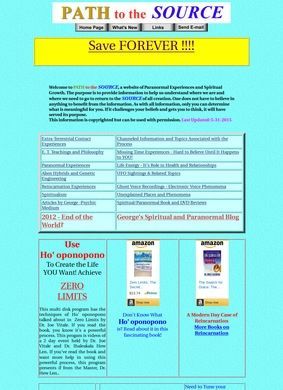
George, who describes himself as a psychic medium, is the sole author behind Path to the Source, and that single fact shapes how everything else on the site should be read. Path to the Source is not a research organisation, a magazine with a masthead, or a forum where many voices argue. It is one individual's collected writing on a long list of paranormal and spiritual subjects, gathered under one roof and offered to anyone curious enough to wander through it. Knowing that George is the author behind nearly all of it changes the way the content lands, because you are reading a point of view, not a survey of competing claims.
Topics from ET contact to reincarnation
The range of topics is genuinely wide. Path to the Source carries articles on extraterrestrial contact experiences and channeled messages described as ET teachings, pieces on UFO sightings, and writing about missing time, alien hybrids, and genetic engineering. Alongside that sit entries on electronic voice phenomena, the ghost recordings people capture and try to interpret, plus material on reincarnation, spiritualism, and places the site files under unexplained. There is also a thread on life energy and health. The 2012 doomsday material is here too, which dates parts of the archive and is worth flagging for anyone who likes their sources current. If you have an appetite for the cross-section of UFO lore and metaphysics, Path to the Source covers a lot of ground in one place.
Content sections and structure
Structurally, the content splits into a few recognisable buckets. A set of articles carries George's own byline. There is a section of reviews covering books and DVDs tied to paranormal themes, which is one of the more practical corners of the whole thing, since a reader trying to decide whether a particular title is worth their money gets a take from someone who has clearly read widely in the field. A blog runs on the side, tracking spiritual and paranormal news. And Path to the Source points outward to third-party products, the Ho'oponopono training materials being the named example, so part of what the site does is steer interested readers toward things sold elsewhere.
Affiliate links to outside products
That outward-pointing element shapes how you weigh the editorial parts. The bulk of the writing on Path to the Source is informational, not a pitch for a service, and George is not selling consultations or readings through the pages reviewed here. But the promotion of outside training materials means a reader should keep one eye on where the editorial ends and the recommendation begins. That is not a knock so much as a note on how to read it. Plenty of enthusiast sites in this space fund themselves through affiliate links, and Path to the Source is upfront enough about what it is pointing you toward.
Who should read this site?
On the question of who this is for, the answer is fairly narrow and Path to the Source does not pretend otherwise. Someone with no patience for channeled messages or EVP recordings will bounce off it within a paragraph. Someone who already reads in this area, who follows UFO accounts or takes an interest in spiritualism and reincarnation, will find a personal library assembled by a fellow traveller. The book and DVD reviews are probably the most broadly useful element, because they translate the author's interest into something a newcomer can act on without having to accept any single claim at face value.
Credibility without outside reviews
Credibility is the harder part to settle, and here the limits of what turned up in external searches need to be acknowledged. Searching for outside commentary on Path to the Source returned nothing of substance. No reviews on the usual platforms, no ratings, no third-party write-ups that could be verified. That absence does not mean the site is doing anything wrong; small personal sites run by one author rarely accumulate a public review trail, and the paranormal field in particular is full of dedicated little corners that the wider web never bothers to rate. But it does mean a reader cannot lean on anyone else's verdict. You are judging Path to the Source on its own pages, on whether George's writing reads as thoughtful and honest to you, and not on a chorus of other voices vouching for it.
Contact by email only
On the contact side, Path to the Source offers an email address at the geohanover domain, and that is the route in. No phone number surfaced, no physical address. For a personal information site this is not unusual, and an email is a perfectly reasonable way to reach a solo author who is sharing writing as a hobby or a calling. Still, anyone hoping to verify who is behind the material, or to reach someone quickly, has only that one channel, and it is fair to set expectations accordingly. A reader who wants institutional reassurance will not find it here; a reader who just wants to read and occasionally write to the author will be fine.
What Path to the Source has going for it is breadth and a consistent authorial voice. One person curating extraterrestrial contact material, EVP, reincarnation, spiritualism, and book reviews under a single banner gives the place a coherence that aggregator sites often lack. You are not jumping between a dozen contributors with clashing standards; you are following one mind through a set of related obsessions.
Risks of one-author reporting
For some readers that is exactly the appeal. The downside is the flip side of the same coin. Everything passes through one filter, so Path to the Source is only ever as reliable as you judge George to be, and there is no editorial layer between his conclusions and the page. The dated 2012 material is a reminder that the archive has been building for a long while and not all of it has aged at the same pace.
Path to the Source is best described as a personal anthology rather than a reference. It is most rewarding if you treat it as one enthusiast's reading list and field notes, and least rewarding if you arrive expecting verified, sourced reporting on UFO encounters or contact accounts. The writing stands or falls on the author's own credibility, and with no outside reviews to consult, that is a call each reader has to make after spending some time with the articles.
Comparing this site to the Black Vault
Set it next to a site like The Black Vault, the long-running archive of declassified UFO documents and government files, and the contrast sharpens what Path to the Source is. The Black Vault leans on primary documents, public records, and a paper trail a sceptic can chase down; Path to the Source leans on lived experience, channeled material, and one author's interpretation. Neither approach is wrong for this subject, but they serve different readers. If you want documents and a verifiable record, The Black Vault is the place to go. If you want a single curated voice walking you through the metaphysical and experiential side of the paranormal, with book and DVD pointers along the way, Path to the Source is a reasonable place to spend an afternoon, as long as you know what kind of source you are reading.