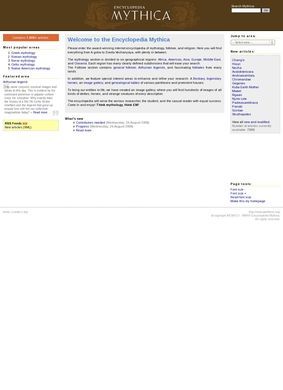
You are reading a myth, maybe for a class or maybe for your own curiosity, and a name surfaces that you cannot place: a minor Norse giant, a Maori creator figure, a creature from Arthurian legend mentioned once and never explained. General encyclopedias hand you a paragraph and move on. This is the gap Encyclopedia Mythica fills, and it has been filling it from the same address since 1995, which makes it older than most of the reference sites people now reach for by reflex.
Scope across cultures and regions
The scope is the first thing that registers. More than 11,420 articles sit here, covering deities, heroes, creatures, legends, and religious figures from cultures across the world. The arrangement is geographic, so you can move through the Americas, Asia, Europe, the Middle East, and Oceania, with separate sections for Folklore and a catch-all Miscellaneous category that holds entries resisting tidy regional sorting. That structure rewards browsing as much as searching. You can start with one figure and follow the regional grouping outward into a whole pantheon you did not know you were curious about.
Greek mythology and obscure figures
Some of the collections are deep enough to function as standalone references. Greek mythology runs to 1,605 articles, which is the kind of coverage that handles Zeus and Athena alongside the obscure river gods and local daimons that a quick search elsewhere will never surface. The Maori entries are unusually substantial at 1,210 articles, and that figure is worth dwelling on. Maori tradition is underrepresented on most English-language reference sites, so a body of work that large is genuinely useful to anyone studying Pacific cosmology. Norse mythology accounts for 762 articles, Roman for 571, and Arthurian legend for 184. The Roman set, in particular, is the sort of thing that helps untangle which gods were borrowed from the Greeks and which were homegrown, a distinction that trips up a lot of casual readers.
How entries work together
The writing follows an encyclopedic register, which here means short, factual, and cross-referenced. An entry on a particular hero will link to the gods, monsters, and rival figures tied to that story, so the cross-linking turns what could be a flat glossary into something closer to a map of relationships. For a student trying to reconstruct a family tree of Olympian gods, or a writer checking whether two creatures from different traditions share a common ancestor in the source material, that web of internal links does most of the heavy lifting.
Factual writing without embellishment
I find the consistency of tone reassuring in a subject that often attracts breathless retellings. Encyclopedia Mythica does not embellish. The entries state who a figure is, where the tradition places them, and what the principal stories say, then stop. That restraint is exactly what you want from a reference rather than a storybook, and it is one reason the site has held up across so many years while flashier mythology sites have come and gone.
When brevity becomes a limitation
There are limits worth naming. The encyclopedic brevity that makes Encyclopedia Mythica efficient also means individual entries can feel sparse if you are after deep scholarly analysis or competing interpretations of a myth. This is a place to confirm who Cu Chulainn was and which cycle he belongs to, not to read a twenty-page essay on the symbolism of his death. Treated as a first stop rather than the last word, it does its job well.
The content carries a Creative Commons CC BY-NC-ND 3.0 US license, which tells you something practical about how it can be used. You are free to share and cite the material non-commercially with attribution, but you cannot remix or republish altered versions, so it suits citation and reference work more than reuse in derivative projects. The site also notes a partnership with Excel Education, which sits alongside Encyclopedia Mythica as its current institutional backing.
The audience is clear from how the site is built: students working through a mythology unit, researchers wanting a quick cross-cultural check, and general readers who fell down a rabbit hole and want reliable footing. Each of those groups is served differently. The student gets a citable, organized reference; the researcher gets breadth across traditions that rarely sit together in one place; the curious reader gets a browsable structure that invites wandering.
What keeps pulling me back to the Maori and Greek numbers is the contrast they draw. A site can claim global coverage and still quietly mean European and Mediterranean coverage, with everything else reduced to a token page or two. In Encyclopedia Mythica, the Oceania material is treated as a major collection in its own right, and the regional sections give Asia, the Middle East, and the Americas their own front doors instead of folding them into a single non-Western bin. That editorial choice, sustained over decades, is the difference between a mythology reference that is genuinely worldwide and one that only says so.
From 1995 to today
Longevity is its own quiet credential. Surviving on the web since 1995 means Encyclopedia Mythica predates most of the platforms now treated as permanent, and it has kept its articles available and organized through every shift in how people read online. Plenty of early reference projects vanished or ossified into broken link graveyards. Encyclopedia Mythica still loads, still cross-references, and still adds to a body of work that already numbers in the thousands of entries.
Anyone who needs to pin down a name from a tradition that the big general references treat as a footnote will find that Encyclopedia Mythica quietly solves the problem. The Maori section alone covers ground that most English-language sites barely touch, and depth of that kind is exactly why a reference launched in 1995 is still worth opening today.