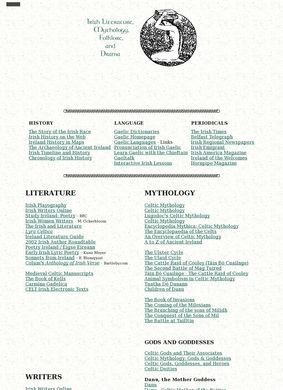
One person built and still maintains this, and her name sits right there in the footer: Anniina Jokinen, the same compiler behind the wider Luminarium.org project that has been running since 1996. That single-curator origin shapes everything about Irish Literature, Mythology, Folklore, and Drama. It does not behave like an encyclopedia trying to host everything itself. It behaves like a knowledgeable person who has spent years gathering the good links and arranging them so a student or a curious reader does not have to start a search from scratch.
Writers behind the literature section
The literature section is the part most people will arrive for, and it sets the tone for the rest of Irish Literature, Mythology, Folklore, and Drama. It gathers biographical pages and full-text destinations for the writers an Irish syllabus revolves around: Jonathan Swift, Oscar Wilde, James Joyce, Samuel Beckett, and Seamus Heaney. That is a defensible spine. Swift and Wilde for the older satirical and aesthetic tradition, Joyce and Beckett for the modernist core, Heaney bringing it close to the present. The point of the page is to send you to biographical context and primary texts, which is a sensible division of labour for a reference hub that does not pretend to own the source material.
Celtic deities and heroic legends
Mythology gets comparable care within Irish Literature, Mythology, Folklore, and Drama. The Celtic deities are laid out (Danu, The Dagda, Lugh, Brigid) alongside the legendary figures who carry the heroic cycles: Cu Chulainn, Fionn mac Cumhail, and Oisin. These come with narrative summaries, a welcome addition because the Irish mythological corpus is genuinely confusing to a newcomer. The various cycles overlap, names shift spelling, and a reader meeting Cu Chulainn for the first time benefits from a short prose orientation before being handed off to denser scholarship. The folklore material sits next to it and covers fairy tales, saints' stories, the seasonal festivals of Samhain and Lughnasadh, plus proverbs and blessings. Those last two categories are easy to do badly, and their inclusion here points to someone paying attention to the texture of a tradition, beyond its famous names.
From Gaelic lessons to arts coverage
Where Irish Literature, Mythology, Folklore, and Drama widens past what you might expect is in its practical and cultural sections. There is a language area with Gaelic dictionaries, pronunciation guides, and online learning routes, Duolingo among them, which is a frank acknowledgement that a reference page in this field now competes with apps people already use. The arts coverage stretches into fine art galleries, traditional music archives, dance, theatre companies, and film. Periodicals get their own grouping, with links out to The Irish Times, the Belfast Telegraph, and literary magazines. That last touch is worth dwelling on, because it pushes Irish Literature, Mythology, Folklore, and Drama past the purely historical and into living Irish culture. A reader can move from the Tain to a current newspaper without leaving the framework Jokinen built.
Risk of outdated links
The honest weakness of Irish Literature, Mythology, Folklore, and Drama is also its design: it lives or dies on whether the outbound links still resolve. Curated link directories age, and the page itself carries a last-updated stamp that is several years old. For the canonical destinations (major author archives, established institutions, national newspapers) that lag matters little, since those URLs tend to be stable. For the more marginal entries (a small theatre company, a niche music archive, a personal fan page that has since vanished) the risk of dead ends climbs the longer a page sits without a sweep. None of that is visible until you start clicking, and a visitor should expect a few links to have gone stale.
Academic citations validate the resource
On the question of whether to trust Irish Literature, Mythology, Folklore, and Drama, the supporting evidence is unusually good for a site of this scale. The broader Luminarium domain is cited as a reference in academic library guides, including the Colorado Community College System LibGuides and EBSCO Research Starters, and it turns up in academic discussion as a faculty-curated resource.
Faculty recommendations on Reddit
A Reddit r/history thread, with a modest run of upvotes, describes it as the work of a professor with contributions from faculty. That is a meaningful indicator: librarians and instructors recommend it precisely because the curation comes from someone with subject knowledge, not from an algorithm chasing traffic. No conventional review profile exists for Irish Literature, Mythology, Folklore, and Drama, no Google or Trustpilot star count, which is exactly what you would expect from a non-commercial educational page that has never sought customers.
Contacting the project directly
The ways to reach the project are minimal, and it is fair to note that. A single email address in the footer is the only route in, with no phone number, no postal address, and no separate form. For a one-person scholarly project that is normal rather than a red mark; the email reaches the actual person responsible. But it does mean there is no institutional backstop behind Irish Literature, Mythology, Folklore, and Drama. If Jokinen stops maintaining the page, there is no organization to keep the links current or to answer a query, and the absence of any structure beyond a personal address is the quiet cost of the same individual curation that makes the content trustworthy.
Value for students and teachers
For its intended audience the value of Irish Literature, Mythology, Folklore, and Drama is specific and hard-won. A student assembling background on Joyce or Cu Chulainn, a teacher hunting for a reliable starting set of links, a general reader who wants a map of Irish culture from the old gods to today's papers: all of them are served by the way the material is organized. The breadth across literature, myth, folklore, language, arts, and periodicals goes further than a typical single-author resource attempts, and the academic citations confirm it has earned trust among people who evaluate sources for a living.
Will the links stay updated?
The unresolved question is whether upkeep matches ambition. The strength of Irish Literature, Mythology, Folklore, and Drama is a careful human hand; the vulnerability is that the same hand has not visibly passed over the page in a long while, and a curated collection whose links are not regularly checked slowly turns from a guide into an archive of where things used to be. The curation quality is high enough that the core content holds up, but the link rot in the peripheral entries does cost something, and anyone planning to use it heavily should set aside time to verify the destinations that matter most to them.