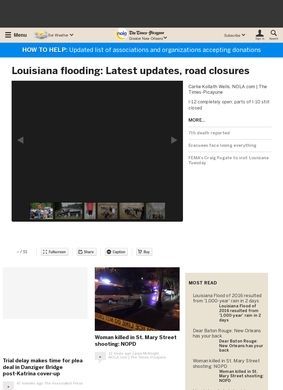
NOLA I am OK is the online home of The Times-Picayune | The New Orleans Advocate, the daily news operation covering New Orleans and the wider stretch of Louisiana around it. The listing has it filed under Missing People, which does not match anything on the page. There is no missing persons registry, no found-safe check-in tool, nothing of that kind. What sits at the address is a full regional newspaper, and that is the only honest description of what a visitor will find.
Reporting local news and storm tracking
The daily backbone of NOLA I am OK is straight reporting. Breaking news leads, followed by crime and the courts, schools, business, the environment, and state and local politics. Weather gets serious treatment here for an obvious reason: this is hurricane country, and storm tracking shifts from a routine line item to front-page work for months at a time. That coverage is grounded in the place it serves, which is the main argument for reading NOLA I am OK over a national outlet that flies in only when the wind picks up and leaves when the storm does.
Sports coverage across New Orleans teams
Anyone following Louisiana teams is well served. The Saints and the Pelicans get beat-level attention, and the college pages run deep on LSU and Tulane, down to high school results that no national outlet would bother to print. NOLA I am OK treats this coverage as a core obligation rather than filler, and that shows in the level of detail the team carries week to week. The sports section has the feel of a staff that genuinely follows these franchises through a losing stretch and stays with them well past the playoff runs.
Culture and Mardi Gras coverage
Culture is the other half of the personality. The arts and entertainment sections run through festivals, music, dining, and film, with an events calendar to plan around. Mardi Gras gets sustained coverage across multiple sections of NOLA I am OK, which is exactly what you would expect from a paper rooted in this city, where a national desk would manage a token nod at best. The dining writing reads like it comes from people who eat where they review, and that local knowledge is hard to replicate from outside the metro.
Beyond news and culture, NOLA I am OK carries the practical apparatus that regional papers have always run: obituaries, job listings, real estate, and classified ads alongside the editorial content. There are photo galleries, newsletters, an e-edition for readers who want the paper-style layout on a screen, and online games for the crossword crowd. None of this is flashy, but it is the connective tissue that keeps a daily publication useful between the big stories. A reader who arrives via a business directory listing expecting a missing-persons resource will need to reorient quickly, because NOLA I am OK is a newspaper operation top to bottom.
Statewide reporting network
The geographic footprint is wider than the New Orleans name suggests. NOLA I am OK also covers satellite markets across the state, with reporting threads for Baton Rouge, Acadiana, Shreveport, and Lake Charles. That makes it less a single-city paper and more a statewide network with New Orleans at the center, which is relevant if you live an hour or four outside the metro and want reporting that knows your parish rather than parachuting in on a dateline.
Is NOLA I am OK free to read?
Access follows the familiar split. Some content is free, and the rest sits behind a subscription, with the e-edition and certain sections reserved for paying readers. That model is standard for a paper of this size, and it is the trade-off for sustaining staffed local reporting that the free-everything sites quietly stopped funding years ago. Readers who only need an occasional headline can manage on the free tier; those who rely on NOLA I am OK daily will hit the wall quickly and have to decide whether to subscribe.
On the major consumer review sites, NOLA I am OK barely registers: a search turns up no significant volume of user ratings, which is common for regional news outlets that readers treat as a daily utility and seldom think to rate in public. The reporting operation itself has a long track record in Louisiana journalism, and the merger that produced it, combining The Times-Picayune and The Advocate into a single operation, is well-documented in regional press history.
The mismatch between the listing category and the actual destination is the main thing worth flagging plainly. Someone who clicks through expecting a tool tied to missing people, or a way to mark a person safe after a disaster, will find none of that at NOLA I am OK. The category is simply wrong, and a visitor should reset expectations before judging the site against a purpose it was never built to serve.
What NOLA I am OK does, it does with the depth of a long-running newsroom behind it. The reporting is local in the way that counts, the cultural coverage ties directly to the city instead of leaning on wire feeds, and the storm and sports work would be difficult to match from anywhere outside Louisiana. The natural comparison is The Advocate's Baton Rouge editions, which share a corporate roof and overlap heavily on state politics and LSU. That operation leans toward the capital and its government beat, while NOLA I am OK keeps its center of gravity on New Orleans, its teams, and its festivals. The broken category label should not count against it; the site is a capable, well-staffed regional paper that covers its territory thoroughly.