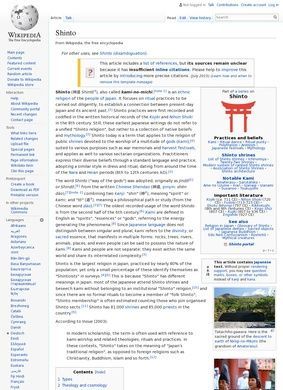
This Wikipedia entry opens by wrestling with a definitional problem most encyclopedia articles would skip: whether Shintoism belongs in the category of "religion" at all, given that it centers on ritual practice far more than fixed doctrine and sits awkwardly inside the Western taxonomy of faiths. That framing runs through the whole page, and it is a smart place to begin, because it warns the reader that Japan's indigenous tradition does not map neatly onto ideas of scripture, creed, and congregation. From there the piece builds outward into belief, practice, history, and the shape of worship in Japan today.
Kami and the ethics of purity
Central to the coverage is the concept of kami, the supernatural entities that populate the tradition, and the article treats them carefully instead of flattening them into a single tidy definition. It draws the creation myths from the Kojiki and the Nihon Shoki, walks through the ideas of purity and impurity that govern so much of the ritual life, and lays out an ethical outlook built on sincerity and harmony. A reader comes away with a coherent picture of how belief and behavior connect, which is often where general introductions to Shintoism fall apart.
Shrines, priests, purification rituals
The practical machinery of worship gets real space here. The article describes the jinja, the shrines that anchor the tradition, and gives the striking figure of roughly 100,000 of them across Japan. It covers shrine architecture, the kannushi priesthood, and the miko who serve as shrine maidens, so a reader comes away understanding who does what and where. The purification rituals known as harae are explained, along with the hobei offerings and the kamidana, the small home shrines that carry the practice into ordinary households.
Purity in everyday life
What keeps this section from feeling like a dry inventory is the way it ties the objects and roles back to the underlying concern with purity. Purification is not presented as quaint custom but as the working logic behind much of what shrine visitors do. The entry also reaches into contemporary life, noting divination, amulets and talismans, festivals, and rites of passage. Some of the most memorable details are the everyday ones: blessings for new vehicles and purification rites performed at construction sites, which show Shintoism as a living tradition rather than a museum piece.
Those modern touches answer a question a curious reader is likely to bring. People often assume Shintoism is either ancient history or pure folklore, and the article quietly corrects that by showing it woven into the routines of present-day Japan, handled without editorializing.
History from Yayoi to Buddhism
The historical arc is where the article has the most value as a reference. It traces roots back to the Yayoi period, then follows the long encounter with Buddhism that reshaped Japanese religious life, and it does not pretend the two developed in isolation. The coexistence of Shintoism and Buddhism in Japan is treated as a defining feature, which is honest, because the two have borrowed from each other for centuries and many people practice both without contradiction.
State Shinto and postwar change
The account of the Meiji era is the part worth reading closely. It explains the emergence of so-called State Shinto, when the government fused the tradition with national ideology, and then the postwar separation of religion and state imposed after the Second World War. This is delicate territory, and the article treats it as history rather than polemic, giving the reader enough to understand why the modern picture looks the way it does. Demographics and global reach round things out, including the small communities of practitioners who keep some form of Shintoism alive outside Japan.
Alongside the narrative, the page keeps returning to the scholarly debate raised at the start. The tension between ritual and doctrine, and the mismatch between Shinto and imported categories of religion, is not resolved so much as respected. A weaker treatment would force a clean verdict; this one lets the ambiguity stand because the ambiguity is the truth of the subject.
Sources, citations, further reading
The writing carries the standard Wikipedia apparatus, and here it does real work. A table of contents lets a reader jump straight to shrines or to history without wading through the rest. Inline citations sit throughout, so claims about the Kojiki or about Meiji policy can be checked against their sources instead of taken on faith. A references section, further reading, and external links give anyone who wants to go deeper a clear path forward, which is exactly what a student writing a paper on Shintoism needs.
Linking shrines, kami, mythology
Cross-links are generous and well chosen. Dedicated articles on Shinto shrines, on kami, on Japanese mythology, on State Shinto, and on Shrine Shinto branch off from the main page, so the entry works as a hub as much as a single essay. A reader who arrives wanting only a definition can leave with a whole reading map. The images help too, showing shrines, torii gates, and ritual objects that turn abstract descriptions into something concrete.
There are limits worth naming, and they are the ordinary limits of the format. A single encyclopedia article cannot convey what it feels like to walk through a torii gate or take part in a festival, and it does not try to. The prose is functional and occasionally flat, and readers hoping for narrative color or a scholar's distinctive argument will need to follow the external links to specialist works. For a first, orienting pass, that trade is more than fair.
Balancing belief, practice, history
One quiet virtue is proportion. The article gives roughly the right weight to each part of the subject, so beliefs, practices, and history each get their due without any one swallowing the others. That balance is harder to achieve than it looks, and it is what separates a genuinely useful reference from a pile of facts. The emphasis feels like it reflects the tradition itself and not the interests of whoever happened to write the section.
Beyond torii gates and tourism
Depth of coverage is the other thing that stands out. The entry does not stop at the tourist-friendly image of torii gates and shrine visits. It goes into purity concepts, priesthood roles, the textual basis in the Kojiki and Nihon Shoki, and the thorny question of classification, so Shintoism comes across as a serious field of study and not a curiosity, delivered without ever becoming impenetrable.
The page does the essential job for anyone approaching Shintoism cold: it defines the tradition, situates it in Japanese history, and shows how it is practiced now, all with sources attached. It is comprehensive without being bloated, and its willingness to sit with the definitional puzzle instead of papering over it is a mark of quality, and that discipline runs through the whole treatment of Shintoism.
A starting point for students
A student assigned a paper on Japanese religion, or a traveler working out what they will be looking at on a trip to Kyoto, could do worse than starting here. The section on kami and shrines lays down the core vocabulary, the history section carries that through to the Meiji period, and the further-reading and external-links sections point toward specialist scholarship once the shape of Shintoism is clear.