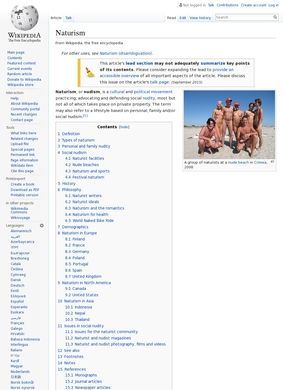
How much someone actually learns about Nudism beyond the giggling stereotypes depends on the source. Quite a lot, going by this Wikipedia article, which treats the subject as a documented social practice with a history, a legal footprint, and a body of research behind it. The page opens by naming the thing clearly: naturism, also called Nudism, defined by the International Naturist Federation in 1974 as "a way of life in harmony with nature characterised by the practice of communal nudity with the intention of encouraging self-respect, respect for others and for the environment." Setting non-sexual social nudity apart from anything pornographic right at the top does the reader a useful service, because that confusion is exactly what most people bring to the topic.
Historical development from 1778 to present
The historical spine of the article is its most useful stretch. It tracks the word "naturisme" back to its first documented use in 1778, then walks forward through the milestones: the earliest known naturist club, the Fellowship of the Naked Trust, formed in British India in 1891; the first large organized club, Freilichtpark in Hamburg, in 1903; and the 1951 founding of the International Naturist Federation that still anchors the movement internationally. These are dates and names a curious reader can carry away and check elsewhere, and that concreteness is what separates a genuine reference entry from a vague think-piece. The German thread is especially well populated, with roughly 100,000 participants cited by 1932, which gives a sense of how quickly Nudism spread in central Europe.
Early clubs and international federation
From there the article moves to the institutions that organize the practice today. Alongside the INF it covers the American Association for Nude Recreation, British Naturism, and the Federation Francaise de Naturisme, so a reader gets a map of who runs things on different continents. It then lays out the kinds of places where Nudism happens: landed and non-landed clubs, holiday centres and resorts, official nude beaches, and dedicated naturist villages. The taxonomy is spelled out plainly, because the difference between a members-owned club with its own grounds and a loose group that rents space is the sort of practical distinction newcomers rarely grasp from popular coverage.
Organizations and venues worldwide
Legal status gets a region-by-region treatment that is more careful than expected. Denmark permits clothing-optional use on all of its beaches; Germany, France, and Croatia are described as highly permissive; and at the other end, Indonesia and Thailand push Nudism into underground communities. The legal picture varies enough that a single summary answer is impossible, and the article does not pretend otherwise. The Croatian figure is striking on its own: roughly 15% of the country's tourism income is attributed to naturism, which reframes the whole thing from fringe hobby to measurable economic sector.
Legal status across regions
The data points are handled with the restraint you would want from an encyclopedia entry. A cited survey reports that 28% of Germans and Austrians said they would visit a nude beach, against 2% of Japanese respondents, a contrast that says more about cultural attitudes than any paragraph of generalization could. Numbers like these are scattered through the entry rather than bolted on, and each one is tied to a claim it actually supports. There is no padding to make Nudism sound bigger than it is, which is a trap a lot of lifestyle writing falls into.
Survey data on cultural attitudes
Where the article goes a step further than a simple summary is the section on health and psychology. It reports research linking the practice with higher life satisfaction, more positive body image, and higher self-esteem. That is presented as findings drawn from studies rather than as advocacy, and the distinction is worth noting, because it would be easy for a page on this subject to slide into either mockery or cheerleading. Here the tone stays even. A reader who wants to argue the point at least gets pointed toward something to argue with.
Research on health outcomes
It also does not duck the difficult parts. There is honest coverage of controversy: the persistent conflation of social nudity with sexual activity, child-protection concerns, and the legal lines that separate Nudism from pornography. Including all of that in the same entry is what makes the rest credible. The demographic section rounds things out with a frank note that club membership among young people declined in the early 21st century, followed by a more recent uptick in France and Germany, so the picture is of a practice in flux, not one frozen in some golden age.
Controversy, concerns, membership trends
If there is a limit to the entry, it is the one common to the format: depth is uneven across regions, and the well-documented European and North American history of Nudism sits next to much briefer sketches of how the practice fares elsewhere. The numbers are good but they are snapshots from different sources and different years, so anyone building a serious argument should chase the references instead of leaning on the summary.
Geographic gaps in documentation
As a starting point, the article defines its terms, dates its claims, names its organizations, surveys the law country by country, and grants space to both the research and the objections. I appreciated that the health section stays factual without becoming promotional; that balance is harder to pull off than it looks. For a topic this freighted with assumptions, a page that stays this level-headed is genuinely useful.