Someone in Berlin wants to schedule a video call with a colleague in San Francisco and a third person in Sydney, without anyone having to wake up at 3 a.m. or do the daylight-saving math in their head. That exact moment is where Time and Date does some of its best work. Type the three cities into the meeting planner and it draws a strip showing which overlapping hours are reasonable for all of them, with the awkward late-night blocks shaded out. It is the kind of small, practical problem that sounds trivial until you get it wrong, and the site has built a whole toolkit around getting it right.
Meeting planner for multiple time zones
The foundation of Time and Date is the World Clock, a running list of current local times across the globe, with the option to build a personal world clock holding only the cities you care about. There is a UTC reference too, and a clock widget you can paste into an external site. From there the time-zone tools branch out in directions that cover almost every reason a person might need to reconcile two clocks: a converter for one-off lookups, an event time announcer that tells your audience when a webinar starts in their own zone, a time-difference calculator, a worldwide map, a list of zone abbreviations, and a running record of which countries are about to shift on or off daylight saving time. That last one quietly saves a lot of missed calls every spring and autumn.
World Clock and time-zone converters
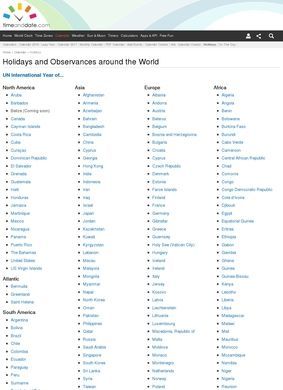
Calendars are the other half of the operation, and the coverage is genuinely deep. Time and Date generates monthly and yearly calendars for more than two hundred countries, with holidays baked in, plus printable PDF versions and a creator for custom layouts. There is a holidays-worldwide section, an "On This Day in History" feature, a roundup of the lighter fun holidays, leap-year explainers, and a reference for the quirks of days, weeks, and months that most people half-remember and occasionally need to check. For a site whose category here is holidays and observances, the holiday data is broad, country-specific, and kept current, which is exactly what the placement calls for.
Daylight saving time alerts
What I find more useful day to day are the calculators Time and Date keeps alongside the calendars. A duration tool counts the days between two dates. A business-date calculator adds working days while skipping weekends and holidays, which is the sort of thing payroll and project schedules actually run on. There are weekday and week-number finders, a date-pattern calculator, even a Roman numeral converter and a distance calculator parked alongside them. None of these are flashy. All of them answer a question someone genuinely typed into a search bar with a real deadline behind it.
Calendars for two hundred countries
The countdown and timer set in Time and Date rounds out the practical corner: a plain stopwatch, a countdown to any date you name, ready-made countdowns to eclipses, seasons and the New Year, and embeddable widgets so you can drop a live counter onto your own page. That embeddable angle runs through the site, since the clock widgets and counters are clearly built with developers and site owners in mind as much as casual visitors. It is a thoughtful touch that turns a reference into something other pages can borrow from.
Holiday data and historical dates
Beyond the scheduling machinery, the Sun, Moon and Space section goes well past what a utility site needs to. Time and Date gives you sun and moon calculators, moon phases, a night-sky view, meteor-shower listings, a day-and-night world map, eclipse details, seasonal markers, and live astronomy streams. It is the area where the site stops being purely functional and starts rewarding curiosity, and it is well organized enough that a teacher or a hobby stargazer can find a specific figure quickly.
Calculators for date and duration
The weather component of Time and Date is more conventional but solid: local conditions, two-week and hourly forecasts, a look back at the past week, and climate data for context. It does not try to compete with a dedicated meteorology service, and it does not need to. Paired with the Time and Date time-zone and astronomy tools, it fills out the picture for someone planning travel or an outdoor event in an unfamiliar place. A news strand covers astronomy, time-zone changes, and calendar and holiday developments, with a newsletter for people who want those updates pushed to them.
Stopwatch, countdown, embeddable widgets
Registered accounts on Time and Date add a personal layer on top of all this: saved world clocks, stored events, custom units, and a paid tier that strips ads and adds further features. The free tier of Time and Date is generous enough that most visitors will never feel pushed toward paying, which is a healthy balance for a reference people return to constantly. Localization for more than two hundred countries means the calendars and holiday data are not a Western default with everything else bolted on, and that breadth is a big part of why the site works for a global audience instead of a single region.
Sun, Moon and Space section
If there is a fair criticism, it is that the sheer breadth can make the homepage feel crowded, and a first-time visitor may need a moment to spot the one tool they came for among the dozens on offer. The naming is clear and the search helps, so this is mild friction at worst.
Accounts, localization, paid features
Time and Date is a deep, reliable, well-maintained reference that does the unglamorous job of answering precise questions about time, dates, calendars and the sky, and it does that job better than almost anything else aimed at a general audience. The astronomy and weather extras are genuine additions rather than the main draw, and the only real cost of so much capability is a slightly busy front door. As a place to settle a date-or-time question and trust the answer, the site is close to indispensable.