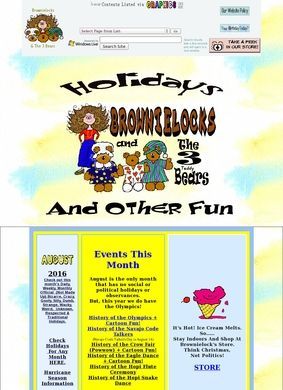
You hit the third week of June and realize you have no idea what to make of the calendar: Father's Day is obvious, but a coworker mentions it is also National Splurge Day, and your kid swears there is a holiday about doughnuts somewhere in there. That scramble to figure out what a given day "is," and whether the claim holds any water, is exactly the itch Brownie Locks was built to scratch. The site is a sprawling, ad-free reference to holidays and observances, leaning American but not exclusively so, and it answers the question most calendar apps cannot: not the name of the day alone, but where it came from and why anyone marks it.
How the site organizes holidays
The organizing logic is simple and it works. Everything sorts by month, and within each month you get the daily, weekly, and monthly observances stacked together, the famous ones sitting right next to the genuinely obscure. Brownie Locks does not list a date and move on. It carries holiday histories, the cultural background behind a given observance, trivia, and original cartoons pegged to specific events. Flag Day, Juneteenth, the Summer Solstice, Wimbledon, Father's Day: each gets more than a one-line entry, and the cartoon tied to an event is a small flourish that tells you a person sat down and made this, not a script scraping a feed.
Histories and cultural context for each observance
Beyond the day-by-day calendar there is a vein of broader cultural material, including writeups on wedding traditions and related customs. That widens the appeal past someone who just wants to know if today is National Donut Day. A teacher building a lesson, a trivia host hunting for filler, a writer needing color for a seasonal piece: all of them find what they need on Brownie Locks.
Beyond the calendar
The site states it is rated for ages 12 and up, which lands about right. The content is clean and approachable enough for a curious kid, but the histories have enough substance to hold an adult's attention for longer than a glance. The result reads less like an almanac dump and more like a knowledgeable friend walking you through the calendar. It sits outside any business directory and has no interest in being one; it is a reference, full stop.
Content rated for ages 12 and up
This is the part that surprised me, and it is worth dwelling on because it cuts against how nearly every free reference site online operates. Brownie Locks runs no banner ads. It runs no affiliate links. For a site whose entire premise is high-volume seasonal traffic, the kind of audience advertisers would happily pay to reach, that restraint is unusual and a little admirable. You are not dodging pop-ups or scrolling past sponsored junk to reach the actual answer about Arbor Day. Whoever runs Brownie Locks clearly decided that an uninterrupted read was worth more than the ad revenue, and the pages are calmer for it.
No ads, no affiliate links
The money, instead, comes from a Zazzle store selling holiday-themed merchandise. It is an honest arrangement: the reference material stays free and uncluttered, and if a particular cartoon or theme charms you, there is a product attached. Nobody is forced through a paywall and nobody is tracked into an ad funnel. Plenty of "free" sites bury you in interstitials to monetize; Brownie Locks took the quieter road and let the store sit off to the side for whoever wants it.
Zazzle store funds the reference material
That choice shapes the whole experience of using the place. The pages load as content, plain and direct, and the trust that builds over repeat visits is earned, not assumed. When a site is not trying to extract a click from you on every screen, you start to take its holiday histories at face value, which is the right instinct for a reference you are going to cite to a classroom or a friend. Brownie Locks reads like a labor of genuine interest, and that comes through on nearly every page you open.
Pages load as plain content
On the question of who stands behind it, the picture is partial but not absent. A Contact link sits in the navigation, so there is a route in if you have a correction or a question. For a one-person-feeling reference project this is normal enough, and the presence of a working contact route counts for more than elaborate credentials. Brownie Locks is not hiding; it just keeps the front page focused on holidays.
Contact route and limited outside validation
Outside validation is limited, and honesty demands I say so. Brownie Locks keeps a Facebook page that has drawn roughly 2,250 likes, with around 180 people actively engaging, which is a respectable following for a niche calendar site and points to a real audience that keeps coming back season after season. What you will not find is a footprint on the usual review platforms. Searching for ratings turns up a Utah locksmith that shares part of the name and nothing else; no Google, Trustpilot, or Yelp profile for the website itself surfaced. That is not damning. A free reference rarely accumulates star ratings the way a restaurant or a shop does, because people consult it and leave without thinking to grade it.
Credibility through consistent work
So the credibility rests on the work itself. The breadth of observances covered, the inclusion of histories and cultural context instead of bare dates, the original cartoons, the deliberate refusal to monetize through advertising: these are the marks of something maintained with care over a long stretch. A site that only wanted clicks would have plastered ads across every page years ago and called it done. The fact that Brownie Locks did the opposite is, frankly, the strongest signal of good faith it offers. Over time, that consistency is what turns a casual visitor into a returning one, and the Facebook following confirms that plenty of people did exactly that.
U.S. focus and functional design
There are limits worth naming so expectations stay calibrated. The U.S. focus means a reader elsewhere will find gaps for their own national or religious observances. The design is functional rather than polished, and someone arriving from a slick modern app may find it dated. None of that undercuts the substance, but it does mean Brownie Locks is a content destination first and a design exercise not at all. If you came for the information, you will leave satisfied; if you came for a sleek interface, look elsewhere.
Set it against the obvious comparison, National Today, the heavily produced holiday site that fronts most search results now. National Today is glossier and SEO-optimized to within an inch of its life, but it is also stuffed with ads, affiliate pushes, and shallow entries written to rank rather than inform. Brownie Locks trades the polish for depth and an ad-free reading experience, and for anyone who wants the story behind Juneteenth or the origin of a wedding custom instead of a quick blurb wrapped in banners, that trade is an easy one to make. Brownie Locks will not win on visuals, but on the thing it set out to do, telling you what a day means and why, it remains a quietly trustworthy place to land, and the kind of independent site the web has fewer of every year.