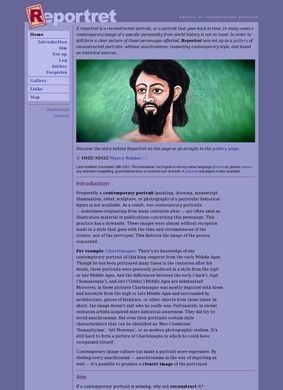
Picture a king or a philosopher who lived two thousand years ago. You want to know what the person looked like. The contemporary likeness is gone, destroyed, or never made, and a quick image search returns a mess of Victorian engravings, marble busts of doubtful identity, and outright invention. This is the gap Reportret sets out to fill. Marco Bakker, a Dutch illustrator, has built a gallery of reconstructed portraits of figures from world history, and the whole point of the work is to give a face to people whose actual appearance has been lost to time.
How reconstructions are made
The method is central to what Reportret offers, and the site is upfront about it. Each portrait is reconstructed, in Bakker's words, "without anachronisms, respecting contemporary style, and based on historical sources." Once you start clicking through the gallery, that single sentence does a lot of work. A Roman emperor is not drawn in a Renaissance pose. A medieval ruler is not given a face borrowed from a later painting. The reconstructions try to stay inside the visual world the subject inhabited, drawing on coins, written descriptions, sculpture, and whatever period material survives as a starting point.
Sources and historical accuracy
What you get on each portrait page is the full image plus the reasoning behind it. There is historical background on the figure, and there are notes on how the reconstruction was put together, which sources fed into it, and where the gaps had to be bridged with informed judgement. That second part is the difference between a piece of historical illustration and a piece of guesswork sold as fact. A reader can trace the chain of decisions, which means the portrait can be questioned, checked, and argued with. For anyone who cares about history as a discipline, that transparency is what makes the gallery genuinely usable.
Teaching skepticism about forgeries
One section pushes this idea further and gives Reportret genuine credibility among projects of its kind. There is a dedicated "Forgeries" area that lays out the distinction between a scholarly reconstruction and a fabricated historical portrait. This is a pointed thing to include. Plenty of faces circulating online as the genuine ancient likeness of some emperor or sage are simply made up, often centuries after the fact, and passed around until they look authoritative. By naming this problem directly and showing examples, Reportret does something most history sites skip: teaching the reader to be skeptical of exactly the kind of image it produces. A gallery of reconstructions that also warns you about fake reconstructions is being honest about its own limits.
Consistency across world history
The breadth of the project comes through in the subjects themselves. Reportret collects significant figures from across world history, the kind of people whose names survive but whose faces did not, and assembles them into one place with a consistent approach. Because every entry follows the same logic, sources first and then careful illustration, the gallery reads as a single coherent body of work by one hand, not a scrapbook of borrowed pictures. That consistency is part of what gives the portraits their credibility. You are looking at a method applied many times over, not a one-off exercise.
Language access and outreach
Reportret runs in three languages, English, Dutch, and German, which widens its reach well past the Netherlands where Bakker is based. The trilingual setup suits the audience the work seems aimed at: teachers, students, history writers, and curious readers across Europe who want a defensible image to look at and to think about. There is also a Links page pointing to related historical resources, a small touch that shows the project sees itself as part of a wider conversation about historical evidence rather than a closed shop. It points outward instead of trying to keep every visitor on the page.
Image licensing for educators
On the practical side, Bakker keeps clear lines around image use. All the portraits are copyrighted in his name, and licensing for educational purposes is available on request. That arrangement is sensible for an illustrator: the work stays protected, but a teacher or a publisher who wants to use a portrait in a lesson or a book has a route to do so legitimately. It also tells you that Reportret is not a hobby gallery thrown online and forgotten. There is a working creator behind it who treats the output as a real body of authored material.
Contact and methodology
For contact, Reportret stays minimal. There is an email address for Bakker and it is reachable, which is the natural channel for a licensing request or a sourcing question. No phone number and no physical address appear on the site, and for a one-person illustration project run by a named individual that is a reasonable setup. Email is the right way to reach an illustrator about reuse rights or a methodological question, and the address given works for exactly that.
Outside commentary on Reportret is limited. A search does not surface third-party reviews or ratings on the usual platforms, so the work speaks for itself; there is no body of external opinion behind it. That is common for a specialist single-author project of this sort. The absence of platform reviews is not a mark against the content; it simply means a visitor judges the gallery on what is in front of them, which is where the sourced reconstructions and the openly stated method do the actual work.
Reconstruction as argument, not proof
There is a clear-eyed thing to say about what these portraits are and are not. A reconstruction is an argument about a face, built from evidence, not a photograph recovered from the past. Bakker never pretends otherwise, and the inclusion of methodology notes and the Forgeries section makes that honesty structural to Reportret rather than a disclaimer folded into the fine print. A reader who treats each portrait as a careful, sourced proposal, open to revision, is using the gallery exactly the way it is meant to be used. Anyone hoping for a guaranteed true likeness of someone who died before portraiture could capture them is asking for something no historical resource can supply.
Reportret does one thing: it reconstructs the faces of historical figures by working from evidence and showing its reasoning in full. Within that scope, it does the job with unusual care. A history teacher hunting an image that will not embarrass them in front of a class, a writer who needs a face they can stand behind, or a reader who simply wants to picture a figure from the past without falling for an internet forgery will find Reportret considerably more useful than the general run of alternatives in this niche.
The combination of named authorship, stated sources, per-portrait methodology, and an open lesson on forgeries puts it well ahead of the typical "ancient portrait" page that lifts an image with no provenance. A figure's face here comes attached to the reasons it was drawn that way, and those reasons are on the page for anyone who wants to read them.