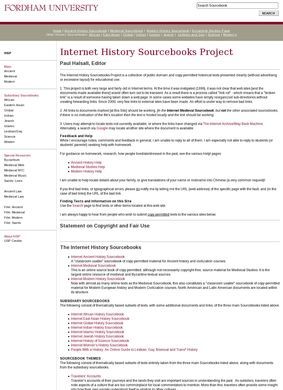
A teacher building a week on the First Crusade needs the documents themselves, the chronicles and the letters, and needs them free to hand to a room of students. That precise need is what the Internet History Sourcebooks Project was built to answer. It is a large collection of public-domain and copy-permitted primary-source texts, gathered for classroom use and served on plain pages with no advertising anywhere on them.
The spine of the Internet History Sourcebooks Project is three sourcebooks. Ancient History, Medieval History, and Modern History hold the bulk of the material, each a deep index of source documents arranged for someone teaching or studying that stretch of time. Anyone who has run a survey course will recognise the shape of it at once.
Each of the three books inside the Internet History Sourcebooks Project works as a standing reader. The Ancient book collects the foundational texts of the classical and early world; the Medieval book covers the long centuries that give the project much of its depth; the Modern book carries the documents a contemporary-history course has to set in front of students. A reader can move from one era to the next without leaving the site or creating a new login.
The texts do the work here; the packaging is deliberately plain.
The stated audience is narrow and named plainly: high-school and university or college courses. So the readers are students, teachers, and researchers, and the material is chosen with them in mind. A source sits in the collection because it can be assigned and read, and because its copyright status permits copying. The Internet History Sourcebooks Project holds to that rule throughout, which is part of why instructors have trusted it for so long.
That word, primary, is doing real work. A source here is the actual charter, decree, chronicle, or letter, not a textbook's summary of it, so a student learns to read the past in its own words. Getting those texts free of charge, and cleared for copying, removes the friction that keeps a lot of teachers reaching for a paraphrase instead.
Before the breadth impresses anyone, the discipline behind the selection is what the Internet History Sourcebooks Project gets right: every text is cleared for educational use, so a teacher can copy and distribute without a rights problem waiting downstream.
The absence of advertising deserves a moment. A page a teacher projects in class, or sends home to teenagers, stays free of the pop-ups and trackers that sit on most free-text sites. Paired with the copyright clearance, that makes the material genuinely safe to assign, a genuinely low bar that a surprising number of free archives still fail.
How wide the collections run
Past the three core books, the project reaches much further than a first glance suggests. The Internet History Sourcebooks Project carries a set of subsidiary collections that turn the focus onto particular regions and peoples, and a second set built around themes.
That range is what separates the Internet History Sourcebooks Project from a plain document dump. The editorial choices read like a historian deciding what a course genuinely needs, then going and finding it.
Subsidiary and thematic collections
The regional and topical sourcebooks cover African, East Asian, Indian, Islamic, Jewish, Science, Women's, LGBTQ+, and Global history. Beside them sit thematic collections gathered around a single thread: travelers' accounts, slavery across cultures, legal history, and even historical films. A student writing on cross-cultural slavery, or on how outsiders described the places they passed through, arrives to a curated starting set already assembled by the Internet History Sourcebooks Project.
The thematic side rewards browsing as much as searching. Travelers' accounts put the reader behind the eyes of people crossing borders they barely understood. The slavery collection sets the practice side by side across cultures instead of treating it as one region's story. Legal history gathers the statutes and rulings that a good deal of social history rests on. Even the historical-films section has a use, giving a teacher a way to discuss how the past gets dramatised and where the drama parts company with the record.
The breadth counts because primary sources for these subjects are scattered and often hard to find in usable, quotable form. Pulling them into one indexed place is the real service the Internet History Sourcebooks Project performs, and it is the reason a researcher keeps a tab open on it.
Bibliographies, articles, and teaching models
The Internet History Sourcebooks Project does not stop at source texts. It carries comprehensive bibliographies, including ones on the Crusades and on Byzantine saints, that point a researcher toward the wider scholarship around a topic. There are scholarly articles as well, such as work on medieval gender and history, sitting next to the documents they draw on.
Those bibliographies do a job search engines still handle badly. They gather the serious secondary literature on a narrow subject into one curated list, so a student starting a paper on the Crusades gets a reading path instead of a pile of results. The Byzantine-saints bibliography aims at an even more specialised corner, the kind a general library catalogue tends to scatter.
There is also a layer aimed squarely at instructors. The Internet History Sourcebooks Project includes example course websites that show the sourcebooks in real teaching, so someone drafting a syllabus can see how another instructor wired the same texts into a class. Few archives bother to show that side of the work at all. The Internet History Sourcebooks Project treats the teaching, along with the collecting, as part of its work.
Navigation across the Internet History Sourcebooks Project is old-fashioned and it works. Index pages list the holdings, a search function covers the rest, and that is the whole apparatus. No filtering wizard, no account to create, just links that open texts.
Behind all of it is one editor. The Internet History Sourcebooks Project is edited by Paul Halsall, who keeps gathering copy-permitted texts sent in by others, which is how a collection this size stays fed over the years. It lives inside Fordham University's History Department in New York while running on its own terms, a quasi-independent effort under an institutional roof.
That single-editor model carries an obvious limit. Coverage tracks one person's reach and the texts people chose to contribute, so some areas run deeper than others and the presentation stays spare. For the stated purpose that spareness works in its favour, because a fast page of readable sources with nothing between the student and the text is exactly what a deadline calls for. The Internet History Sourcebooks Project has lasted by refusing to complicate that.
The Ancient, Medieval, and Modern sourcebooks still open as lists of links on the Internet History Sourcebooks Project, and the pages still carry no advertising.