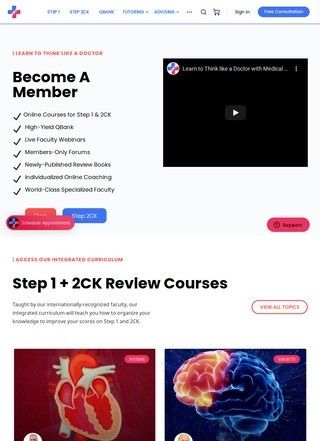
The centerpiece was a comprehensive USMLE Step 1 review course branded "Power," built to cover the basic medical sciences a student has to carry into the exam. That course, along with a Step 2CK companion, is what Medical School Companion sold to medical students, and the offering went deeper than a single class. There were topic-specific review books, one-on-one coaching, and a named faculty advisory board standing behind the whole thing.
There is a problem worth stating early. The live site would not load. Every attempt, the Medical School Companion homepage and an internal About Us page alike, returned the same hosting-outage notice telling visitors to contact the hosting provider. What follows is reconstructed from cached and indexed pages, because the operation itself was unreachable during this look, and that fact colors everything after it.
What the catalog covered before the lights went out
Even in cached form, the shape of the business is clear enough. Medical School Companion, also styled MSC MedEd, was a USMLE exam-prep outfit aimed squarely at students grinding toward Step 1 and Step 2CK.
Those two exams gate a medical career in the United States, and a prep company that covers both is speaking to students at a high-pressure, high-stakes point in their training. The catalog had four recognizable parts.
The Power review course
The flagship was the Power course, the product Medical School Companion led with. It was pitched as a comprehensive walk through the basic medical sciences that Step 1 leans on, and a page titled "The best USMLE Step 1 review courses" framed it directly against the field. That is a confident position for any prep company to stake out, since it invites the exact comparison shopping a nervous student will do anyway.
For someone choosing where to spend a limited number of study months, a single course promising to cover the sciences end to end is an attractive shape, assuming the teaching behind it holds up. The naming leans on effort as the selling point, which fits an exam students study for full time over several months.
The topic review books
Underneath the course sat a shelf of subject books. The company published review titles on medical genetics, microbiology, pharmacology, physiology, and pathology, the high-yield disciplines that tend to decide Step 1 scores.
Splitting the material this way lets a student patch one specific weak area instead of buying a single monolith, and the chosen subjects line up neatly with where most exam takers actually bleed points. It is a sensible way to sell prep to people who already know their own gaps.
Coaching, mentoring, and tutoring
Past the self-study products, there was a human layer. A "Mentoring, Advising, Tutoring, Coaching Hub" and a separate "Coaching Booking" page let students book one-on-one time, the sort of personal guidance a book cannot give.
This is the part of Medical School Companion that would have justified a premium, because individual tutoring is usually where prep money goes furthest for a student who is genuinely stuck. Booking pages suggest the coaching was a live, schedulable service, not a vague promise.
The faculty advisory board
Credibility rested on the people. Medical School Companion listed a faculty advisory board of experienced medical educators, and the names are recognizable in this corner of medical training. Mary Ruebush, PhD, appears as a microbiology and immunology instructor, and she is the author of the Becker Step 1 USMLE lecture notes, a reference plenty of exam takers already own. A faculty member named Neilson is listed with a Ross University affiliation. Real, checkable educators behind a prep course count for something, and the Ruebush connection to Becker is the single strongest signal in the whole picture.
An About Us page rounded out the catalog in the cached version, the standard spot where a prep company explains its method and introduces its people. That page was among the ones that would not load on a live visit, so its current contents are a blank. What the indexed snippets preserve is Medical School Companion presenting itself as faculty-led and exam-focused, organized entirely around the specific mountain that Step 1 represents for a second-year medical student.
Reputation is where the picture falls apart fastest. On Reddit's r/step1, a student opened a thread asking whether anyone had reviewed the on-demand Step 1 course from Medical School Companion, and it drew only a handful of votes and comments, with no rating attached. Glassdoor shows a single entry under the company's name, but that is an employee review of the workplace, not a customer verdict on the teaching, and no score surfaced in it. None of the usual customer-review platforms, Google, Trustpilot, Yelp, or the rest, carried a rating for the course at all.
Two same-named products muddy any search and deserve to be set aside. A Princeton Review book called Medical School Companion and a mobile app of the same name from a different developer are separate things entirely, and neither reflects on this prep company. Counting either one toward its reputation would be dishonest.
The outage is the detail that reframes all the rest. A hosting-provider error page is not proof a company has folded, since sites lapse over a missed invoice or a migration gone sideways and reappear days later none the worse. It does mean a prospective student cannot enroll today, cannot read the syllabus, and cannot confirm the coaching is still bookable, which for a paid service edges close to disqualifying on its own. Prep money is time-sensitive in a way few purchases are, and a scheduled Step 1 date does not slide because a website happens to be down.
So the ledger is lopsided. The offering itself reads well: a comprehensive Power course, targeted subject books, bookable one-on-one coaching, and a faculty name most Step 1 students would recognize on sight. Against that sits a live site that will not open, contact details that could not be confirmed because of it, and a near-total absence of independent student feedback, with even the lone Reddit poster essentially asking a room full of strangers whether the thing was any good.
Right now nobody outside the company can confirm Medical School Companion is still operating, or that the course delivered results for the students who tried it.