A dog swallows something it should not have at two in the morning, and the owner is left guessing whether to drive to an emergency vet or wait it out. That panic is exactly the moment the ASPCA built one of its best known services around: a poison control center staffed around the clock, reachable by phone, designed to tell a frightened pet owner what happened and what to do next. The hotline carries a consultation fee, and the ASPCA is candid about that, but it answers a real question at the worst possible hour. That single service tells you a lot about how the organization thinks. It identifies the practical crises pet owners face and puts something concrete behind them.
Poison control and emergency guidance
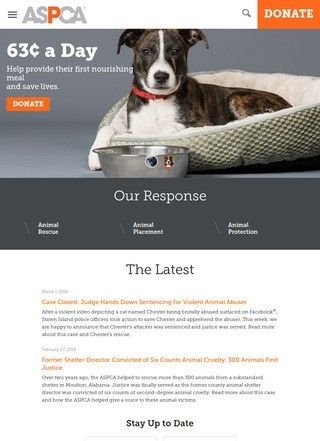
The American Society for the Prevention of Cruelty to Animals has been operating since 1866, working out of New York City, and the ASPCA website reflects an organization that has accumulated a wide range of programs over a very long stretch of time. It is far from a single-issue site. Someone arriving to adopt a cat lands in a different part of the operation than someone reporting suspected cruelty, and both are different again from the person reading up on whether grapes are dangerous for dogs. The breadth can feel sprawling at first, but most of it is genuinely useful, and the navigation does enough to keep the parts separated.
Finding adoptable pets through a national network
Adoption is probably the front door for most visitors. The ASPCA runs a searchable database of shelters and rescue groups, connecting prospective owners to adoptable pets across a network instead of limiting results to animals in its own care. A person in another state is not going to fly to New York for a dog, and the ASPCA seems to understand that its reach as a referral hub is larger than its reach as a local shelter. The database is the kind of tool that brings people back, because adoption is rarely a one-afternoon decision.
Pet care library for dogs, cats, horses, small animals
The reference material on the ASPCA site is deep. There is an extensive pet care library covering dogs, cats, horses, and small animals, with breed information, health guidance, and nutrition advice sitting alongside it. This is the section that quietly does the most work, because it answers the everyday questions that never rise to the level of an emergency. What should a new kitten eat. Is a particular plant toxic. How much exercise does a specific breed need. The horse and small-animal coverage is worth singling out, since plenty of pet resources stop at cats and dogs and leave owners of everything else on their own.
Behavior problems as a welfare issue
Animal behavior and training get their own dedicated section, which is a sensible split from the general pet care library. The ASPCA frames behavior problems as a welfare issue, and the reasoning is straightforward: biting, anxiety, and litter box trouble are among the main reasons animals get surrendered, so helping owners work through these problems keeps pets out of shelters. Treating training as a welfare concern, and not as mere owner convenience, is a more thoughtful approach than most general pet sites take. The guidance reads as practical and specific.
Beyond consumer-facing advice, the ASPCA publishes professional training resources aimed at animal shelters and rescue organizations, along with research on animal welfare topics. That professional layer is easy to miss as a casual visitor, but it shows a genuine effort to raise standards across the field. A shelter worker looking for better intake or housing practices is part of the intended audience here, which widens the site well beyond pet-owner basics.
Medical services for low-income pet owners
The veterinary side is anchored by the ASPCA Animal Hospital, which provides care for low-income pet owners in New York City. It is a geographically bounded program, and the ASPCA site does not pretend otherwise, but it fills a gap that means a great deal to people who cannot absorb a large vet bill. Pairing that hospital with the poison control center gives the organization a real medical presence alongside its advisory work.
Anti-cruelty enforcement and disaster response
The harder edge of the work shows up in anti-cruelty initiatives. The ASPCA supports law enforcement, runs humane law enforcement efforts, and mounts disaster response and animal rescue operations when storms or other emergencies put animals at risk. These are the parts of the organization that the average visitor may never touch directly, yet they are arguably the core of what the founding mission was about. The site does not hide this work behind the more accessible adoption content, and the rescue and disaster-response material gives the whole operation a seriousness that a pure adoption portal would lack.
Advocacy runs through much of the site as well. National campaigns push for animal cruelty legislation, and visitors are invited to press lawmakers on specific bills. This is where the ASPCA moves from helping individual animals to trying to change the conditions that harm them at scale. Whether a given reader agrees with every campaign is beside the point; the advocacy is clearly stated and fits the mission without feeling tacked on.
The fundraising machinery is substantial and visible. The ASPCA takes individual donations, runs monthly giving programs, offers planned giving for people thinking about bequests, and maintains corporate partnerships. A site this large and this program-heavy needs serious money behind it, and the donation infrastructure is built accordingly. Some visitors will find the appeals frequent, which is a fair criticism of nearly every large nonprofit, but the asks are tied to visible programs and not to vague promises.
What holds all of this together is coherence of purpose. Adoption, medical care, poison control, behavior guidance, professional training, cruelty enforcement, disaster rescue, and advocacy are different pressure points on the same problem: animal suffering and the gap between pets and the people who can care for them. The ASPCA covers an unusual amount of that territory under one roof. The flip side is that a first-time visitor can feel overwhelmed, and the site occasionally assumes you already know which program you need before you arrive.
On outside reputation, the ASPCA does not have a meaningful public review record on the usual consumer platforms; the organization operates as a nonprofit institution, and most people do not leave star ratings for it the way they do for a vet clinic or pet store. That absence is normal at this scale. What is on record is a long institutional history and a volume of ongoing programs that are verifiable through the site itself.
How the ASPCA compares to the Humane Society
For anyone deciding where to spend attention or support, the natural comparison is the Humane Society of the United States, which operates in a similar space with national advocacy and broad welfare programming. The two overlap heavily on policy work and public education. Where the ASPCA pulls ahead is in concrete, owner-facing services: the poison control hotline, the searchable adoption network, the NYC animal hospital, and the depth of the pet care and behavior library give it a hands-on usefulness that goes past campaigning. A reader who wants both a practical pet resource and a serious welfare organization will likely get more from the ASPCA than from a group weighted more toward policy alone.