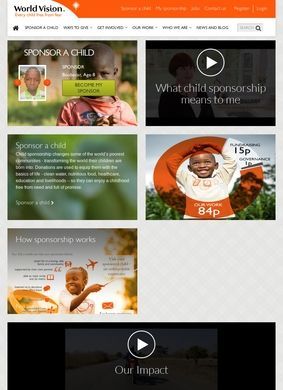
Someone who wants to give to a children's charity usually arrives with a practical worry: where does the money actually go, and can they see any effect from it? End Child Poverty: World Vision UK answers that question more directly than a generic appeal page, because its central offer is child sponsorship at thirty pounds a month, which pairs a UK donor with a named individual child living in need. That structure changes the experience of giving. Money does not disappear into a general pool; a sponsor follows one child and the community around them, which is a far easier thing to stay committed to over years.
Child sponsorship as the core offering
End Child Poverty: World Vision UK is the British arm of World Vision International, a Christian humanitarian body that works in close to a hundred countries and employs more than thirty-four thousand staff worldwide. That scale is worth sitting with for a moment. A small charity might run a handful of projects in one region; an operation of this size can keep field teams in place through long emergencies and across many countries at once, which matters when a crisis drags on past the point where headlines move elsewhere. The UK site sits on top of that global machine and channels British donations into it.
Global reach and emergency capacity
Sponsorship is the headline, but it is not the only route. End Child Poverty: World Vision UK lays out one-off donations for people who want to give without a recurring commitment, charity gifts for those buying on behalf of someone else, and legacy giving for donors thinking about leaving something in a will. There is also in-memory donation, which lets people give in the name of someone who has died, and support for individual fundraising events, so a person running a marathon or holding a collection can route the proceeds here.
Multiple routes for different donors
Spreading the options this way is sensible, because donor motivations differ a great deal. A young supporter with an irregular income behaves nothing like an older one weighing up a bequest, and a site that only offered the monthly plan would lose both ends of that range. End Child Poverty: World Vision UK covers the spread without making any single path feel like the only acceptable one, which is a quiet sign that the people running it understand how giving actually happens.
Digital tools for sponsor engagement
For sponsors who do sign up, End Child Poverty: World Vision UK provides a donor portal at the mysponsorship subdomain plus a mobile app on both iOS and Android. These let a sponsor manage their giving and, in practice, see updates tied to the child they support. That kind of tooling is the difference between sponsorship feeling like a direct debit and feeling like a relationship, and it is the sort of investment that tends to keep people giving longer.
Active appeals in high-need regions
The active appeals on the site read like a map of where humanitarian need is most acute. There is response to the Ebola outbreak in the Democratic Republic of Congo, to the conflict in Sudan, and to the crises across the Middle East. These are not soft, comfortable causes; they are places where access is dangerous and progress is slow, which tells you the organisation is willing to put its name to the hard work rather than only the photogenic projects.
Long-term programmes on protection, education
Underneath the appeals sit the longer programme themes: reducing childhood poverty, responding to emergencies as they break, protecting children from abuse and exploitation, and pushing for inclusive education so that disabled children and others often left out get a place in school. The protection and education strands are the ones I find most credible, because they require patient, structural work over years and cannot be solved by a single shipment of supplies. A charity framing its mission around those is in for the long haul.
Financial transparency and charity registration
What helps the whole picture hang together is the financial transparency End Child Poverty: World Vision UK publishes. It states that eighty-two percent of income goes to charitable activities and eighteen percent to fundraising operations. Putting that ratio in plain view is the right instinct. Donors who have been burned before tend to ask exactly this, and an eighty-two percent figure stated openly is a stronger reassurance than any amount of warm language about impact. The UK registered charity number, 285908, is there too, which lets anyone who wants to check the official register do so without hunting.
It is worth being clear-eyed about what sponsorship can and cannot promise. The model is built on a connection to one child, but the practical work usually benefits the whole community around that child, which is how a single monthly gift can stretch to clean water, schooling and protection programmes that no one family could fund alone. Some donors expect a one-to-one transfer and are surprised by the community approach. End Child Poverty: World Vision UK is reasonably honest about this, framing the work around poverty reduction and emergency response rather than implying that thirty pounds buys a fixed list of items for a single household.
If there is a limit to what the site conveys, it is that the sheer breadth of the operation can make it hard for a first-time visitor to grasp where their particular contribution lands. Sponsorship, one-off appeals, legacy giving and event fundraising all sit alongside each other, and a newcomer may need a few minutes to work out which path fits them. That is a navigation challenge more than a flaw, and it comes with the territory of being a large multi-programme organisation.
Weighing it up, End Child Poverty: World Vision UK is a serious, well-run option for anyone whose priority is children living through poverty or conflict. The combination of a clear sponsorship model, a wide set of alternative giving routes, real tooling for sponsors to stay engaged, and an openly stated split of how income is spent puts it on firmer ground than the average appeal page. The work End Child Poverty: World Vision UK points to is genuinely difficult, in places most charities avoid, and the organisation does not dress that down.
A prospective sponsor who reads the financial breakdown and still feels uneasy about the community model should weigh that carefully. The thirty-pound monthly figure is stated up front so there are no surprises later, and the scale of End Child Poverty: World Vision UK is, in the end, its strongest argument: an organisation this size can stay in place when the emergency is no longer news.
Business address
World Vision UK
Opal Drive, Fox Milne,
Milton Keynes,
Buckinghamshire
MK15 0ZR
United Kingdom
Contact details
Phone: 441908841000