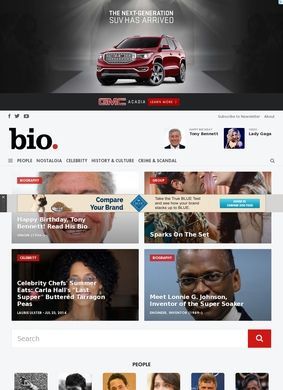
Biography.com, published under the brand Bio., is the editorial home of Hearst Digital Media's reference coverage of notable lives. The catalogue groups people into lanes: History and Culture, Musicians, Athletes, Movies and TV, Power and Politics, Business, Scientists, True Crime, and Scholars and Educators. Each lane collects figures a visitor would expect to find there, written up at length and updated with news pegs when a subject is back in the headlines. That structure tells you a lot about the intent of the site. It is built to be browsed by interest as much as searched by name, so a reader who arrives curious about athletes or political figures lands in a populated section instead of a single stray result.
Long-form profiles with historical context
The writing leans into long-form biographical articles, and that is where the site earns its credibility. A typical entry walks through a life: where someone came from, the turns that made them notable, the controversies, the legacy. Instead of a paragraph and a list of dates, the profiles give a reader enough to understand the person and the period around them. Alongside the full profiles sit historical analyses that step back from a single figure to explain an event or movement, plus shorter news updates that react to current developments. The mix means Bio. works for someone settling in to read about a figure in depth and for someone who only wants a quick factual check. Both kinds of visit are handled by the same library, which keeps the experience consistent whether the stop lasts two minutes or twenty.
Curated lists and themed collections
Curated lists do a lot of the navigation work. They pull together figures around a theme, which is a sensible way to surface names a visitor would not think to search for. Two editorial features build on that. "Notable Now" tracks the people drawing attention at the moment, and "People You Should Know" runs as an ongoing series spotlighting figures outside the usual famous names. Both give Bio. a reason to come back to instead of treating it as a one-time lookup. The themed lists also function as reading paths, so a person who finishes one profile is handed a logical next stop rather than a dead end.
Audio versions and bookmarks for readers
There is also a practical layer built around how people read online. Many articles carry a text-to-speech audio version that turns a long profile into something a visitor can listen to while doing something else. A bookmarks feature lets a registered visitor save profiles to return to, useful when reading across several figures for a project or a class assignment. A newsletter rounds out the regulars and delivers new pieces without anyone needing to check back manually. These are not flashy additions, but they make the site more usable for anyone spending real time with the content, and they point to an editorial team thinking about repeat readers instead of one-off traffic.
Separating editorial content from commerce
One section sits apart from the editorial work: "BIO Buys," a product recommendation area. It is clearly its own thing and worth knowing about so the line between reference content and commerce stays obvious. Everything else on Bio. is built around reading and lookup, and the commercial corner does not crowd that out. The placement keeps the two functions from blurring together, which protects the trust a reference site depends on. For what Bio. is trying to do, that separation is enough.
Behind the Hearst Digital Media operation
A word on reputation: a search for user reviews of Biography.com turns up no substantial pool on the usual review platforms. That is not unusual for a reference site in this category, where people use the pages and move on instead of leaving ratings. The Hearst Digital Media backing is the relevant context here. The site runs on an established media operation, not a side project, and the steady flow of updates reflects institutional capacity instead of volunteer effort. That distinction explains why coverage stays current across so many lanes at once: there is a staff and an editorial process behind the pages, which is hard to sustain on enthusiasm alone.
Reference scope for general audiences
Bio. is a broad reference, not a deep academic resource. The articles are thorough for a general reader, but a researcher needing primary citations or scholarly apparatus will treat it as a starting point and move on to specialist sources. That is the right way to use it, and it does not undercut how much ground Bio. covers. The subject grouping makes it easy to move between related profiles within a lane, which suits a teacher building a unit on scientists or a reader working through political history. Pick the lane that fits, open a full profile to see the long-form depth, and use the audio version on the longer articles to listen instead of read. Across the catalogue, the depth of the profiles and the steady updating give enough substance to make repeated visits worthwhile.