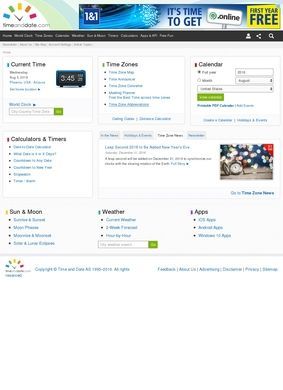
Run by the Norwegian company Time and Date AS since 1995, Time and Date is a public reference site built around a single, relentlessly focused mission: answer questions involving clocks, calendars, and the sky. The premise is narrow and the execution is wide. Pick almost any question about what time it is somewhere, when the sun comes up, or how many days sit between two dates, and there is a tool here built specifically for it. The World Clock is the front door for most visitors, listing real-time local times for cities across the planet, and from there the site fans out into a surprisingly large set of utilities that have accumulated over three decades of steady development.
Coordinating time across zones
The time-coordination tools are the part worth lingering on. The Time Zone Converter does the obvious job of translating one place's clock into another's, but the Meeting Planner goes further by laying several zones side by side so you can spot the overlapping hours where nobody has to wake at three in the morning. The Event Time Announcer solves the related problem of sharing a single moment, a product launch or a live broadcast, with an audience scattered across the map, generating a link that shows each visitor the time in their own zone. Time and Date has packed a lot into this cluster, and for anyone who regularly coordinates with colleagues or family on the other side of the world, it alone justifies a bookmark.
Calendars and date calculators
The calendar section is more than a grid of months. Time and Date offers annual and monthly views, printable PDF versions, and worldwide public holiday listings that distinguish between national days, bank closures, and observances that do not actually stop the working week. There is also a "What Happened on This Day" feature for browsing historical events tied to the current date, which is the sort of thing you open intending to check one fact and close twenty minutes later.
Business day and date math tools
Underneath the calendars sits a row of calculators that quietly do real work. You can measure the duration between two dates, add or subtract a set number of days from a starting point, count business days while respecting public holidays, look up ISO week numbers, and figure out which weekday a given date falls on. These are the kinds of small computations that are genuinely fiddly to do by hand and easy to get wrong, and Time and Date handles them without ceremony. The holiday-aware business day calculator in particular is the sort of feature that saves a contracts or payroll headache. None of this is glamorous, but the accuracy and the absence of friction are what keep people coming back to it instead of reaching for a spreadsheet.
A note on reviews
A note on reputation before going further: Time and Date does not turn up much in the way of formal third-party reviews on the usual rating platforms. Given that it is a free reference tool rather than a business directory or a service people pay for, that absence is expected and means nothing negative. The site has been cited in journalism and referenced in educational contexts for years, and its longevity says more than any star rating would.
Tracking the sky
Astronomy is where Time and Date stretches past pure utility into something closer to a hobbyist's companion. The site publishes sunrise and sunset times, moon phases with moonrise and moonset, and tracking for solar and lunar eclipses complete with countdowns. There are night sky maps and a schedule of upcoming meteor showers. None of this is dressed up as a substitute for a serious observatory feed, but for a curious person trying to decide whether tonight is worth stepping outside, it is plenty.
Weather forecasts and simple timers
The weather section adds 14-day forecasts, hour-by-hour breakdowns, and historical weather data for locations around the globe. Pairing forecasts with the astronomy data is a smart overlap: you can check whether the sky will be clear for a meteor shower without leaving the site. Alongside all of this run the simpler everyday timers, an online stopwatch, a countdown timer you can build and share, and a basic alarm clock. They are the digital equivalents of the gadgets people used to keep in a kitchen drawer, unremarkable on their own but handy to have in the same place as everything else.
Reaching developers and heavy users
Time and Date does not aim only at casual visitors. Developers can reach much of the underlying data through an API, which is how some of these clock and holiday figures end up powering other apps. There are mobile applications and RSS feeds for people who would rather not keep a browser tab open, and an optional Supporter subscription that strips out advertising and adds a few extra features for those who rely on the site heavily. The free tier, ad-supported, covers the overwhelming majority of what a normal person would ever need from Time and Date.
Weighing the site's organisation
What gives me pause is less about any single tool and more about the sheer accumulation of them. A site that has been adding features steadily for three decades risks becoming a maze, and Time and Date occasionally feels like one. The navigation is dense, related tools live under headings that are not always intuitive, and a first-time visitor hunting for, say, the week number lookup may take several wrong turns before landing on it. The depth is real and the data is dependable. But whether the site's organisation has kept pace with everything it now tries to do is a question Time and Date has not fully answered, and that tension is still there after a long session with it.